Level A1 · Chapter 8
Don Quixote of La Mancha
After eight days of hard thought, a fifty-year-old gentleman drops his old name and unveils a new one in three parts.
What you will learn
- Count and give quantities: dos, ocho, cincuenta, cien.
- Say somebody's age.
- Put things in order: el primero, el segundo, el tercero.
Before you read
This text keeps count. Eight days, fifty years, three parts, four weeks. It also puts things in order (la primera, la segunda, la tercera) and it uses tener where English uses "to be": he does not is fifty, he has fifty years.The story in easy Spanish
El caballo ya tiene su nombre. Ahora el hidalgo necesita un nombre nuevo.
The horse has his name now. Next, the gentleman needs a new name of his own.
Pasa ocho días con esta idea, porque un nombre es una cosa seria.
He spends eight days on the idea, because a name is a serious matter.
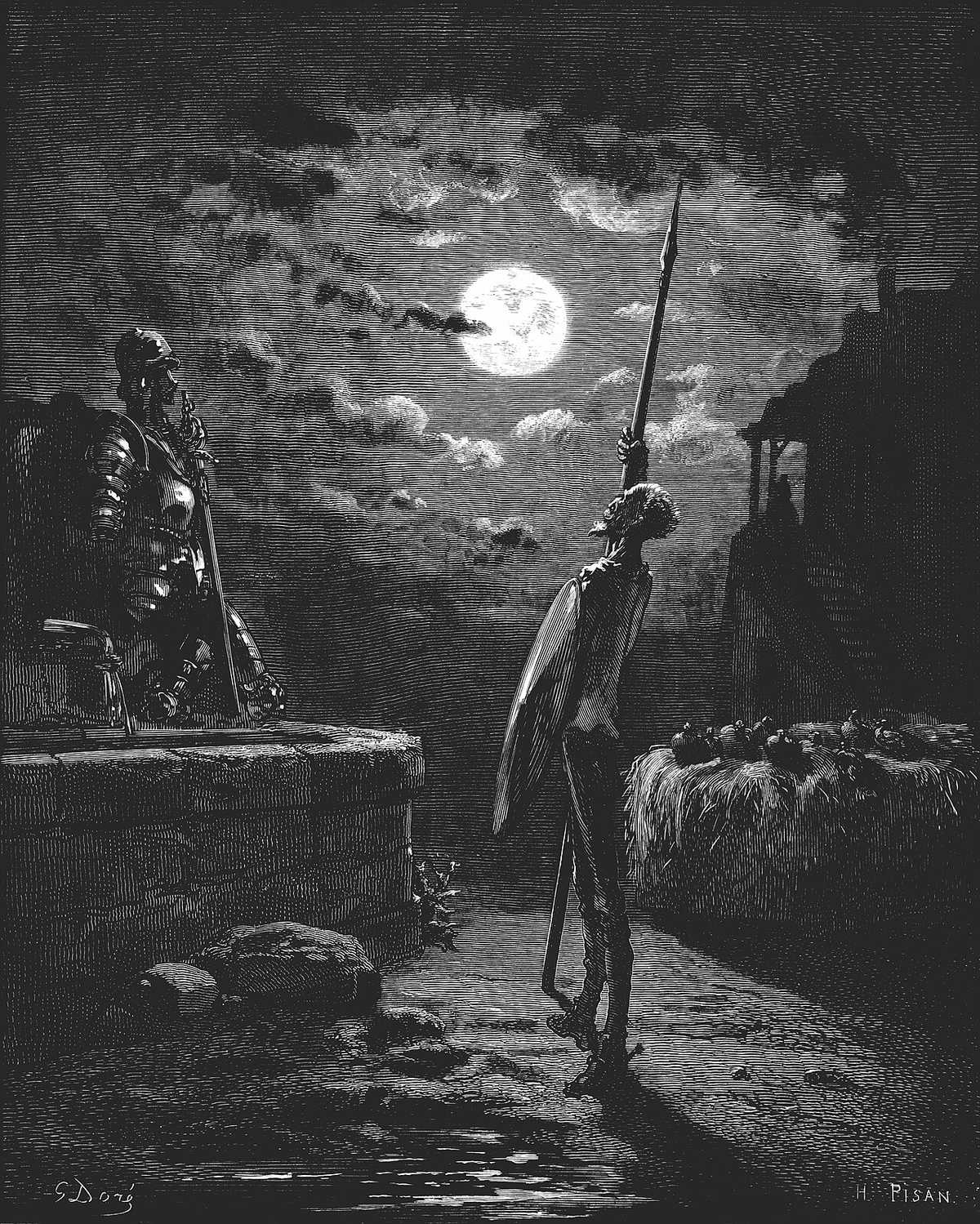
El hidalgo tiene cincuenta años, una casa vieja y un caballo flaco. Ahora tiene también un nombre grande: don Quijote.
The gentleman is fifty years old, and owns an old house and a skinny horse. Now he also has a grand name: Don Quixote.
Pero un caballero de verdad tiene también el nombre de su tierra.
But a real knight carries the name of his homeland as well.
El primer ejemplo es Amadís, el caballero de Gaula.
The first example is Amadís, the knight of Gaul.
Su nombre nuevo tiene tres partes. La primera es «don» y la segunda es «Quijote». La tercera parte es «de la Mancha», su tierra.
His new name has three parts. The first is "don" and the second is "Quixote". The third part is "of La Mancha", his home region.
El «don» es el tratamiento de los señores y los caballeros.
"Don" is the form of address for lords and knights.
En cuatro semanas el hidalgo tiene armas, caballo y nombre. El pobre Alonso Quijano de cincuenta años ya no existe.
In four weeks the gentleman has armour, a horse and a name. The poor fifty-year-old Alonso Quijano no longer exists.
Vocabulary
Numbers
- dos, tres, cuatro
- two, three, four
- ocho
- eight
- cincuenta
- fifty
- cien
- a hundred
- primero, segundo, tercero
- first, second, third
Name and rank
- el tratamiento
- the form of address
- el señor
- the lord, the gentleman
- la tierra
- the homeland
- el ejemplo
- the example
Words from the text
- la parte
- the part
- la idea
- the idea
- serio / seria
- serious
- existir
- to exist
Numbers, ordinals and age
Tiene cincuenta años.
Pasa ocho días con esta idea.
La primera parte es «don» y la segunda es «Quijote».
Age is something you have. This is the first thing to fix, because English speakers get it wrong for months. Spanish does not say he is fifty. It says he has fifty years: tiene cincuenta años. The word años is not optional: leaving it out sounds like an unfinished sentence.
| question | answer |
|---|---|
| ¿Cuántos años tienes? | Tengo treinta y dos años. |
| ¿Cuántos años tiene el hidalgo? | Tiene cincuenta años. |
Counting. The first fifteen are separate words and have to be learnt. From sixteen to twenty-nine they are written as one word. From thirty-one on, they are written as three, with y in the middle.
| 0-10 | 11-20 | tens |
|---|---|---|
| cero, uno, dos, tres, cuatro, cinco | once, doce, trece, catorce, quince | diez, veinte, treinta |
| seis, siete, ocho, nueve, diez | dieciséis, diecisiete, dieciocho, diecinueve, veinte | cuarenta, cincuenta, cien |
| veintiuno, veintidós… but treinta y uno, cuarenta y cinco, cincuenta y dos | ||
uno shortens to un in front of a masculine noun and becomes una before a feminine one: un caballo, una espada, treinta y un años. And cien is exactly a hundred. For 101 upwards it turns into ciento: ciento veinte.
Putting things in order. Ordinals are ordinary adjectives: they agree, and they go where adjectives go, except that with a noun they usually come in front.
| 1st | 2nd | 3rd | 4th | 5th |
|---|---|---|---|---|
| primero / primera | segundo / segunda | tercero / tercera | cuarto / cuarta | quinto / quinta |
Two of them lose their final -o in front of a masculine singular noun: el primer nombre, el tercer día. The feminine keeps everything: la primera parte, la tercera parte. Beyond ten, Spanish quietly gives up and uses cardinals instead: el siglo veinte, not el vigésimo siglo.
The "don", and what a name was worth
Don comes from the Latin dominus, lord. In 1605 it was not a politeness, it was a rank, and one the state kept an eye on: it belonged to titled nobles, bishops, high officials. A village hidalgo (noble in name, broke in fact) had no claim to it whatever. Handing it to yourself in front of your own household was not modesty misfiring. It was a small act of forgery.
The surname is worse, and funnier. A quijote is the plate of armour that covers the thigh, one of the pieces you met in lesson 6. He is calling himself Sir Thighpiece. The -ote ending does not help either: in Spanish it makes things big and slightly ridiculous, the way -o does in Johnno.
Then he adds de la Mancha, in the manner of Amadís de Gaula. But Gaul is a kingdom out of romance, and La Mancha is a flat, hot, dusty stretch of central Spain famous for nothing at all. Every element of the name is a claim, and every claim is a joke that Cervantes never bothers to explain, because his readers were laughing before the sentence ended.
Cervantes in the original · «Quiso, como buen caballero…»
Quiso, como buen caballero, añadir al suyo el nombre de la suya y llamarse don Quijote de la Mancha.
Like a good knight, he chose to add to his own name that of his homeland, and to call himself Don Quixote of La Mancha.
The sentence turns on three tiny words: al suyo (to his own name) and la suya (his own land). Cervantes writes quiso, the past of querer, which arrives in lesson 16. And como buen caballero ("like a good knight") is the narrator keeping a perfectly straight face.