A1 to A2 · Updated
Days, months and dates in Spanish
Days and months are written in lower case in Spanish, a date goes day first, and on Monday is just el lunes, with no preposition at all. Those three habits cover almost every date you will ever need to say or write.
The short answer
Days and months take a small letter: lunes, enero. A date goes day, de, month, de, year: el 5 de mayo de 2026. On Monday is el lunes, on Mondays is los lunes, with no en. Only the first of the month can be el primero.
How to remember it
Small letter, day first, el instead of on
| Capitals | none for days or months | el martes, en abril |
|---|---|---|
| A date | el + day + de + month + de + year | el 12 de octubre de 2026 |
| On Monday | el, no preposition | Te veo el lunes |
| Every Monday | los, plural | Los lunes trabajo |
| In a month | en, no article | En agosto |
The forms
The days and the months
| Spanish | English | note |
|---|---|---|
| lunes, martes, miércoles | Monday, Tuesday, Wednesday | the week starts on Monday |
| jueves, viernes | Thursday, Friday | same form in the plural |
| sábado, domingo | Saturday, Sunday | plural sábados, domingos |
| enero, febrero, marzo | January, February, March | lower case |
| abril, mayo, junio | April, May, June | lower case |
| julio, agosto, septiembre | July, August, September | setiembre also accepted |
| octubre, noviembre, diciembre | October, November, December | lower case |
16 sentences that show the difference
Everyday Spanish, the kind you would actually say. The label under each one says which part of the rule it shows.
¿Qué día es hoy?
What day is it today?
Asking the day
Hoy es jueves.
Today is Thursday.
No article after es
¿A qué fecha estamos?
What is the date today?
Asking the date
Estamos a 3 de marzo.
It is the 3rd of March.
Estamos a
Hoy es 3 de marzo.
Today is the 3rd of March.
Or with es
Nací el 14 de julio de 1995.
I was born on 14 July 1995.
A full date
Nos vemos el viernes.
See you on Friday.
El for on
Los domingos como con mi familia.
On Sundays I have lunch with my family.
Los for every
En agosto cierra la tienda.
The shop closes in August.
En for months
El primero de mayo es fiesta.
The first of May is a holiday.
El primero
Mi cumpleaños es el 2 de enero.
My birthday is on 2 January.
A birthday
El fin de semana voy a la playa.
At the weekend I am going to the beach.
El fin de semana
Trabajo de lunes a viernes.
I work Monday to Friday.
De... a...
Te llamo el martes por la tarde.
I will call you on Tuesday afternoon.
Day + part of day
La semana que viene.
Next week.
Que viene
Estamos en primavera.
It is spring.
Seasons with en
Where English gets in the way
English capitalises days and months and needs on for days: on Monday. Spanish writes them small and swaps on for the article: el lunes. English can put the month first, May 5th, but Spanish never does: el 5 de mayo, with de joining every part.
The mistake to avoid
En el lunes and Lunes with a capital. Both come straight from English. It is el lunes and lunes, small, unless it opens the sentence.
The cases that break the rule
el lunes
No en, no on, ever. The article does the work of the English preposition: el lunes is on Monday, los lunes is on Mondays. En lunes is a classic English speaker's mistake.
Hoy es lunes
After es, no article: hoy es lunes, mañana es sábado. The article only comes back when the day is the subject or a time: el lunes es mi día favorito.
los martes
Lunes to viernes end in -s already and do not change in the plural. Only sábado and domingo add one: los sábados, los domingos.
el primero de mayo
The only date where Spain can use the ordinal, and it is optional: el uno de mayo is also correct. Every other day is a plain number: el dos, never el segundo.
12/10/2026
Written dates go day, month, year in Spain and almost all of Latin America. 12/10 is the twelfth of October, not the tenth of December.
Lunes 5 de mayo
A capital letter only when the word opens a sentence or a title. In headers and letters you will see Madrid, 5 de mayo de 2026, with the month still small.
Days and dates in Spanish exercises
8 sentences to fill in. Type your answer and check it, or read them straight through with the answers showing. Accents count here, the way they count in the language.
-
Te veo ___ viernes.
See you on Friday.
el · The article replaces English on. En el viernes is not Spanish.
-
___ sábados voy al mercado.
On Saturdays I go to the market.
Los · Every Saturday, so the plural article.
-
Mi cumpleaños es el 9 ___ junio.
My birthday is on 9 June.
de · De joins the day and the month.
-
Las clases empiezan ___ septiembre.
Classes start in September.
en · In a month is en, with no article.
-
Hoy ___ martes.
Today is Tuesday.
es · Ser, and no article after it.
-
¿A qué fecha ___?
What is the date?
estamos · The fixed question is ¿a qué fecha estamos?, answered estamos a...
-
Trabajo de lunes ___ viernes.
I work Monday to Friday.
a · From... to... is de... a...
-
Nos vemos la semana que ___.
See you next week.
viene · La semana que viene, the week that comes, is next week.
More exercises, from Don Quixote
8 more, these ones straight out of the course: the inn, the windmills, Rocinante and the road. Same rule, older Spanish.
-
Don Quijote sale de casa ___ julio.
Don Quixote leaves home in July.
en · A month takes en and no article.
-
___ sábados come lentejas.
On Saturdays he eats lentils.
Los · A habit on that day of the week, so los and the plural.
-
Llegan a la venta ___ viernes.
They reach the inn on Friday.
el · One particular Friday, so el.
-
___ domingos come palomino.
On Sundays he eats squab.
Los · Domingo adds -s in the plural.
-
Hace mucho calor ___ verano.
It is very hot in summer.
en · Seasons work like months: en verano.
-
Sancho vuelve a su pueblo el 2 ___ agosto.
Sancho goes back to his village on 2 August.
de · De between day and month.
-
Cervantes muere el 22 de abril ___ 1616.
Cervantes dies on 22 April 1616.
de · De also between month and year.
-
Hoy ___ lunes y Sancho tiene hambre.
Today is Monday and Sancho is hungry.
es · Ser and no article after it.
Common questions
Are days of the week capitalised in Spanish?
No. Days and months are written small: lunes, marzo. They only take a capital at the start of a sentence or as part of a name: Semana Santa, Viernes Santo.
How do you say on Monday in Spanish?
El lunes. The article replaces the English preposition, so there is no en. Los lunes means every Monday.
How do you write the date in Spanish?
El 5 de mayo de 2026, day first and de between every part. In figures, 5/5/2026 or 05-05-2026, always day before month.
How do you ask what day it is?
¿Qué día es hoy? for the day of the week or the date. ¿A qué fecha estamos? or ¿a cuántos estamos? specifically for the date.
Is it el uno or el primero de mayo?
Both are correct in Spain. El primero is more common in Latin America. For every other day it is a plain number: el dos, el tres.
What does el fin de semana include?
Saturday and Sunday, and for many people Friday evening too. El fin de semana is this weekend, los fines de semana every weekend.
How do I say next week and last week?
La semana que viene or la próxima semana for next week. La semana pasada for last week. Same pattern with mes and año.
What are the seasons in Spanish?
La primavera, el verano, el otoño, el invierno. All lower case and all with en: en invierno.
The things to remember
- Days and months are written with a small letter.
- On Monday is el lunes, on Mondays is los lunes, with no preposition.
- A date is el + number + de + month + de + year.
- In a month or a season is en: en abril, en verano.
- Only the first of the month can take an ordinal, el primero.
The book this comes from
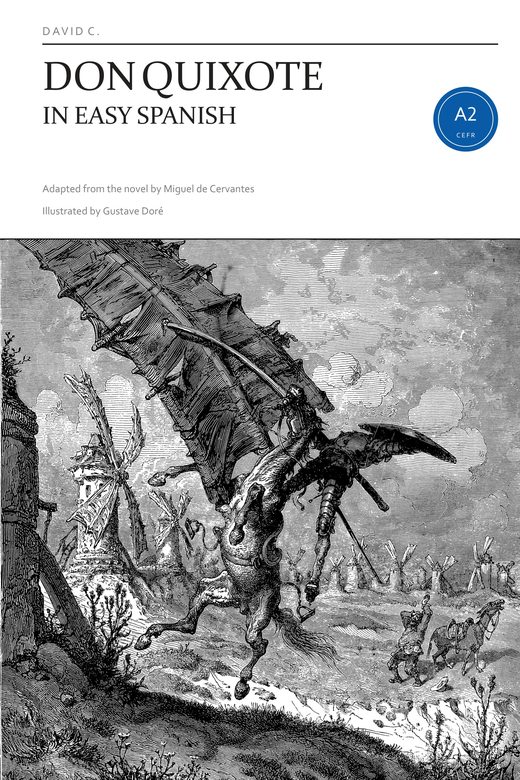
Don Quixote in Easy Spanish: the whole novel retold in Spanish you can actually read, in 58 short episodes, with the hard words glossed in the margin. It is where every Don Quixote sentence on this page comes from.
In EPUB and PDF with its audiobook, and a second novel in the same Spanish. See the books.
Where the course teaches this
2 lessons build it up, each one inside a chapter of the story rather than in the abstract. Free to read, with the vocabulary, the audio and the exercises.
- Writing a letter: tú and usted on paperLesson 41The letter to Dulcinea
- Numbers, ordinals and ageLesson 8Don Quixote of La Mancha
Next to this one
The points that sit closest to this one, and that a student usually meets around the same time.