A1 · Updated
Telling the time in Spanish
Spanish tells the time with ser and the article: es la una, son las tres. Minutes are added with y up to the half hour and taken away with menos after it. Two verbs, one article and two little words.
The short answer
Use es la una for one o'clock and son las for every other hour: son las cinco. Add minutes with y up to the half: las cinco y cuarto, y media. After the half, count down with menos: las seis menos diez. At a time is a las.
How to remember it
Ser, la or las, then y before the half and menos after it
| One o'clock | es la, singular | Es la una |
|---|---|---|
| Every other hour | son las, plural | Son las tres |
| Up to half past | y + minutes, cuarto or media | Las tres y cuarto |
| After half past | the next hour menos the minutes | Las cuatro menos diez |
| At a time | a la, a las | A las ocho |
The forms
Every way the clock can be read
| clock | Spanish | note |
|---|---|---|
| 1:00 | es la una | singular verb and article |
| 3:00 | son las tres | en punto if you want to be exact |
| 3:05 | son las tres y cinco | y + minutes |
| 3:15 | son las tres y cuarto | cuarto, no article |
| 3:30 | son las tres y media | media agrees with hora |
| 3:40 | son las cuatro menos veinte | count down from the next hour |
| 3:45 | son las cuatro menos cuarto | quarter to four |
| 12:00 | son las doce / es mediodía | medianoche for midnight |
| 20:00 | son las ocho de la tarde | or las veinte, on timetables |
16 sentences that show the difference
Everyday Spanish, the kind you would actually say. The label under each one says which part of the rule it shows.
¿Qué hora es?
What time is it?
The question
Es la una y media.
It is half past one.
One takes es la
Son las dos en punto.
It is two o'clock sharp.
En punto
Son las siete y diez.
It is ten past seven.
Y before the half
Son las nueve menos cuarto.
It is a quarter to nine.
Menos after the half
Son las once menos cinco.
It is five to eleven.
Menos
¿A qué hora empieza la película?
What time does the film start?
Asking about an event
Empieza a las diez.
It starts at ten.
A las
Quedamos a la una.
Let us meet at one.
A la for one
Me levanto a las siete de la mañana.
I get up at seven in the morning.
De la mañana
Cenamos a las nueve de la noche.
We have dinner at nine in the evening.
De la noche
Trabajo por la mañana.
I work in the morning.
Por with no clock time
Son casi las cuatro.
It is almost four.
Casi
Eran las tres cuando llegó.
It was three when he arrived.
In the past, imperfect
El tren sale a las 18:40.
The train leaves at 18:40.
Timetables use 24 hours
Llego sobre las cinco.
I will get there around five.
Sobre for around
Where English gets in the way
English says it is for every hour and adds past or to. Spanish uses ser in the plural for every hour but one, because it is counting hours: son las tres. And it reads the clock from the hour, not the minutes: las tres y diez, the three and ten, where English says ten past three.
The mistake to avoid
Es las tres and a tres. The verb agrees with the number of hours, so son las tres, and the article never drops: a las tres, not a tres.
The cases that break the rule
Es la una
The only singular hour. Everything from two to twelve is plural, son las, because the word understood is horas. One thirty is still es la una y media.
Y cuarto, y media
No article before cuarto and media, unlike French and unlike the hour itself. And media, not medio, because it agrees with the hidden word hora.
Menos cuarto
Spain counts down from the next hour after the half. Latin America often says un cuarto para las cuatro or simply las tres cuarenta y cinco, and both are understood everywhere.
De la tarde
De la mañana, de la tarde, de la noche go with a clock time. Without one, it is por: por la tarde. In Spain la tarde runs until it gets dark, often eight or nine.
Era la una
Telling the time in the past always takes the imperfect, never the preterite: eran las diez. It is the background of a story, not an event in it.
Las 20:00
Timetables, tickets and the radio use the 24 hour clock: las veinte horas. In conversation people say las ocho de la tarde.
Telling time in Spanish exercises
8 sentences to fill in. Type your answer and check it, or read them straight through with the answers showing. Accents count here, the way they count in the language.
-
___ la una y diez.
It is ten past one.
Es · One is the only singular hour, so es la una.
-
___ las cuatro y media.
It is half past four.
Son · Every hour but one is plural, so son las.
-
Son las seis ___ cuarto. (6:15)
It is a quarter past six.
y · Before the half, minutes are added with y.
-
Son las nueve ___ diez. (8:50)
It is ten to nine.
menos · After the half, Spain counts down from the next hour with menos.
-
La clase empieza ___ las diez.
The class starts at ten.
a · At a time is a las, with the article.
-
Son las tres y ___. (3:30)
It is half past three.
media · Media, agreeing with the understood word hora, and no article.
-
Cenamos a las diez de ___ noche.
We have dinner at ten at night.
la · De la noche, with the article, after a clock time.
-
Cuando llegué, ___ las once.
When I arrived, it was eleven.
eran · Telling the time in the past takes the imperfect.
More exercises, from Don Quixote
8 more, these ones straight out of the course: the inn, the windmills, Rocinante and the road. Same rule, older Spanish.
-
Don Quijote sale de casa ___ las seis de la mañana.
Don Quixote leaves home at six in the morning.
a · At a time is a las, never a seis on its own.
-
Llegan a la venta ___ la tarde.
They reach the inn in the afternoon.
por · Without a clock time it is por la tarde.
-
___ la una cuando Sancho se despierta.
It is one o'clock when Sancho wakes up.
Es · La una is the only singular hour.
-
La cena en la venta es a las nueve ___ la noche.
Dinner at the inn is at nine in the evening.
de · With a clock time, de la noche.
-
Eran las doce ___ punto.
It was twelve o'clock exactly.
en · En punto marks the exact hour.
-
Son las cinco ___ cuarto y no llega nadie. (4:45)
It is a quarter to five and nobody is coming.
menos · After the half, menos from the next hour.
-
Sancho come a las dos y ___. (2:30)
Sancho eats at half past two.
media · Y media for the half hour.
-
Cuando vuelven, ___ las diez de la noche.
When they get back, it is ten at night.
son · Plural hour, plural verb.
Common questions
How do you ask what time it is in Spanish?
¿Qué hora es? is the standard question. ¿Tienes hora? is the polite way to ask a stranger, the equivalent of do you have the time.
Why is it es la una but son las dos?
Because the verb agrees with the number of hours. One hour is singular, es la una. Two or more are plural, son las dos. The word horas is understood after the article.
How do you say quarter past and quarter to?
Quarter past is y cuarto: las dos y cuarto. Quarter to is menos cuarto from the next hour: las tres menos cuarto for 2:45.
How do you say at what time?
¿A qué hora...? with a at the front: ¿a qué hora sale el tren? The answer keeps the a: a las ocho.
How do you say am and pm in Spanish?
With de la mañana, de la tarde and de la noche, or with the 24 hour clock on timetables. De la madrugada covers the small hours, from about one to six.
How do you say noon and midnight?
Mediodía and medianoche: a mediodía, a medianoche, without the article. Las doce works for both.
Do Spaniards use the 24 hour clock?
In writing, timetables, tickets and on the radio, yes: las 21:30. In conversation almost everyone switches back to las nueve y media de la noche.
How do I say around five?
Sobre las cinco or a eso de las cinco. Hacia las cinco also works and sounds a little more written.
The things to remember
- Es la una, son las dos, son las tres. One is the only singular hour.
- Y cuarto and y media before the half, menos after it.
- At a time is a la una, a las tres.
- De la mañana with a clock time, por la mañana without one.
- In the past, eran las tres, always imperfect.
The book this comes from
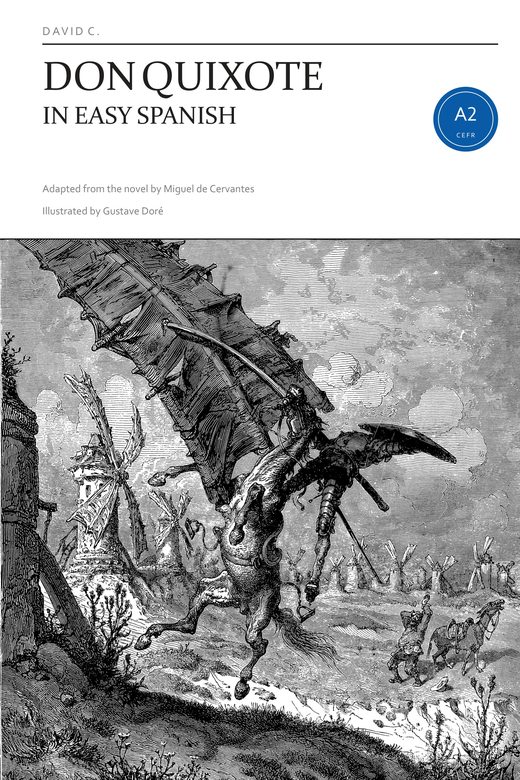
Don Quixote in Easy Spanish: the whole novel retold in Spanish you can actually read, in 58 short episodes, with the hard words glossed in the margin. It is where every Don Quixote sentence on this page comes from.
In EPUB and PDF with its audiobook, and a second novel in the same Spanish. See the books.
Where the course teaches this
One lesson covers it, each one inside a chapter of the story rather than in the abstract. Free to read, with the vocabulary, the audio and the exercises.
- Numbers, ordinals and ageLesson 8Don Quixote of La Mancha
Next to this one
The points that sit closest to this one, and that a student usually meets around the same time.