A1 · Updated
Spanish subject pronouns: tú, usted, vosotros
Spanish has four ways to say you, and usually drops the pronoun altogether because the verb already says who is speaking. The trick is knowing which you to pick, and when a pronoun earns its place in the sentence.
The short answer
The pronouns are yo, tú, él, ella, usted, nosotros, vosotros, ellos, ellas, ustedes. Usted and ustedes take the third person verb: usted habla. Spain uses vosotros for informal plural, Latin America uses ustedes for both. Most of the time you leave the pronoun out: hablo, not yo hablo.
How to remember it
Leave it out unless you are contrasting
| Tú | one person, informal | ¿Tú qué quieres? |
|---|---|---|
| Usted | one person, formal, third person verb | ¿Usted qué quiere? |
| Vosotros | several, informal, Spain only | ¿Qué queréis? |
| Ustedes | several, formal in Spain, all in Latin America | ¿Qué quieren? |
| Drop it | the verb ending already says who | Vivo en Madrid |
The forms
Every subject pronoun with hablar
| pronoun | verb | who |
|---|---|---|
| yo | hablo | I |
| tú | hablas | you, one, informal |
| él, ella, usted | habla | he, she, you formal |
| nosotros, nosotras | hablamos | we |
| vosotros, vosotras | habláis | you, several, informal, Spain |
| ellos, ellas, ustedes | hablan | they, you several |
16 sentences that show the difference
Everyday Spanish, the kind you would actually say. The label under each one says which part of the rule it shows.
Soy de Londres.
I am from London.
No yo needed
Yo soy de Londres y ella es de París.
I am from London and she is from Paris.
Contrast, so pronouns
¿Cómo estás?
How are you?
Tú, informal
¿Cómo está usted?
How are you?
Usted, formal
¿De dónde sois?
Where are you from?
Vosotros, Spain
¿De dónde son ustedes?
Where are you from?
Ustedes
Nosotras vivimos juntas.
We live together.
Feminine we
Ellos trabajan y ellas estudian.
They work and they study.
Contrast by gender
¿Quién quiere café? Yo.
Who wants coffee? Me.
A one word answer
Yo también.
Me too.
Yo, not mí
Pago yo.
I will pay.
Emphasis at the end
Llueve.
It is raining.
No pronoun for it
Es importante.
It is important.
No pronoun for it
Usted tiene razón.
You are right.
Usted with tener
¿Podemos tutearnos?
Can we use tú with each other?
Tutear
Vosotros tenéis la llave.
You lot have the key.
Vosotros with emphasis
Where English gets in the way
English needs a subject in every sentence, even an empty one: it is raining. Spanish does not, because hablo can only be I. Putting yo in front of every verb is not wrong, but it sounds insistent, as if you kept stressing I. English has one you, Spanish has four, split by number and by distance.
The mistake to avoid
Usted tienes and yo soy, yo tengo, yo vivo. Usted always takes the third person, usted tiene. And repeating yo in every sentence is the clearest sign of an English speaker: let the verb do it.
The cases that break the rule
Usted habla
Usted comes from vuestra merced, your grace, so it takes the third person verb like él. Usted hablas mixes both systems and is one of the commonest beginner mistakes.
Vosotros
Only in Spain. In Latin America ustedes covers every plural you, friends included. You will understand both, but pick one system and stay consistent.
Es importante
Spanish has no word for the English it as a subject. Ello exists but is rare and formal. Weather, time and impersonal statements simply have no subject.
Yo también
After also and too it is the subject form: yo también, tú tampoco. A mí también is the answer to gustar sentences: me gusta, a mí también.
Nosotras
Nosotras, vosotras and ellas are only for groups of women. One man in the group and it is nosotros, vosotros, ellos.
Vos
In Argentina, Uruguay and much of Central America, vos replaces tú with its own verb forms: vos tenés. It is standard there, but you do not need it to be understood.
Spanish subject pronouns exercises
8 sentences to fill in. Type your answer and check it, or read them straight through with the answers showing. Accents count here, the way they count in the language.
-
¿Usted ___ hijos? (tener)
Do you have children?
tiene · Usted takes the third person verb, like él.
-
¿Vosotros ___ español? (hablar)
Do you speak Spanish?
habláis · Vosotros, with its own ending -áis, only used in Spain.
-
¿Ustedes ___ de México? (ser)
Are you from Mexico?
son · Ustedes takes the third person plural.
-
Yo trabajo y ___ estudias.
I work and you study.
tú · A contrast between two people, so the pronoun is needed. Estudias says it is tú.
-
Me encanta el cine. A mí ___.
I love cinema. So do I.
también · After a gustar sentence, a mí también.
-
¿Quién tiene las llaves? ___.
Who has the keys? Me.
Yo · The one word answer uses the subject form, yo.
-
Ana y yo ___ juntas. (vivir)
Ana and I live together.
vivimos · Ana y yo is nosotras, so the first person plural.
-
___ mucho hoy. (llover)
It is raining a lot today.
Llueve · No pronoun for it. The verb stands alone.
More exercises, from Don Quixote
8 more, these ones straight out of the course: the inn, the windmills, Rocinante and the road. Same rule, older Spanish.
-
¿Usted ___ don Quijote? (ser)
Are you Don Quixote?
es · Usted with the third person, es.
-
Sancho, ¿tú ___ hambre? (tener)
Sancho, are you hungry?
tienes · Tú, the second person, -es.
-
Sancho tiene miedo, pero don Quijote no. ___ es muy valiente.
Sancho is scared, but Don Quixote is not. He is very brave.
Él · Él marks the contrast between the two men. Without it, es could be either.
-
Señores, ¿___ son caballeros?
Gentlemen, are you knights?
ustedes · Several people addressed formally, ustedes.
-
Sancho y yo ___ a la venta. (ir)
Sancho and I are going to the inn.
vamos · Sancho y yo is nosotros.
-
Amigos, ¿qué ___ aquí? (hacer)
Friends, what are you doing here?
hacéis · Informal plural in Spain, so vosotros.
-
Señor ventero, usted ___ muy amable. (ser)
Mr Innkeeper, you are very kind.
es · Formal you, third person verb.
-
¿Quién es el caballero? ___ soy.
Who is the knight? I am.
Yo · A stressed answer, so the pronoun appears.
Common questions
When should I use tú or usted?
Tú with friends, family, children and people your age in casual settings. Usted with older strangers, officials, and in formal business. In Spain tú is used much more than in most of Latin America. When in doubt, start with usted and let the other person offer tú.
Why do Spanish speakers drop the subject pronoun?
Because the verb ending already says who: hablo can only be I, hablamos only we. The pronoun comes back for contrast or emphasis: yo pago, I am paying, not you.
Do they use vosotros in Latin America?
No. Latin America uses ustedes for every plural you, formal or not. Vosotros is only Spain. Both are understood everywhere.
Why does usted use the third person?
Because it began as vuestra merced, your grace, a noun. You were talking to someone's grace, in the third person, and the verb stayed that way when the phrase shrank to usted.
How do you say it in Spanish?
As a subject, you usually do not say it at all: es verdad, it is true, llueve, it is raining. As an object it is lo or la: lo tengo, I have it.
What is the difference between nosotros and nosotras?
Nosotras is a group made only of women. Any mixed group is nosotros. The same goes for vosotros and vosotras, ellos and ellas.
What does tutear mean?
To speak to someone using tú. ¿Nos tuteamos? is the polite way to suggest switching from usted to tú. Its opposite is tratar de usted.
What is vos?
The informal you of Argentina, Uruguay and parts of Central America, with its own forms: vos sos, vos tenés. It replaces tú there. A learner can stick to tú and be understood anywhere.
The things to remember
- The verb ending already tells you who, so the pronoun is usually dropped.
- Use a pronoun to contrast, to stress, or to answer with one word.
- Usted and ustedes take the third person verb.
- Vosotros is Spain only. Latin America uses ustedes for every plural you.
- There is no Spanish word for it as a subject: llueve, es importante.
The book this comes from
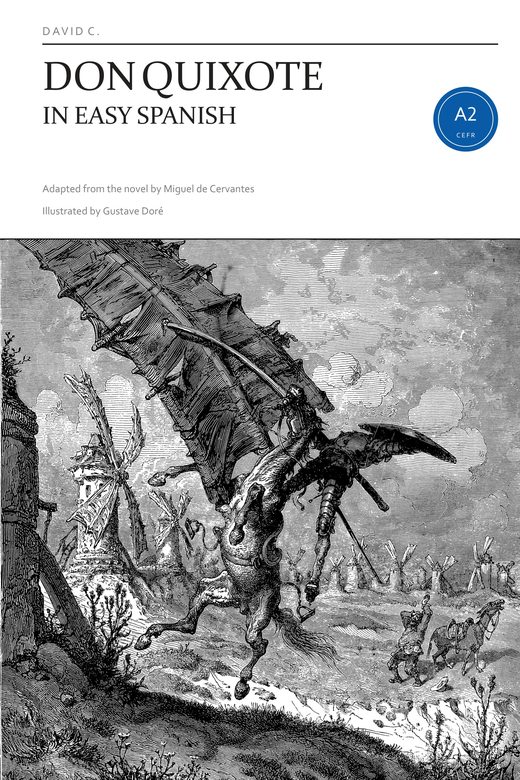
Don Quixote in Easy Spanish: the whole novel retold in Spanish you can actually read, in 58 short episodes, with the hard words glossed in the margin. It is where every Don Quixote sentence on this page comes from.
In EPUB and PDF with its audiobook, and a second novel in the same Spanish. See the books.
Where the course teaches this
2 lessons build it up, each one inside a chapter of the story rather than in the abstract. Free to read, with the vocabulary, the audio and the exercises.
- The affirmative imperative: tú and ustedLesson 14The innkeeper's advice
- SER + what you are. Gender and numberLesson 1The gentleman of La Mancha
Next to this one
The points that sit closest to this one, and that a student usually meets around the same time.