Level A1 · Chapter 14
The innkeeper's advice
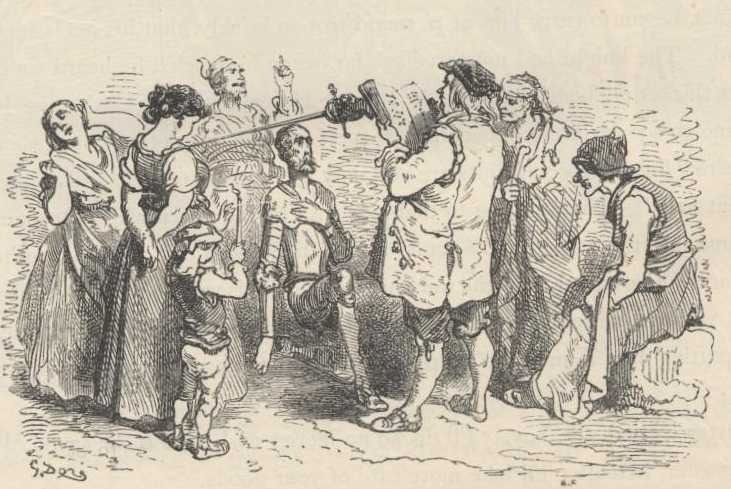
The innkeeper gives the newly dubbed knight the most practical advice in the whole book: money and clean shirts.
What you will learn
- Give an order or a piece of advice, both informally (tú) and politely (usted).
- Use the short forms: di, haz, pon, sal, ven, ten.
- Stick the pronoun onto the end of the command: dímelo, llévalas, dígame.
Before you read
Almost everything the innkeeper says is a command: lleva, pon, haz, busca, sal. Don Quixote answers him politely, with usted, and there the forms change: dígame, créame.The story in easy Spanish
Ya es de día y don Quijote sale al corral con su espada nueva.
It is daylight now, and Don Quixote comes out into the yard with his new sword.
El ventero quiere perder a este huésped y por eso le da consejos prácticos.
The innkeeper wants to be rid of this guest, so he gives him some practical advice.
«Escucha bien, señor caballero: lleva siempre dinero, camisas y ropa limpia.»
"Listen carefully, sir knight: always carry money, shirts and clean clothes."
«Pon el dinero en las alforjas y ciérralas bien. Haz una bolsa para las medicinas.»
"Put the money in your saddlebags and close them properly. Make a little bag for medicines."
«Y busca un escudero con un burro para tus armas.»
"And find yourself a squire with a donkey for your weapons."
Don Quijote responde con mucho respeto: «Dígame, señor del castillo.
Don Quixote answers with great respect: "Tell me, lord of the castle.
¿Los caballeros de los libros llevan dinero?»
Do the knights in the books carry money?"
«Los libros no lo dicen todo. Créame usted», contesta el ventero.
"The books do not say everything. Believe me," the innkeeper answers.
«Di siempre la verdad, sé valiente y sal ahora de mi castillo.»
"Always tell the truth, be brave, and now leave my castle."
Don Quijote sube a Rocinante y va hacia su pueblo sin pagar nada.
Don Quixote climbs onto Rocinante and heads for his village without paying a penny.
Vocabulary
The knight's luggage
- las alforjas
- the saddlebags
- la bolsa
- the bag, the purse
- la camisa
- the shirt
- la ropa
- the clothes
- la medicina
- the medicine
- el dinero
- the money
People of the road
- el escudero
- the squire
- el burro
- the donkey
- el huésped
- the guest
Words for advice
- el consejo
- the piece of advice
- limpio / limpia
- clean
- el respeto
- the respect
The affirmative imperative: tú and usted
Lleva siempre dinero.
Pon el dinero en las alforjas y ciérralas bien.
Dígame, señor del castillo.
To give an order to tú, take the he/she form of the present tense and stop there: él lleva → lleva (carry), él come → come (eat), él escribe → escribe (write).
For usted, swap the vowel for the opposite one: -ar verbs end in -e, and -er / -ir verbs end in -a.
| Infinitive | tú | usted |
|---|---|---|
| llevar (to carry) | lleva | lleve |
| beber (to drink) | bebe | beba |
| escribir (to write) | escribe | escriba |
A handful of very common verbs have a one-syllable tú form. These have to be learnt by heart:
| Infinitive | tú | usted |
|---|---|---|
| decir (to say) | di | diga |
| hacer (to do, make) | haz | haga |
| poner (to put) | pon | ponga |
| salir (to go out) | sal | salga |
| tener (to have) | ten | tenga |
| venir (to come) | ven | venga |
| ser (to be) | sé | sea |
The pronoun is glued on the end, making one single word: cierra + las → ciérralas (close them), di + me + lo → dímelo (tell it to me), diga + me → dígame. The order is person first, thing second: me before lo.
Gluing the pronoun on makes the word longer, so a written accent is often needed to keep the stress where it was: cierra → ciérralas.
Money, shirts and saddlebags
The innkeeper gives the soundest advice in the book, and it comes from the last man you would expect. In the books of chivalry heroes never pay for lodging or wash their clothes: the author looks the other way. Cervantes does not.
Anyone really travelling across Castile carried alforjas: two cloth bags slung over the animal, one on each side. Inside went bread, cheese, a spare shirt and a purse of coins, sewn into the lining because of thieves. There were no banks on those roads, no letters of credit, and very little law.
Two chapters later Don Quixote will find Sancho Panza, and Sancho's saddlebags will turn into one of the most important characters in the novel.
Cervantes in the original · «una cosa tan clara y tan necesaria de traerse como…»
una cosa tan clara y tan necesaria de traerse como eran dineros y camisas limpias
a thing as plain and as necessary to carry as money and clean shirts
This is the innkeeper's advice, the thing the books of chivalry never mention. You can read dineros, camisas and limpias. Today you would say dinero in the singular.