Level A1 · Chapter 15
The boy tied to the oak tree
Don Quixote rights his first wrong and rides away pleased with himself. The boy is the one who pays for it.
What you will learn
- Tell in the past what happened and was over.
- Form the preterite of regular -ar, -er and -ir verbs.
- Place events in time: ayer, entonces, aquella tarde, de pronto.
Before you read
The verbs in this text are no longer in the present. Volvió, encontró, gritó, obedeció, salió: this is the past tense stories are told in. Watch the written accent on the last syllable.The story in easy Spanish
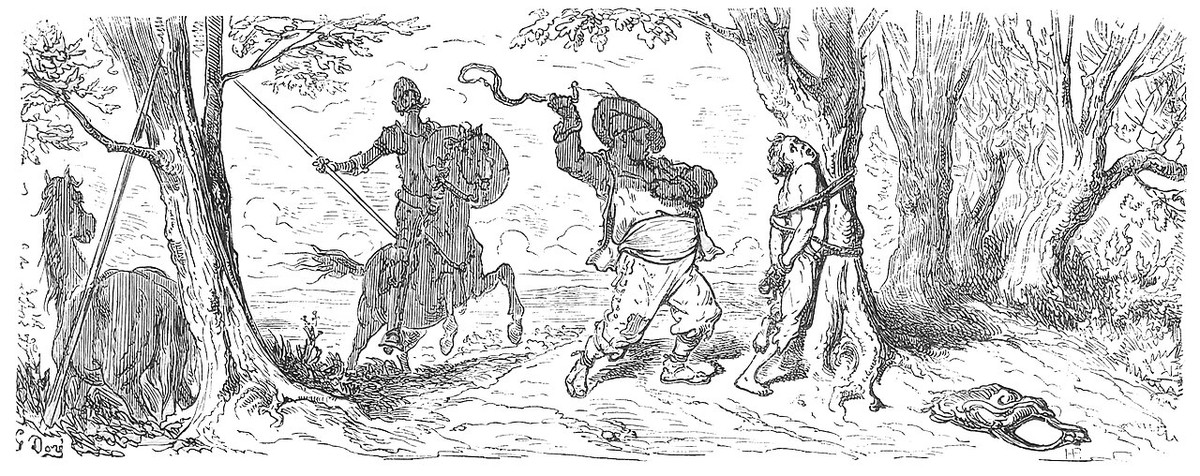
Aquella mañana don Quijote volvió hacia su pueblo. De pronto escuchó unos gritos entre los árboles y entró en el bosque.
That morning Don Quixote headed back towards his village. Suddenly he heard shouting among the trees and rode into the wood.
Allí encontró a Andrés, un muchacho atado a una encina. Un labrador rico, Juan Haldudo, lo golpeó con un cinturón de cuero.
There he found Andrés, a boy tied to a holm oak. A rich farmer, Juan Haldudo, was beating him with a leather belt.
«¿Por qué pegas a este chico?», preguntó el caballero. «Es mi criado y pierde mis ovejas», contestó el labrador.
"Why are you hitting this lad?" asked the knight. "He is my servant and he loses my sheep," answered the farmer.
«¡Miente!», gritó Andrés. «No me pagó nueve meses de trabajo.»
"He is lying!" shouted Andrés. "He has not paid me for nine months of work."
Entonces don Quijote levantó la lanza y ordenó: «Desata al muchacho y paga ahora mismo.»
Then Don Quixote raised his lance and gave the order: "Untie the boy and pay him right now."
El labrador miró la lanza larga, obedeció y prometió el dinero en su casa.
The farmer looked at the long lance, obeyed, and promised the money once they got home.
El caballero salió del bosque muy contento con su primera aventura.
The knight rode out of the wood delighted with his first adventure.
Aquella tarde Juan Haldudo ató otra vez al muchacho y continuó con el cinturón. Andrés aprendió aquel día una cosa nueva sobre los caballeros andantes.
That afternoon Juan Haldudo tied the boy up again and went on with the belt. Andrés learnt something new that day about knights-errant.
Vocabulary
The wood and the fields
- la encina
- the holm oak
- el bosque
- the wood
- la oveja
- the sheep
- el grito
- the shout
Master and servant
- el labrador
- the farmer
- el criado
- the servant, the farmhand
- el muchacho
- the lad, the boy
- atar / desatar
- to tie / to untie
- pegar
- to hit
- deber
- to owe
When it happened
- ayer
- yesterday
- entonces
- then, at that moment
- de pronto
- suddenly
- aquella mañana / aquella tarde
- that morning / that afternoon
The preterite: regular verbs
Aquella mañana don Quijote volvió hacia su pueblo.
El labrador obedeció y prometió el dinero.
Andrés aprendió aquel día una cosa nueva.
This is the tense of what happened and was over: a finished event, with its beginning and its end inside the story. It is the tense stories are told in, and from here on Don Quixote can finally be narrated properly.
| hablar (speak) | comer (eat) | vivir (live) | |
|---|---|---|---|
| yo | hablé | comí | viví |
| tú | hablaste | comiste | viviste |
| he / she / usted | habló | comió | vivió |
| we | hablamos | comimos | vivimos |
| you (pl., Spain) | hablasteis | comisteis | vivisteis |
| they / ustedes | hablaron | comieron | vivieron |
Two things save work here: -er and -ir verbs take exactly the same endings, and only two forms carry a written accent, -é / -í (I) and -ó / -ió (he/she).
Those two accents do all the heavy lifting. Without it, hablo means "I speak, right now". With it, habló means "he spoke, yesterday". One small stroke changes both the person and the time.
This tense comes with the markers of closed time: ayer (yesterday), anoche (last night), entonces (then), de pronto (suddenly), aquella tarde (that afternoon), aquel día (that day).
Servants, day wages and nine months unpaid
Andrés is a hired servant: he works the whole year for a fixed sum, usually very little money, his food and a pair of shoes. Field labourers were paid a jornal, a day's wage for a day from sunrise to sunset, worth about two reales in the Castile of 1600. Nine months unpaid was not an outrage: it was ordinary, because the master paid when he felt like it and the servant had nobody to complain to.
That is why Juan Haldudo obeys the moment he sees the lance, and why he ties the boy up again the moment the lance rides off. The law of that road was whoever happened to be standing on it.
Cervantes does not close the scene here. Andrés turns up again in chapter 31, and the only thing he asks of Don Quixote is that, for the love of God, he never help him again.
Cervantes in the original · «Señor caballero, este muchacho que estoy castigando…»
Señor caballero, este muchacho que estoy castigando es un mi criado
Sir knight, this boy I am punishing is a servant of mine
Un mi criado is an old construction. Today you would say un criado mío. You already know the key words: caballero, muchacho, criado.