Level A1 · Chapter 15.5
Review 3: lessons 11 to 15
The vocabulary from lessons 11 to 15 that does not come back, the grammar of the block in one table, and two exercises.
What you will learn
- Ask with qué, quién, dónde, cómo and por qué, and follow the answer.
- Give an order to tú and to usted, and say what you like and what you do not.
- Tell what is happening now apart from what happened once and finished.
The story in easy Spanish
El caballero anda despacio por un campo seco y sin sombra.
The knight rides slowly across a dry field with no shade.
Al final del camino ve una venta con torres de plata.
At the end of the road he sees an inn with silver towers.
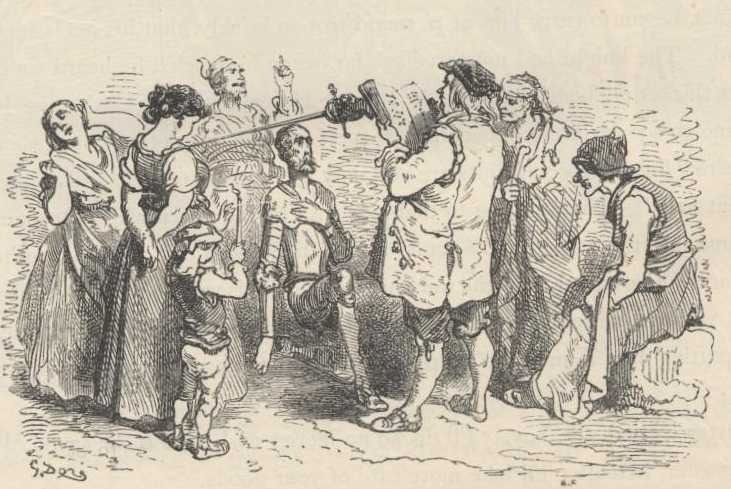
Dos mujeres saludan y un porquero toca su cuerno.
Two women say hello and a swineherd blows his horn.
Para él, ese cuerno es la trompeta de un gigante.
To him, that horn is a giant’s trumpet.
Esa señal le gusta, y ellas se ríen mucho de él.
He likes that signal, and the women laugh at him a great deal.
Por la noche vela las armas junto a la pila del agua.
At night he keeps watch over his armour beside the water trough.
Un arriero quita el hierro y don Quijote golpea con la lanza.
A muleteer moves the iron away and Don Quixote strikes with his lance.
El ventero le da un consejo antes de abrir la puerta.
The innkeeper gives him a piece of advice before opening the door.
«Lleva dinero, ropa limpia y alforjas, y busca un escudero.»
"Take money, clean clothes and saddlebags, and find yourself a squire."
Al día siguiente entró en un bosque y escuchó una voz.
The next day he went into a wood and heard a voice.
Un labrador golpeó a un muchacho atado a una encina.
A farmer was beating a boy tied to an oak tree.
El muchacho cuidó las ovejas y no cobró su dinero.
The boy had looked after the sheep and had not been paid.
El labrador usó un cinturón de cuero, pero el caballero gritó.
The farmer used a leather belt, but the knight shouted.
Vocabulary
The July morning (lesson 11)
- la sombra
- the shade, the shadow
The inn and the castle (lesson 12)
- la torre
- the tower
- la plata
- the silver
- la trompeta
- the trumpet
- el porquero
- the swineherd
- el cuerno
- the horn
- la señal
- the signal, the sign
- saludar
- to greet, to say hello
- reírse
- to laugh
The night of the vigil (lesson 13)
- velar las armas
- to keep watch over the armour
- la pila
- the trough, the basin
- el arriero
- the muleteer
The innkeeper’s advice (lesson 14)
- el consejo
- the piece of advice
- las alforjas
- the saddlebags
- la ropa
- the clothes
- la bolsa
- the purse, the bag
The boy at the oak tree (lesson 15)
- la encina
- the holm oak
- atado / atada
- tied
- el cinturón de cuero
- the leather belt
- la oveja
- the sheep
- cobrar
- to get paid
Lessons 11 to 15 in one table
The vocabulary list above comes first. Cover the English, read the Spanish aloud, mark whatever does not come back inside three seconds. Then read the table.
| point | rule | from the summary above |
|---|---|---|
| question words | always accented, always between two question marks | ¿Por qué golpea al arriero? |
| exclamative qué | accented too, and it opens with ¡ | ¡Qué campo tan seco! |
| y, ni, o, pero | join two ideas of equal weight | ropa limpia y alforjas |
| gustar | the thing liked is the subject, and the person is me, te, le | Esa señal le gusta. |
| tú command | the él form of the present | Lleva dinero. Busca la bolsa. |
| usted command | swap the vowel: -e for -ar verbs, -a for -er and -ir | Lleve dinero. Escriba aquí. |
| preterite | one event, finished, and the accent on entré and entró is not decoration | Entró en un bosque y escuchó una voz. |
Gustar, the wrong way round
The sentence you want is I like the castle, and Spanish builds it as the castle is pleasing to me, so the verb agrees with the castle and not with you.
| to whom | verb | what |
|---|---|---|
| me | gusta | el castillo |
| te | gusta | la venta |
| le | gustan | las torres |
The full preterite is in the verb tables at the back of the book.