Level A1 · Chapter 16
The merchants from Toledo
Six silk traders find a lance across the road and an impossible question waiting for them.
What you will learn
- Narrate a whole scene in the past, from start to finish.
- Use the preterite of the seven most frequent irregular verbs.
- Chain events together: primero, entonces, después, al final.
Before you read
Seven very common verbs refuse to follow last lesson's rule: fue, vio, tuvo, estuvo, hizo, dio. They carry no written accent, and each one has to be learnt separately.The story in easy Spanish
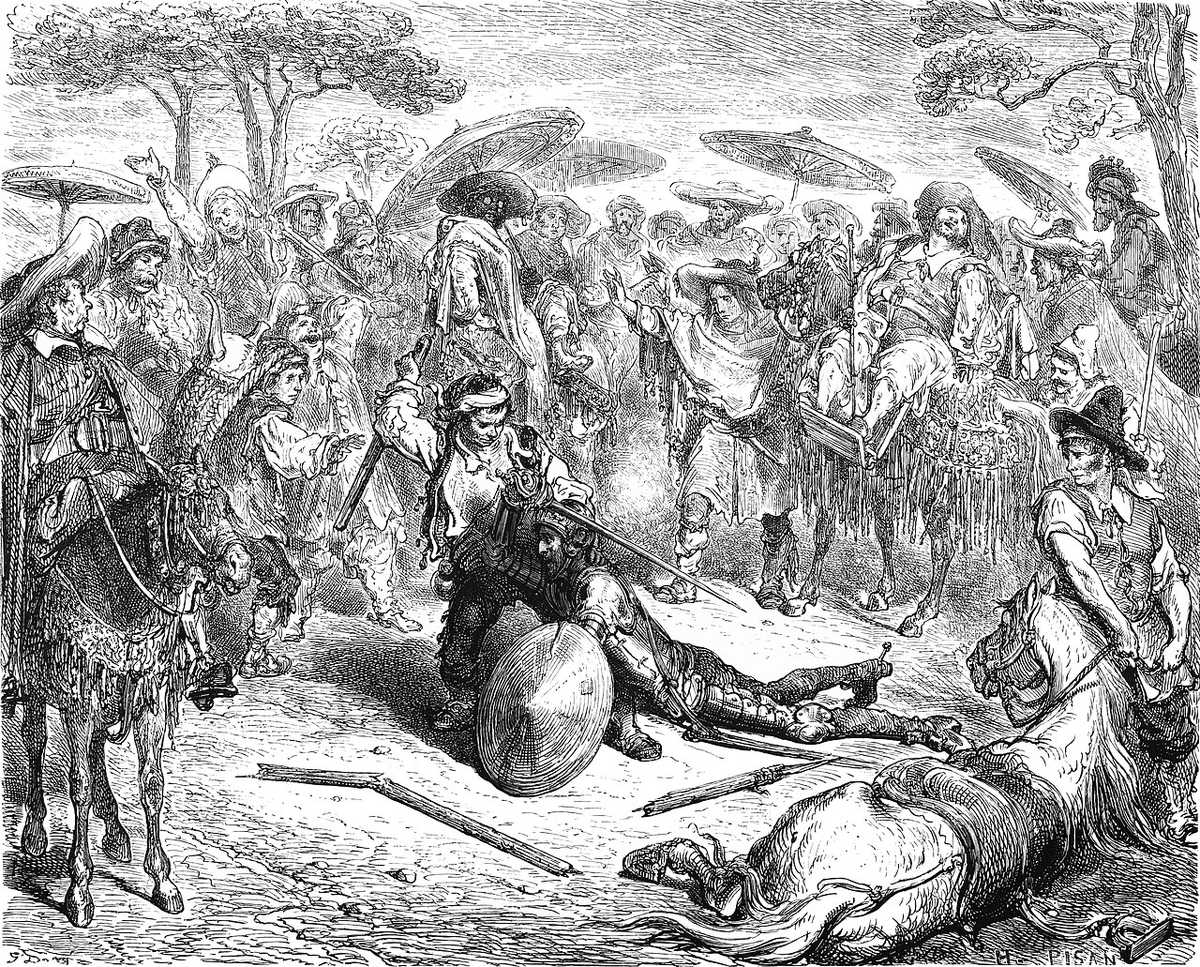
Aquella tarde don Quijote fue hacia su pueblo por el campo de Montiel. De pronto vio en el camino a seis mercaderes de Toledo.
That afternoon Don Quixote rode towards his village across the plain of Montiel. Suddenly he saw six merchants from Toledo on the road.
Los mercaderes hicieron aquel viaje para comprar seda en Murcia. Con ellos fueron cuatro criados a caballo y tres mozos de mulas a pie.
The merchants were making that journey to buy silk in Murcia. With them went four servants on horseback and three mule-boys on foot.
Don Quijote estuvo un momento quieto en medio del camino. Entonces tuvo una idea magnífica.
Don Quixote sat motionless for a moment in the middle of the road. Then he had a magnificent idea.
Para él, aquellos hombres no compraron seda: fueron caballeros de una aventura.
To his mind those men were not buying silk: they were knights out of an adventure.
Hizo un gesto con la lanza y dio un grito terrible: «¡Aquí no pasa nadie! ¡Primero, la verdad!»
He made a gesture with his lance and let out a terrible shout: "Nobody passes here! First, the truth!"
Los mercaderes se miraron. Uno de ellos, un hombre tranquilo, dio un paso adelante.
The merchants looked at one another. One of them, a calm man, took a step forward.
«Señor caballero, ¿qué verdad?», preguntó con mucha calma.
"Sir knight, what truth?" he asked, perfectly calmly.
Aquella pregunta fue el principio del desastre. Fue un suceso muy extraño en un camino tranquilo.
That question was the beginning of the disaster. It was a very strange incident on a quiet road.
Vocabulary
Trade
- el mercader
- the merchant
- la seda
- the silk
- el viaje
- the journey
- el mozo de mulas
- the mule-boy
The scene
- el gesto
- the gesture
- el paso
- the step
- quieto / quieta
- still, motionless
- la calma
- the calm
- el suceso
- the event, the incident
- el desastre
- the disaster
Chaining the story
- primero
- first
- entonces
- then
- después
- afterwards
- al final
- in the end
Irregular preterites: the seven you cannot avoid
Don Quijote fue hacia su pueblo y vio a seis mercaderes.
Estuvo un momento quieto y entonces tuvo una idea.
Hizo un gesto con la lanza y dio un grito terrible.
The most used verbs in any language are almost always the most irregular ones: they get said so often that they never wear smooth. These seven have to be memorised, and with them you can narrate half the novel.
| Infinitive | I | you | he / she | they |
|---|---|---|---|---|
| ser / ir (be / go) | fui | fuiste | fue | fueron |
| tener (have) | tuve | tuviste | tuvo | tuvieron |
| estar (be) | estuve | estuviste | estuvo | estuvieron |
| hacer (do, make) | hice | hiciste | hizo | hicieron |
| ver (see) | vi | viste | vio | vieron |
| dar (give) | di | diste | dio | dieron |
Three warnings that save trouble:
First: none of these forms takes a written accent. It is fue, vio, dio, never fué or vió.
Second: ser and ir share exactly the same forms. Fue mi criado is "he was my servant". Fue a Murcia is "he went to Murcia". What follows always settles it, and in four centuries nobody has got confused.
Third: the spoken stress falls on the stem, not on the ending: TU-vo, HI-zo, ES-tuvo. In the regular verbs it fell at the end: vol-VIÓ.
To chain a whole story together: primero… (first), entonces… (then), después… (afterwards), al final… (in the end).
The roads, the silk and why Murcia
Cervantes does not write "some men were passing by". He writes six merchants, from Toledo, on their way to Murcia, to buy silk, with four servants on horseback and three mule-boys on foot. That book-keeper's inventory is what makes the scene ridiculous: the gentleman's fantasy crashes straight into an exact set of facts.
And the facts were real. Murcia grew the best silk in Spain. Toledo wove it and sold it. Between the two cities ran a constant traffic of merchants with hard cash, loaded mules and armed servants, because the roads of La Mancha were long, dry and unpoliced.
Thirteen men on serious business meet one man on a different kind of business entirely. What happens next fills the following lesson, and it does not end well for the knight.
Cervantes in the original · «descubrió don Quijote un grande tropel de gente…»
descubrió don Quijote un grande tropel de gente, que, como después se supo, eran unos mercaderes toledanos que iban a comprar seda a Murcia. Eran seis, y venían con sus quitasoles
he saw coming along the road he was on some six merchants from Toledo, on their way to buy silk in Murcia
There is this lesson's vio, exactly as Cervantes wrote it in 1605. You can also recognise camino, seis, mercaderes, comprar and seda.