Level A1 · Chapter 17
The most beautiful woman in the world
Don Quixote demands an impossible confession from six merchants. This is where the imperfect begins: the tense of description and habit.
What you will learn
- Describe what a person, a thing or a place was like in the past.
- Say what someone used to do, or did every day.
- Compare two things: more than, less than, as … as.
Before you read
You are about to see two past tenses side by side. The ones ending in -ó and -aron you already know from lessons 15 and 16. The new ones end in -aba and -ía, and they are not doing the same job. Watch what each one is used for. The grammar section explains it afterwards.The story in easy Spanish
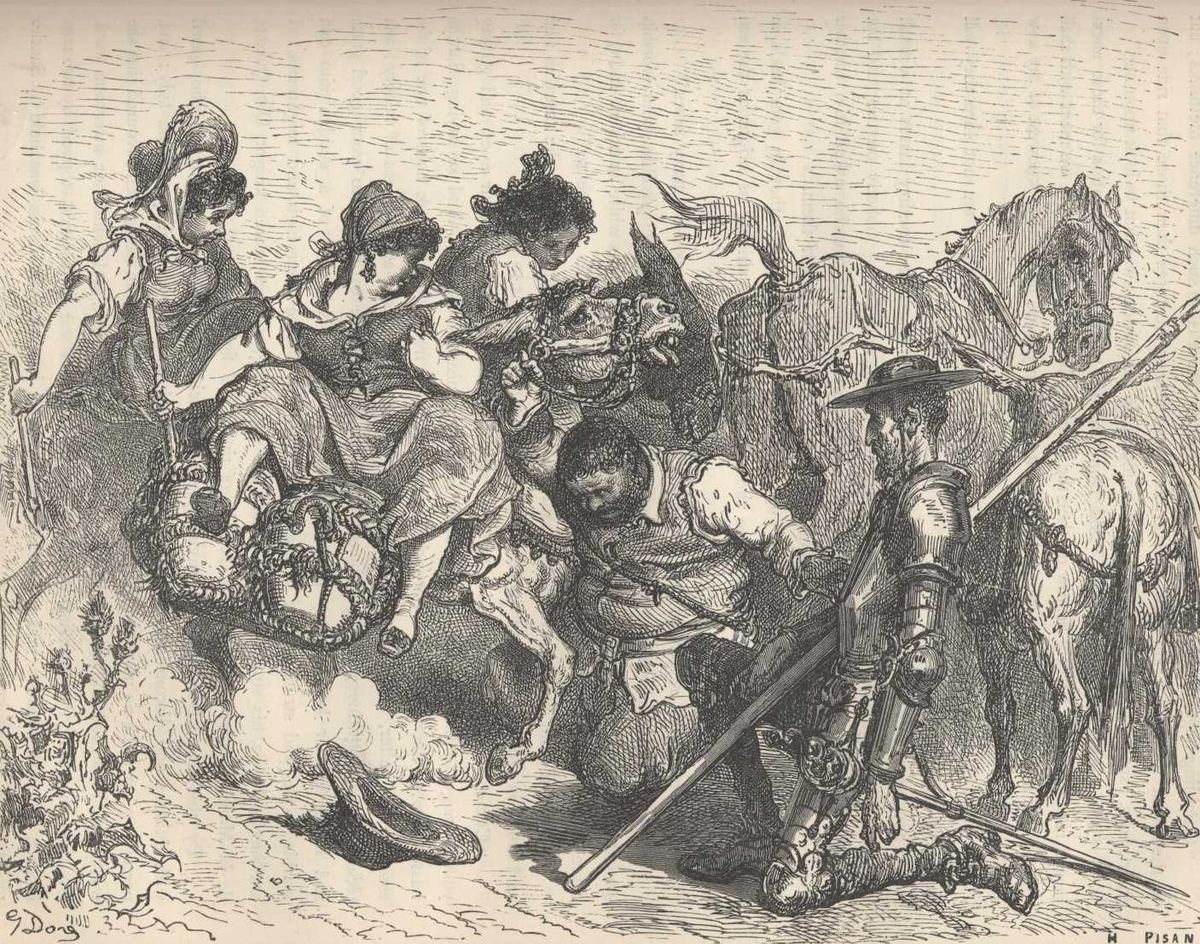
Don Quijote estaba en medio del camino. Delante de él había seis mercaderes de Toledo.
Don Quixote was standing in the middle of the road. In front of him were six merchants from Toledo.
Todos los días pensaba en Dulcinea. Para él era la mujer más hermosa del mundo.
Every day he thought about Dulcinea. For him she was the most beautiful woman in the world.
«Dulcinea del Toboso es más hermosa que todas las mujeres», gritó el caballero.
"Dulcinea del Toboso is more beautiful than all other women," shouted the knight.
Un mercader respondió con calma: «Enséñanos un retrato de esa señora.»
One merchant answered calmly: "Show us a portrait of this lady."
«Si es tan hermosa como dices, confesamos la verdad con mucho gusto.»
"If she is as beautiful as you say, we will gladly confess the truth."
Aquella respuesta era peor que un insulto. Don Quijote atacó con la lanza.
That answer was worse than an insult. Don Quixote charged with his lance.
Pero Rocinante era viejo y andaba despacio. Tropezó y cayó en el camino.
But Rocinante was old and walked slowly. He tripped and fell on the road.
Un mozo de mulas cogió la lanza y la rompió en pedazos.
A mule-boy grabbed the lance and broke it into pieces.
Después golpeó al caballero muchas veces. Los mercaderes siguieron su viaje.
Then he beat the knight again and again. The merchants carried on with their journey.
Un vecino del pueblo pasaba por allí. Lo subió a su burro y lo llevó a casa.
A neighbour from the village was passing by. He put him on his donkey and took him home.
Vocabulary
People on the road
- el mercader
- the merchant
- el mozo de mulas
- the mule-boy
- el vecino
- the neighbour
- el burro
- the donkey
Describing in the past
- hermoso / hermosa
- beautiful
- despacio
- slowly
- con calma
- calmly
- peor
- worse
The fall
- tropezar
- to trip, to stumble
- romper
- to break
- el pedazo
- the piece
- el retrato
- the portrait
- el insulto
- the insult
The imperfect, and when it is not the preterite
Rocinante era viejo y andaba despacio.
Todos los días pensaba en Dulcinea.
Un vecino del pueblo pasaba por allí.
None of them. That is the whole point. The imperfect does not report what happened. It reports what things were like, what was going on around the action, and what someone used to do.
The endings are the most regular in Spanish. Two sets, no exceptions:
| -ar (andar, to walk) | -er / -ir (comer, vivir) | |
|---|---|---|
| yo | andaba | comía / vivía |
| tú | andabas | comías |
| él / ella | andaba | comía |
| nosotros | andábamos | comíamos |
| vosotros | andabais | comíais |
| ellos | andaban | comían |
Note that yo and él share one form, so the subject pronoun comes back when it is not obvious who you mean.
Only three verbs in the entire language are irregular here:
| ser | ir | ver |
|---|---|---|
| era | iba | veía |
| eras | ibas | veías |
| era | iba | veía |
| éramos | íbamos | veíamos |
| erais | ibais | veíais |
| eran | iban | veían |
Preterite or imperfect: the photo and the film
This is the one distinction in A1 that English does not hand you for free, so take it slowly.
The preterite (lessons 15 and 16) is a photograph. One event, taken once, with edges: it started and it ended, and the story moves forward because of it. The imperfect is the film running behind the photograph. It has no edges. It is the weather, the age of the horse, the habit of years, the thing that was already going on when the photograph was taken.
| Preterite: the photo | Imperfect: the film behind it |
|---|---|
| Tropezó y cayó. He tripped and fell. | Rocinante era viejo. Rocinante was old. |
| Un mozo rompió la lanza. A mule-boy broke the lance. | Todos los días pensaba en Dulcinea. Every day he would think about Dulcinea. |
| Los mercaderes siguieron su viaje. The merchants carried on. | Un vecino pasaba por allí. A neighbour was passing by. |
Three questions decide it every time:
- Did it finish? If the sentence points at a single completed event: preterite.
- Was it a habit? If English could say used to or would: imperfect.
- Is it scenery? Age, size, weather, time of day, how someone felt, what was going on when something else happened: imperfect.
Look at the last paragraph of the story. Un vecino pasaba por allí: that is the film, he was already on the road. Lo subió a su burro: that is the photo, one action, done. Both in the same breath, and the pair of tenses is what tells you which is which.
Comparing, while you are here
Don Quixote spends the whole scene comparing. más … que (more … than), menos … que (less … than), tan … como (as … as). And the superlative: la más hermosa del mundo (note del, not en).
Two comparatives refuse the pattern: bueno gives mejor and malo gives peor. That is why the text says era peor que un insulto, never más malo que.
Toledo in 1605
Toledo had been the capital of Spain until 1561, when Philip II moved the court to Madrid (an hour away on a modern train, three days on a sixteenth-century mule). Toledo never quite forgave it, and it never quite lost its money either. In 1605 it was still the wealthiest city in Castile, famous across Europe for two products: sword blades, tempered in the river Tagus, and silk.
So six merchants from Toledo riding to Murcia to buy silk is not a random detail. Cervantes is giving you the most ordinary, most credible traffic on that road. These men have servants, mules and a schedule. They are the seventeenth century getting on with business. And the knight blocking their way in his great-grandfather’s armour is a man from a book that was already two hundred years out of date.
Notice how they answer him. Not with anger: with a reasonable request. Show us the portrait. Merchants deal in evidence. That is exactly the wrong thing to ask a man whose entire world runs on faith.
Cervantes in the original · «Todo el mundo se tenga, si todo el mundo no…»
Todo el mundo se tenga, si todo el mundo no confiesa que no hay en el mundo todo doncella más hermosa que la emperatriz de la Mancha, la sin par Dulcinea del Toboso
Let the whole world stand still, unless the whole world confesses that in the whole world there is no maiden more beautiful than the empress of La Mancha, the peerless Dulcinea del Toboso
Count them: todo el mundo three times, mundo four. Cervantes is not being clumsy: he is imitating the swollen style of the chivalry novels. You can already read the comparative in it: más hermosa que.