Level A1 · Chapter 18
The priest and the barber open the library
Two friends put Don Quixote’s books on trial, one by one. This is where the present perfect and the participle arrive.
What you will learn
- Talk about something that has happened today or recently, with the present perfect.
- Form the participle of any verb, and know the handful that break the rule.
- Use the participle as an adjective: estoy cansado, la lanza está rota.
Before you read
A new past appears, and this one is built from two words: he vuelto, ha dormido, hemos hablado. The first word is always a form of haber. It looks exactly like the English I have returned. That is good news, with one catch that the grammar section explains.The story in easy Spanish
Don Quijote ha vuelto a casa muy enfermo. Ha dormido dos días en su cama.
Don Quixote has come home very ill. He has slept for two days in his bed.
Aquella mañana llegaron dos amigos: el cura y el barbero del pueblo.
That morning two friends arrived: the village priest and the barber.
«La culpa es de estos libros», dijo la sobrina, y abrió la biblioteca.
"These books are to blame," said the niece, and she opened the library.
El ama trajo agua bendita. «He visto cosas muy raras en esta casa.»
The housekeeper brought holy water. "I have seen very strange things in this house."
Dentro había más de cien libros grandes. Todos eran de caballerías.
Inside there were more than a hundred large books. They were all books of chivalry.
El barbero le dio un libro al cura. El cura leyó el título en voz alta.
The barber handed the priest a book. The priest read the title out loud.
«Este ha hecho todo el mal de esta casa. Dáselo al ama.»
"This one has done all the harm in this house. Give it to the housekeeper."
Pero otros libros le gustaron mucho. «Este poema está bien escrito. Ponlo aquí.»
But he liked other books very much. "This poem is well written. Put it here."
El ama estaba cansada de tantos juicios. «Ya hemos hablado bastante», repitió.
The housekeeper was tired of so many trials. "We have talked enough now," she repeated.
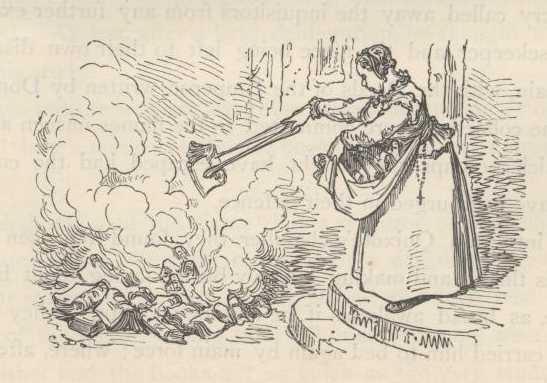
«Échalos todos por la ventana.» Y por la ventana salieron casi todos.
"Throw them all out of the window." And out of the window went nearly all of them.
Vocabulary
People of the village
- el cura
- the priest
- el barbero
- the barber
- el ama
- the housekeeper
- la sobrina
- the niece
The library
- la biblioteca
- the library
- el título
- the title
- el poema
- the poem
- en voz alta
- out loud
- el agua bendita
- holy water
The trial of the books
- la culpa
- the blame, the fault
- el juicio
- the trial, the judgement
- quemar
- to burn
- echar
- to throw out
- cansado / cansada
- tired
- roto / rota
- broken
The present perfect and the participle
Don Quijote ha vuelto a casa muy enfermo.
He visto cosas muy raras en esta casa.
Ya hemos hablado bastante.
The first one. It is the verb haber, and behind it comes the participle, which never changes at all.
This is the same machine as English I have spoken. Learn the six forms of haber and you have the whole tense:
| haber | + participle |
|---|---|
| yo he | hablado (spoken) comido (eaten) vivido (lived) |
| tú has | |
| él / ella ha | |
| nosotros hemos | |
| vosotros habéis | |
| ellos han |
The participle itself is easy: -ar verbs take -ado, -er and -ir verbs take -ido. Eight common verbs refuse, and English speakers meet them constantly:
| verb | participle | |
|---|---|---|
| hacer | hecho | done, made |
| escribir | escrito | written |
| ver | visto | seen |
| decir | dicho | said |
| volver | vuelto | come back |
| romper | roto | broken |
| poner | puesto | put |
| abrir | abierto | opened |
Which past, then?
You now have three. In Spain the division is mostly about the calendar:
- Perfect: today, this week, this year, ya, todavía no, and any time still felt as open: Ha vuelto a casa. He visto cosas raras.
- Preterite: a closed moment, finished and dated: Aquella mañana llegaron dos amigos.
- Imperfect: the film behind it all: Dentro había más de cien libros.
Notice all three working together in the story. The perfect brings you up to date, the preterite moves the morning forward, the imperfect describes the room.
The participle as an adjective
The same word does a second job. After haber it is frozen, always -o. But after ser or estar, or beside a noun, it becomes an ordinary adjective and agrees like any other:
Estoy cansado / El ama está cansada / La lanza está rota / Los libros están quemados / Este poema está bien escrito.
That is where estoy cansado comes from: literally "I am tired-ed". Spanish has no separate adjective for it.
Censorship and the Inquisition
The scene is funny, and it is also documentary. In 1605 no book could be printed in Spain without a royal licence and a church approval, both printed in the opening pages, and Cervantes’ own novel carries them. The Inquisition published an Index of forbidden books, and a public burning was an ordinary event, not a scandal.
So when the priest sits down and judges the library volume by volume (this one lives, this one burns, this one goes out of the window), he is doing, in a farmyard in La Mancha, exactly what the tribunals did in the cities. The chapter is called el donoso y grande escrutinio: the delightful and mighty scrutiny. An escrutinio is a formal examination.
The joke has a sharp edge. The priest keeps stopping to praise the books he is supposed to be destroying, and one of the volumes he discusses is a novel written by a certain Cervantes, judged in public by its own author. Meanwhile the housekeeper, who cannot read, has the only consistent policy in the room: burn the lot.
Cervantes in the original · «no hay para qué perdonar a ninguno…»
no hay para qué perdonar a ninguno, porque todos han sido los dañadores
there is no reason to pardon a single one, because they have all been the culprits
It is the niece speaking, and she wants no book saved. There you have this lesson's present perfect, unchanged since 1605: han sido. The participle dañadores has turned into a noun, the ones who did the damage.