Spanish grammar · A2 to B2 · Updated
The Spanish conditional
Same stem as the future, different endings: hablaría, tendría. It does three jobs. It softens a request into politeness. It says what would happen if something else were true. And it reports a future that was spoken about in the past.
The short answer
The conditional takes the same stem as the future and the endings of the imperfect: hablaría, comería, viviría. It is what would happen, the polite way to ask, and the way Spanish guesses about the past: serían las tres, it must have been about three.
How to remember it
Future stem plus imperfect endings
| Stem | the same as the future, so the same twelve oddities | tendr- |
|---|---|---|
| Endings | -ía, -ías, -ía, -íamos, -íais, -ían | tendría |
| Would | what would happen if something else were the case | Yo no lo haría |
| Politeness | softens a request or a piece of advice | Podría ayudarme |
| Guessing back | a guess about the past, the way the future guesses about now | Serían las tres |
The forms
Conditional endings, and the same odd stems
| regular | stem changes | |
|---|---|---|
| yo | hablaría | tendría, haría, diría |
| tú | hablarías | pondrías, saldrías |
| él, ella, usted | hablaría | podría, sabría, querría |
| nosotros | hablaríamos | vendríamos |
| vosotros | hablaríais | habríais |
| ellos, ustedes | hablarían | tendrían, harían |
20 sentences that show the difference
Everyday Spanish, the kind you would actually say. The label under each one says which part of the rule it shows.
Yo no lo haría.
I would not do it.
What you would do
Me gustaría verte.
I would like to see you.
Politeness
¿Podría ayudarme?
Could you help me?
Polite request
¿Te importaría cerrar la puerta?
Would you mind shutting the door?
Polite request
Deberías descansar.
You should rest.
Advice
Yo que tú, iría.
If I were you, I would go.
Advice
Si tuviera dinero, viajaría.
If I had money, I would travel.
The other half of a si clause
Con más tiempo, lo haría mejor.
With more time, I would do it better.
A condition without si
Serían las tres cuando llegó.
It must have been about three when he arrived.
A guess about the past
Tendría unos veinte años.
He must have been about twenty.
A guess about the past
Dijo que vendría.
He said he would come.
The future inside reported speech
Pensé que sería más fácil.
I thought it would be easier.
The future inside reported speech
Prometió que llamaría.
He promised he would call.
Reported speech
Querría un café.
I would like a coffee.
Ordering
Sería mejor esperar.
It would be better to wait.
A softened opinion
Yo diría que sí.
I would say so.
Hedging
Habría que preguntar.
Somebody ought to ask.
Impersonal advice
¿Sería posible cambiarlo?
Would it be possible to change it?
Polite request
Nunca lo habría imaginado.
I would never have imagined it.
Conditional perfect
De haberlo sabido, no habría venido.
Had I known, I would not have come.
A condition without si
Where English gets in the way
English marks this tense with a separate word, would, sitting in front of the verb. Spanish has no such word and never will, so stop looking for one: it is all inside iría. The trap is that English would does two completely different jobs. When it means what somebody used to do, as in every summer we would go to the sea, that is not this tense at all. That is the imperfect you learned long ago: íbamos al mar. Ask yourself whether the sentence is about something imagined or about something that really happened again and again. Imagined gets the conditional, habitual gets the imperfect.
The mistake to avoid
Three predictable ones. First, hunting for would: ✗ Yo quiero ir or a bare yo ir for I would go → ✓ Yo iría. Second, forgetting that the irregular stems carry over: ✗ haceria, ✗ tenería, ✗ poderías → ✓ haría, tendría, podrías. If it was irregular in the future, it is irregular here. Third, and the ugliest, dropping the accent: ✗ hablaria → ✓ hablaría. Without the tilde the i glues itself to the a and the word stops being Spanish.
The cases that break the rule
Si sería
The conditional never follows si. It lives in the other half: si tuviera, haría. This is the same mistake as English "if I would have", and it is just as wrong in Spanish.
Dijo que vendría
Not a condition at all. When a future is reported from the past, it comes out as a conditional. English does exactly the same with "he said he would come".
Serían las tres
A guess about the past, matching serán las tres for the present. Spanish shifts the tense where English adds "must have".
Querría and quisiera
Both mean "I would like" and both are polite. Quisiera, the imperfect subjunctive, is commoner in a shop. Querría is fine and slightly more formal.
Debería, podría, tendría que
The three verbs of advice. Debería is should, podría is could, tendría que is would have to. All three soften an instruction into a suggestion.
Habría que
The impersonal one, with no subject at all: habría que llamar, someone ought to call. It is how Spanish suggests something without pointing at anybody.
Spanish conditional exercises
8 sentences to fill in. Type your answer and check it, or read them straight through with the answers showing. Accents count here, the way they count in the language.
-
Yo no lo (hacer) ___ en tu lugar.
I would not do it in your place.
haría · Hacer takes the future stem har-, plus the imperfect ending -ía.
-
¿(Poder, usted) ___ ayudarme un momento?
Could you help me for a moment?
Podría · The polite request. Puede ayudarme is fine too, and podría is softer.
-
Si tuviera más tiempo, (viajar, yo) ___ más.
If I had more time, I would travel more.
viajaría · The conditional goes in this half, never after si.
-
Me dijo que (venir) ___ a las ocho.
He told me he would come at eight.
vendría · A future reported from the past becomes a conditional. Venir gives vendr-.
-
(Deber, tú) ___ descansar un poco.
You should rest a bit.
Deberías · Debes would be an order. Deberías is advice, and it is what people say.
-
(Ser) ___ las tres cuando llegamos.
It must have been about three when we arrived.
Serían · A guess about the past, matching serán las tres for right now.
-
Me (gustar) ___ un café con leche.
I would like a white coffee.
gustaría · The polite order in a bar. Quiero un café would sound blunt.
-
(Haber) ___ que avisar a los vecinos.
Somebody ought to tell the neighbours.
Habría · The impersonal one, with no subject. It suggests without pointing at anybody.
More exercises, from Don Quixote
8 more, these ones straight out of the course: the inn, the windmills, Rocinante and the road. Same rule, older Spanish.
-
Yo (gobernar) ___ la ínsula mejor que nadie.
I would govern the island better than anyone.
gobernaría · The conditional is the infinitive plus the endings of the imperfect: ía, ías, ía, íamos, íais, ían.
-
¿(Poder, usted) ___ ayudarme?
Could you help me?
Podría · The conditional is how Spanish asks politely. Podr is the same irregular stem as the future.
-
Dijo que (venir) ___ al día siguiente.
He said he would come the next day.
vendría · The future seen from the past. He said "vendré", and reporting it moves it to vendría.
-
Con un caballo mejor, (llegar, nosotros) ___ antes.
With a better horse, we would arrive sooner.
llegaríamos · A condition that is not real. No si here, but the same idea, and the conditional carries it.
-
(Ser) ___ las tres cuando llegaron a la venta.
It must have been three when they reached the inn.
Serían · Guessing about the past. The future guesses about now, the conditional guesses about then.
-
Yo que tú, no (decir) ___ nada.
If I were you, I would not say anything.
diría · Yo que tú replaces the whole if half, and what follows is the conditional. Dir is the irregular stem.
-
Me (gustar) ___ ver esa ínsula.
I would like to see that island.
gustaría · Me gustaría is softer than me gusta: a wish rather than a fact.
-
(Haber) ___ unos treinta molinos en el campo.
There must have been about thirty windmills in the field.
Habría · Habría is the guessing form of había, and it stays singular however many windmills there are.
Common questions
How is the conditional formed?
The whole infinitive plus -ía, -ías, -ía, -íamos, -íais, -ían: hablaría, comería, viviría. The irregular stems are the same dozen as the future, so learning one set covers both tenses.
What is the conditional used for?
Softening a request: ¿podría ayudarme? Saying what would happen: yo no lo haría. Reporting a future from a past point: dijo que vendría. And guessing about the past: serían las diez.
Is the conditional the same as the imperfect subjunctive?
No, and the two work together. Si tuviera dinero, viajaría. The si half takes the imperfect subjunctive and the result half takes the conditional. Swapping them round is a common error.
Which verbs are irregular in the conditional?
The same twelve that are irregular in the future, and they change in exactly the same way: tendría, pondría, saldría, vendría, haría, diría, podría, querría, sabría, habría, cabría, valdría. Learn the list once and it covers both tenses.
How do I form the conditional perfect?
Habría plus the participle: habría hablado, I would have spoken. It is the half that answers a si clause about the past: si hubiera sabido, habría venido.
How do I ask for something politely in Spanish?
The conditional is the polite gear. ¿Podría ayudarme?, me gustaría un café, ¿le importaría esperar?. In a bar Spaniards often skip it and use the present with por favor, which is friendly rather than rude, but the conditional is never wrong.
Can the conditional be a guess about the past?
Yes, and it is the mirror of the future of probability. Serían las tres means it must have been about three. Estaría cansado means he was probably tired. The future guesses about now, the conditional guesses about then.
Why is the conditional not used after si?
Because Spanish puts the imperfect subjunctive in the si half and keeps the conditional for the other half: si tuviera tiempo, iría. Si tendría is wrong in every variety of Spanish, even though it matches the English word for word.
The things to remember
- Future stem, imperfect endings. If you know the future, you already know this.
- Every single form carries an accent on the í.
- It never follows si. Si tuviera, haría, and never si haría.
- A future reported from the past turns into a conditional: dijo que vendría.
- Debería, podría and me gustaría are the everyday politeness kit.
The same rule in Don Quixote
Real lines from the course, not invented examples. Each one is the sentence the lesson uses to introduce the point.
Aquí yo mostraría todo mi valor.
Here I would show all my courage.
Lesson 33, The dead body and the Knight of the Sorrowful Face
A estas alturas ya se habrán perdido de vista.
By now they will already have vanished from sight.
The book this comes from
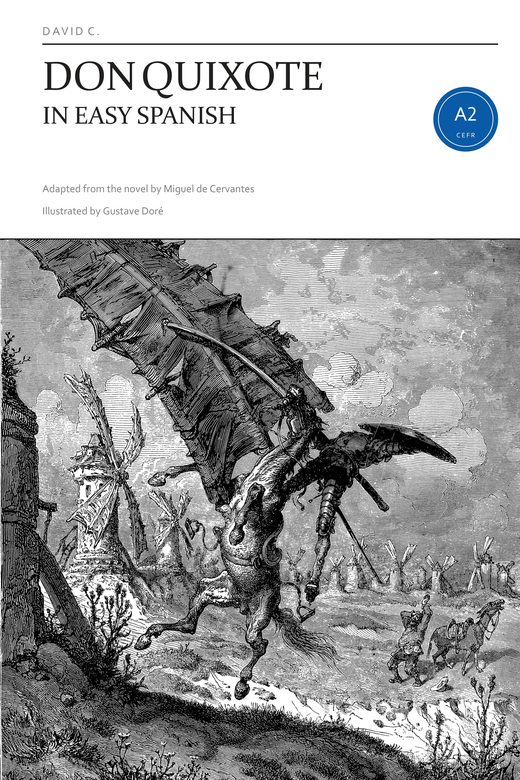
Don Quixote in Easy Spanish: the whole novel retold in Spanish you can actually read, in 58 short episodes, with the hard words glossed in the margin. It is where every Don Quixote sentence on this page comes from.
In EPUB and PDF, with a second novel in the same Spanish. See the books.
Where the course teaches this
2 lessons build it up, each one inside a chapter of the story rather than in the abstract. Free to read, with the vocabulary, the audio and the exercises.
- The simple conditionalLesson 33The dead body and the Knight of the Sorrowful Face
- Will have happened and would have happenedLesson 77The Flight of Clavileño
Next to this one
The points that sit closest to this one, and that a student usually meets around the same time.