Spanish grammar · A2 to B2 · Updated
The Spanish future tense
One set of endings for all three conjugations, stuck on the whole infinitive: hablaré, comeré, viviré. About a dozen verbs shorten the stem and they are best learned as a block. In speech, though, ir a plus an infinitive does most of the work, and the real future often means a guess rather than a plan.
The short answer
The Spanish future adds one set of endings to the whole infinitive, the same for all three families: hablaré, comeré, viviré. Twelve verbs change the stem and keep the endings. In everyday speech, though, most future is said with voy a, and the -é future often means a guess rather than a plan.
How to remember it
Endings on the whole infinitive, not on a stem
| One set | -é, -ás, -á, -emos, -éis, -án, for -ar, -er and -ir alike | hablaré |
|---|---|---|
| On the infinitive | nothing is dropped, the ending is glued on the end | comer + é |
| Twelve stems change | tendré, pondré, saldré, vendré, haré, diré and their family | tendré |
| Every form has an accent | except nosotros | hablaremos |
| Guessing | the same tense says "it must be" about right now | Serán las tres |
The forms
The future endings, and the twelve odd stems
| regular | stem changes | |
|---|---|---|
| yo | hablaré | tendré, pondré, saldré |
| tú | hablarás | vendrás, harás, dirás |
| él, ella, usted | hablará | podrá, sabrá, querrá |
| nosotros | hablaremos | habremos, cabremos |
| vosotros | hablaréis | valdréis |
| ellos, ustedes | hablarán | tendrán, harán, dirán |
20 sentences that show the difference
Everyday Spanish, the kind you would actually say. The label under each one says which part of the rule it shows.
Mañana hablaré con él.
I will talk to him tomorrow.
A plan
El tren llegará a las ocho.
The train will arrive at eight.
A timetable
Comeremos en casa.
We will eat at home.
Regular -er
Viviré aquí un año.
I will live here for a year.
Regular -ir
Tendré que pensarlo.
I will have to think about it.
Stem change
Lo haré mañana.
I will do it tomorrow.
Stem change
Te lo diré luego.
I will tell you later.
Stem change
No podré ir.
I will not be able to go.
Stem change
Saldremos temprano.
We will leave early.
Stem change
Vendrán el domingo.
They will come on Sunday.
Stem change
Voy a llamarte esta tarde.
I am going to call you this afternoon.
The everyday future
Mañana te llamo.
I will call you tomorrow.
Present used as future
Serán las tres.
It must be about three.
A guess about now
Estará en casa.
He is probably at home.
A guess about now
Tendrá unos cuarenta años.
He must be about forty.
A guess about now
¿Dónde estarán las llaves?
Where can the keys be?
Wondering aloud
Ya verás.
You will see.
A warning
No matarás.
Thou shalt not kill.
A solemn order
Cuando llegue, te aviso.
When he arrives, I will let you know.
Cuando takes the subjunctive
Habrá mucha gente.
There will be a lot of people.
Hay in the future
Where English gets in the way
English builds its future with a helper: will go, shall see, two words every time. Spanish builds it inside the verb, and the whole tense fits in one word: iré, verás, empezará. So resist the temptation to hunt for a translation of will. There is not one, and any word you invent for it will be wrong. The deeper difference is the guessing future. Where English reaches for must be or probably, Spanish reaches for the future tense itself, and a sentence like estarán en la venta is about the present, not about tomorrow.
The mistake to avoid
Three, and the first two are visible from the other side of the room. First, translating will: ✗ Yo quiero ver mañana for I will see tomorrow → ✓ Yo veré mañana. Spanish has no separate word for it. Second, chopping the infinitive: ✗ hablé for I will speak, which is the preterite and means I spoke → ✓ hablaré, the whole infinitive plus the ending. Third, and this one costs marks forever, the missing accent: ✗ la batalla empezara → ✓ la batalla empezará. Every future form except nosotros needs its tilde.
The cases that break the rule
Voy a comer
What Spanish actually says most of the time. Voy a plus infinitive covers nearly all near future, and the -é future sounds more distant, more formal or more like a promise.
Serán las tres
Not the future at all: it is a guess about right now. Spanish has no "must be" the way English does, so it uses the future tense instead. This is very common and rarely taught early.
Cuando llegue
Spanish will not put a future after cuando. It takes the present subjunctive: cuando llegue, te aviso. English says "when he arrives", which hides the problem.
Si tengo tiempo
Nor after si. Si tendré tiempo does not exist. Si takes the present, and the future goes in the other half: si tengo tiempo, iré.
Habrá
Hay has one future form for both numbers: habrá una silla and habrá muchas sillas. Habrán with a plural noun is a mistake even native speakers make.
Mañana te llamo
The plain present used for the future, and it is the commonest of the three. It sounds settled, like something already arranged.
Spanish future tense exercises
8 sentences to fill in. Type your answer and check it, or read them straight through with the answers showing. Accents count here, the way they count in the language.
-
Mañana (hablar, yo) ___ con el jefe.
Tomorrow I will speak to the boss.
hablaré · The ending goes on the whole infinitive: hablar plus é. Nothing is dropped.
-
El tren (llegar) ___ a las ocho en punto.
The train will arrive at eight sharp.
llegará · A timetable, which is where the -é future is most at home.
-
(Tener, yo) ___ que pensarlo con calma.
I will have to think it over calmly.
Tendré · Tener changes the stem to tendr-. The endings are the regular ones.
-
No (poder, nosotros) ___ ir a la fiesta.
We will not be able to go to the party.
podremos · Poder gives podr-. And notice nosotros is the one form with no accent.
-
Te lo (decir, yo) ___ cuando lo sepa.
I will tell you when I know.
diré · Decir gives dir-. And cuando lo sepa is subjunctive, because Spanish will not put a future there.
-
(Ser) ___ las tres, más o menos.
It must be about three.
Serán · Not the future at all: a guess about right now. Spanish uses this tense where English says "must be".
-
Si tengo tiempo, (ir, yo) ___ a verte.
If I have time, I will come and see you.
iré · The future goes in the other half. Si tendré tiempo does not exist.
-
En la fiesta (haber) ___ mucha gente.
There will be a lot of people at the party.
habrá · Habrá never goes plural, however many people there are.
More exercises, from Don Quixote
8 more, these ones straight out of the course: the inn, the windmills, Rocinante and the road. Same rule, older Spanish.
-
Mañana (salir, nosotros) ___ al campo.
Tomorrow we will ride out into the country.
saldremos · Salir is one of the twelve irregulars: the stem is saldr, and the endings are the same for every verb.
-
Don Quijote (ser) ___ famoso en todo el mundo.
Don Quixote will be famous all over the world.
será · Regular: the whole infinitive plus the ending. Ser is irregular in almost everything else but not here.
-
(Tener, yo) ___ una ínsula algún día.
I will have an island one day.
Tendré · Tener drops the e and takes a d: tendr. The same happens to poner, venir, salir and valer.
-
¿Dónde (estar) ___ Sancho ahora?
Where can Sancho be now?
estará · The future used for guessing about the present. This is the commonest use of all, and no grammar book leads with it.
-
(Hacer) ___ frío esta noche.
It will be cold tonight.
Hará · Hacer loses the ce: har. Decir does the same and gives dir.
-
Vosotros (venir) ___ conmigo.
You will come with me.
vendréis · Venir behaves like tener: vendr. The vosotros ending is eis, with the accent.
-
(Haber) ___ una batalla mañana.
There will be a battle tomorrow.
Habrá · Habrá is the future of hay, and like hay it stays singular even with a plural: habrá gigantes.
-
Yo (decir) ___ siempre la verdad.
I will always tell the truth.
diré · Decir gives dir, one of the shortest stems in the language.
Common questions
How do I form the Spanish future?
Add -é, -ás, -á, -emos, -éis, -án to the full infinitive: hablaré, comeré, viviré. The endings never change between the three families, which makes this the easiest tense in the language to build.
Which verbs are irregular in the future?
About a dozen, and only in the stem: tener gives tendr-, poner pondr-, salir saldr-, venir vendr-, poder podr-, saber sabr-, haber habr-, querer querr-, hacer har-, decir dir-. The endings stay exactly the same.
When do Spaniards use ir a instead?
For anything planned or close: voy a llamarla esta tarde. The plain future leans towards prediction, promise and guesswork, which is why ¿dónde estará? means "where can he be" rather than "where will he be".
What is the future of probability?
The future tense used for a guess about right now, not about later: ¿dónde estará? means where can he be. Serán las tres means it must be about three. English does this with must or probably, Spanish does it with the future, and it is very common in speech.
Which is more common, iré or voy a ir?
Voy a ir, in ordinary conversation, especially for anything close or already decided. The plain future sounds more formal and is what you meet in writing, in promises and in predictions. Neither is wrong and Spaniards use both in the same conversation.
How do I form the future perfect?
Haber in the future plus the participle: habré hablado, habrás comido. It says something will already be done by a point ahead: para las seis habré terminado. It also does guesses about the recent past: habrá salido ya, he must have left.
Do the future endings change with -ar, -er and -ir?
No, and that is the one easy thing about this tense. All three families take the same endings, and the endings go on the whole infinitive rather than on a stem: hablaré, comeré, viviré. Only the twelve irregular verbs change what the endings attach to.
Does cuando take the future in Spanish?
No. Where English says when I arrive I will call you, Spanish puts the subjunctive after cuando and keeps the future for the other half: cuando llegue, te llamaré. Putting the future after cuando is one of the mistakes English speakers make most often.
The things to remember
- One set of endings for all three families, glued to the whole infinitive.
- Every form carries an accent except nosotros.
- Twelve verbs change the stem: tendré, pondré, saldré, vendré, haré, diré, podré, sabré, querré, habré, cabré, valdré.
- In speech, voy a and the plain present do most of the work.
- The same tense guesses about the present: serán las tres means it must be about three.
The same rule in Don Quixote
Real lines from the course, not invented examples. Each one is the sentence the lesson uses to introduce the point.
Hoy verás cosas que nadie cree.
Today you will see things nobody believes.
A estas alturas ya se habrán perdido de vista.
By now they will already have vanished from sight.
The book this comes from
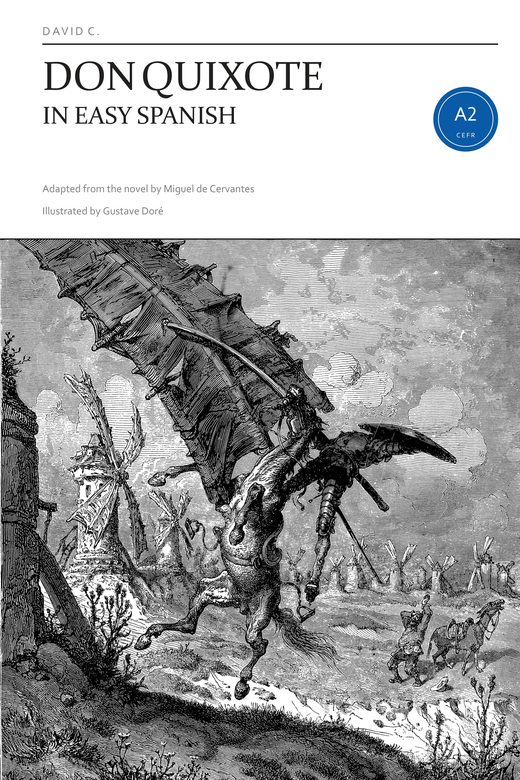
Don Quixote in Easy Spanish: the whole novel retold in Spanish you can actually read, in 58 short episodes, with the hard words glossed in the margin. It is where every Don Quixote sentence on this page comes from.
In EPUB and PDF, with a second novel in the same Spanish. See the books.
Where the course teaches this
2 lessons build it up, each one inside a chapter of the story rather than in the abstract. Free to read, with the vocabulary, the audio and the exercises.
- The simple futureLesson 32The two armies of sheep
- Will have happened and would have happenedLesson 77The Flight of Clavileño
Next to this one
The points that sit closest to this one, and that a student usually meets around the same time.