Level A2 · Chapter 33
The dead body and the Knight of the Sorrowful Face
Twenty lights come down the road at night. Don Quixote decides that a dead knight is asking for revenge, and charges. His name comes out of that night.
What you will learn
- Say what you would do in an imagined situation.
- Form the conditional of regular verbs and of the ten irregular ones.
- Give advice or an opinion politely.
Before you read
Nothing in this lesson is being reported. Don Quixote is talking about a world that does not exist yet: what he would do, what a real knight ought to do, what would become of these men. Spanish has one tense for all of that, and you already know most of it. Watch for verbs ending in -ía, -ías, -íamos and -ían. Every single one carries an accent on the i.The story in easy Spanish
Era de noche y el camino estaba oscuro y vacío.
It was night, and the road was dark and empty.
Sancho tenía hambre. Pensaba que pronto encontraría una venta.
Sancho was hungry. He thought he would soon find an inn.
De pronto vieron muchas luces que venían por el mismo camino.
Suddenly they saw a great many lights coming along that same road.
Parecían estrellas que se movían despacio hacia ellos.
They looked like stars moving slowly towards them.
Sancho empezó a temblar. Don Quijote se puso muy serio.
Sancho began to shake. Don Quixote turned very solemn.
«Esta sería una aventura grande, Sancho. Aquí yo mostraría todo mi valor.»
"This would be a great adventure, Sancho. Here I would show all my courage."
Eran veinte hombres a caballo, vestidos de blanco, con antorchas encendidas.
They were twenty men on horseback, dressed in white, carrying lit torches.
Detrás iba una litera cubierta de luto con un cuerpo muerto.
Behind them came a litter draped in black, carrying a dead body.
Los hombres rezaban en voz baja y no miraban a nadie.
The men were praying under their breath and looking at nobody.
Don Quijote pensó que aquel caballero muerto pedía venganza.
Don Quixote decided that the dead knight was asking for revenge.
«Un caballero verdadero no pasaría de largo. Yo vengaría esta muerte.»
"A true knight would not ride past. I would avenge this death."
Puso su lanza delante y les preguntó quiénes eran.
He levelled his lance and asked them who they were.
Ellos contestaron que tenían prisa y siguieron su camino.
They answered that they were in a hurry, and rode on.
El caballero se enfadó y atacó a todo el grupo.
The knight lost his temper and charged the whole party.
Los encamisados no llevaban armas y huyeron por el campo.
The men in white carried no weapons, and fled across the field.
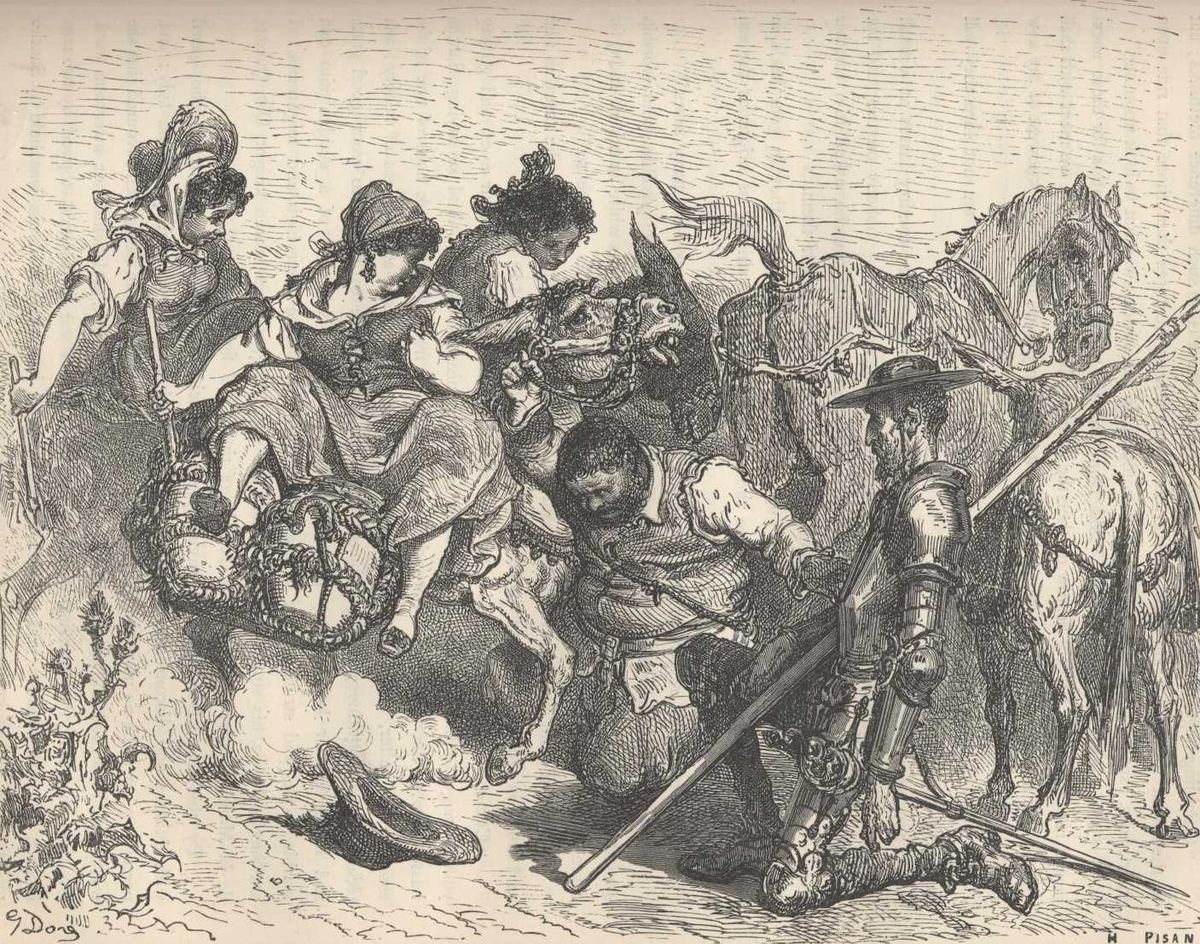
Uno cayó al suelo con una pierna rota debajo de su mula.
One of them fell with a broken leg under his mule.
Era un bachiller que llevaba aquel cuerpo muerto a Segovia.
He was a graduate taking that dead body to Segovia.
«Yo no os mataría», dijo don Quijote. «Solo quería saber la verdad.»
"I would not kill you," said Don Quixote. "I only wanted to know the truth."
Sancho, mientras tanto, llenaba su costal con la comida del grupo.
Sancho, meanwhile, was filling his sack with the party’s food.
Después miró la cara de su amo a la luz de una antorcha.
Then he looked at his master’s face by the light of a torch.
«Sin dientes y con esa cara, nadie os llamaría otra cosa.»
"With no teeth and a face like that, nobody would call you anything else."
«Desde hoy sois el Caballero de la Triste Figura.»
"From today you are the Knight of the Sorrowful Face."
Vocabulary
The night procession
- el encamisado
- the man in white
- la antorcha
- the torch
- la litera
- the litter
- el luto
- mourning
- el entierro
- the burial
- el sacerdote
- the priest
- rezar
- to pray
Fear
- el fantasma
- the ghost
- temblar
- to tremble
- la oscuridad
- the darkness
- huir
- to flee
- rendirse
- to surrender
- la venganza
- the revenge
Supposing and advising
- yo que tú
- if I were you
- en tu lugar
- in your place
- sería mejor
- it would be better
- me gustaría
- I would like
- deberías
- you should
- podrías
- you could
The simple conditional
Aquí yo mostraría todo mi valor.
Un caballero verdadero no pasaría de largo.
Nadie os llamaría otra cosa.
You learned the future last lesson, and you have just learned most of this tense without noticing. The recipe is identical. Take the infinitive whole, with its -ar, -er or -ir still on it, and add one set of endings. The endings this time are the ones you already know from the imperfect of -er and -ir verbs.
| ending | hablar | comer | vivir | |
|---|---|---|---|---|
| yo | -ía | hablaría | comería | viviría |
| tú | -ías | hablarías | comerías | vivirías |
| él, ella, usted | -ía | hablaría | comería | viviría |
| nosotros | -íamos | hablaríamos | comeríamos | viviríamos |
| vosotros | -íais | hablaríais | comeríais | viviríais |
| ellos, ellas, ustedes | -ían | hablarían | comerían | vivirían |
Two things to fix in your head straight away. Every form carries an accent on the i, with no exceptions, because that i has to be pronounced as its own syllable. And the yo form and the él form are identical, so when it is not obvious who you mean, say the pronoun.
The irregulars are already paid for
There is no new list. The ten verbs that change their stem in the future change it in exactly the same way here, and nothing else changes:
| infinitive | future | conditional |
|---|---|---|
| tener, poner, venir, salir | tendré, pondré, vendré, saldré | tendría, pondría, vendría, saldría |
| poder, saber, haber, querer | podré, sabré, habrá, querré | podría, sabría, habría, querría |
| hacer, decir | haré, diré | haría, diría |
What the tense is actually for
Three jobs, and the first is the one Don Quixote is doing all night.
1. The imagined world. Yo mostraría todo mi valor, un caballero verdadero no pasaría de largo, nadie os llamaría otra cosa. None of this is happening. The tense is what tells you so.
2. Politeness. This is the job you will use ten times a day in Spain. Quiero un café is blunt. Querría un café is what a person actually says at a bar. Me gustaría, podrías, deberías and sería mejor all soften a request or an opinion into something civil.
| blunt | civil |
|---|---|
| Quiero hablar con usted. | Querría hablar con usted. |
| Puedes ayudarme. | ¿Podrías ayudarme? |
| Tienes que descansar. | Deberías descansar. |
3. The future seen from the past. Sancho, riding along, pensaba que encontraría una venta. At the moment he thought it, the inn was still ahead of him. English does the same trick with would: he thought he would find an inn. If the sentence starts in the past and looks forward, Spanish uses the conditional, never the future.
And a fourth, borrowed from the future
Just as the future can guess about the present, the conditional can guess about the past. Serían las tres de la mañana means it must have been about three in the morning. You will hear this constantly, and it costs you nothing to recognise.
Night burials and the moving of bones
Everything Don Quixote sees is real, and none of it is unusual. A man of standing was buried in his own town, in his family chapel, among his own dead. If he died somewhere else, his body was depositado, laid in temporary ground, and months later his bones were dug up and carried home. That is exactly what these twelve priests are doing with a knight who died of fever in Baeza and belonged in Segovia.
They travel at night for the obvious reason. Castile in summer is unbearable at midday, the roads are empty after dark, and torches are cheap. The white surplices over black cassocks, the covered litter, the low muttered prayers, the twenty flames moving slowly along a road: this was a common sight, and it was also, to anyone who met it without warning, genuinely frightening. Cervantes gives Sancho the reaction of a normal person, which is to shake, and Don Quixote the reaction of a reader, which is to recognise a scene from a book.
The consequence is serious and Cervantes plays it for laughs. Laying violent hands on a cleric brought automatic excommunication under canon law. The scholar quotes the Latin formula at him, Don Quixote replies that he did not use his hands but his lance, and rides off entirely satisfied with the distinction. The joke is precise, legal and, in 1605, quite daring.
One more thing worth noticing. While his master is fighting phantoms for the honour of a dead stranger, Sancho is quietly emptying the mule that carried the funeral party’s supper. Both men get exactly what they came for.
Cervantes in the original · «creyendo Sancho que, pues aquel camino era real…»
creyendo Sancho que, pues aquel camino era real, a una o dos leguas, de buena razón, hallaría en él alguna venta
Sancho believing that, since that road was a royal one, within a league or two he would reasonably find some inn on it
One word does all the work here, and it is the word of this lesson. Hallaría is the future seen from inside the past: at the moment Sancho was thinking it, the inn was still ahead of him. English builds the same idea with would find, Spanish builds it inside the verb, and the tense quietly warns you that the inn is a belief rather than a fact. It is not there. What arrives instead is twenty torches and a corpse. Two period details: a camino real was a royal highway, maintained and reasonably safe, which is why Sancho expects inns along it, and a legua is roughly five kilometres, about an hour on a donkey.