Level B1 · Chapter 61
Looking for Dulcinea’s Palace
Master and squire walk into El Toboso at night looking for a palace that does not exist. The only large thing they find is the church.
What you will learn
- Talk about a person or a thing when you do not yet know which one.
- Use lo que sea, quien sea, el que sea and donde sea.
- Say that there is nothing and nobody that fits what you are after.
Before you read
Sancho spends the whole lesson hunting for something that is not there, and Spanish has a special way of talking about that. Watch every phrase of the shape el edificio que…, lo que…, cualquiera que… and notice which of them put the verb in the subjunctive. The difference is not about the verb at all. It is about whether the speaker already knows which thing he is talking about.The story in easy Spanish
Don Quijote y Sancho llegaron a El Toboso pasada la medianoche.
Don Quixote and Sancho reached El Toboso after midnight.
El pueblo dormía y no se oía más que algún perro y un burro lejano.
The village was asleep and nothing was heard but a dog or two and a distant donkey.
«Guíame, Sancho», dijo el caballero en voz baja delante de las primeras casas.
"Lead the way, Sancho," said the knight quietly in front of the first houses.
«Llévame al palacio de Dulcinea, que tú ya has estado dentro».
"Take me to Dulcinea’s palace, since you have already been inside."
Sancho tragó saliva, porque nunca había estado en ninguna casa de aquel pueblo.
Sancho swallowed hard, because he had never been in any house in that village.
«Señor, yo la vi de día», contestó, «y de noche todo cambia mucho».
"Sir, I saw her by daylight," he answered, "and at night everything looks very different."
«Cualquiera que busque un palacio a estas horas encuentra lo primero que aparezca».
"Anyone hunting for a palace at this hour finds the first thing that turns up."
Dieron vueltas por calles estrechas que se parecían todas unas a otras.
They wandered through narrow streets that all looked like one another.
Don Quijote decía que buscaran el edificio que fuera más alto de todos.
Don Quixote kept saying they should look for whichever building was tallest.
Explicó que las princesas viven siempre en lo alto, donde se ve el campo.
He explained that princesses always live high up, where you can see the countryside.
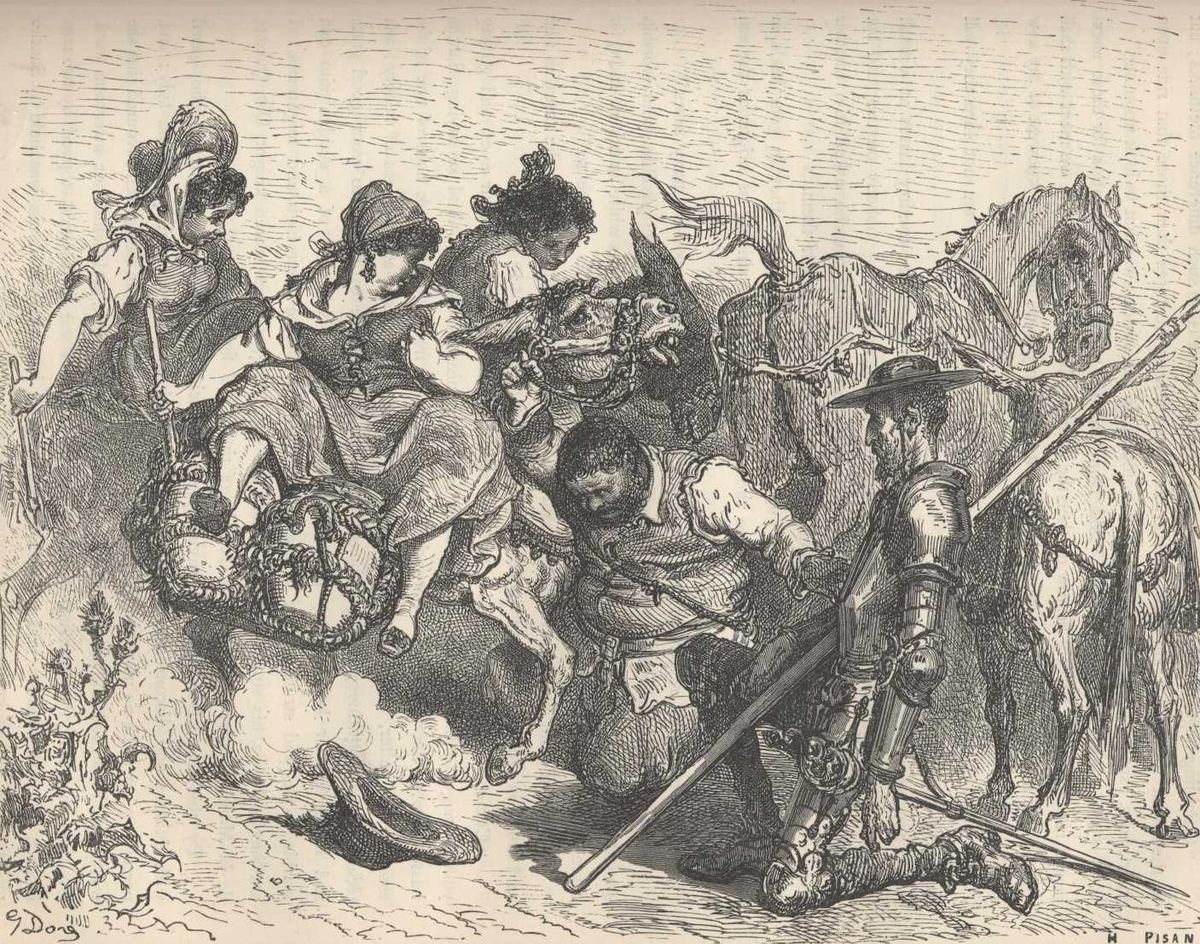
De pronto tropezaron con un bulto grande y oscuro que ocupaba media calle.
Suddenly they bumped into a large dark shape that filled half the street.
Era la iglesia del pueblo, con su torre y su puerta cerrada.
It was the village church, with its tower and its shut door.
«Con la iglesia hemos dado, Sancho», dijo el caballero muy despacio.
"We have run into the church, Sancho," said the knight very slowly.
Sancho contestó que ojalá no dieran también con su propia sepultura.
Sancho answered that he hoped they would not run into their own grave as well.
Añadió que andar de noche por los cementerios no es buena señal para nadie.
He added that walking around graveyards at night is a good sign for nobody.
Después propuso salir del pueblo y esperar escondidos entre los árboles.
Then he suggested leaving the village and waiting hidden among the trees.
Que su amo se quedara allí y que él fuera solo a buscar a la señora.
His master could stay there while he went alone to find the lady.
«Ve tú», aceptó don Quijote, «y dile lo que sea necesario decirle».
"You go," Don Quixote agreed, "and tell her whatever needs telling her."
«Habla con quien te abra la puerta, pero no vuelvas sin respuesta».
"Speak to whoever opens the door, but do not come back without an answer."
Se quedó esperando en un bosquecillo, con la lanza apoyada en un tronco.
He stayed waiting in a small wood, his lance leaning against a trunk.
Sancho se sentó debajo de un árbol y empezó a pensar despacio.
Sancho sat down under a tree and began to think slowly.
Tenía que traerle a su amo una Dulcinea, la que fuera, antes del mediodía.
He had to bring his master a Dulcinea, any Dulcinea at all, before midday.
No había ninguna en tres leguas a la redonda, y él lo sabía muy bien.
There was not one within nine miles in any direction, and he knew it perfectly well.
Cualquier cosa que dijera al volver iba a tener que sostenerla después.
Whatever he said when he came back, he was going to have to keep it up afterwards.
Miró el cielo, que empezaba a aclararse por el lado de la sierra.
He looked at the sky, which was beginning to grow light over towards the hills.
Le quedaban pocas horas para inventar algo que su amo se creyera.
He had few hours left to invent something his master would believe.
Vocabulary
The village at night
- la calle estrecha
- the narrow street
- la torre
- the tower
- el bulto
- the dark shape
- el cementerio
- the graveyard
- la sepultura
- the grave
- el bosquecillo
- the small wood
- el tronco
- the trunk
- la medianoche
- midnight
Searching without knowing what for
- guiar
- to lead the way
- dar vueltas
- to go round in circles
- tropezar con
- to bump into
- esconderse
- to hide
- a la redonda
- in any direction
- la señal
- the sign
- sostener
- to keep something up
- inventar
- to make up
Anyone, whoever
- cualquiera
- anyone at all
- cualquier cosa
- anything at all
- lo que sea
- whatever
- quien sea
- whoever
- el que sea
- whichever one
- donde sea
- wherever
- como sea
- however, at all costs
- cuando sea
- whenever
El que sea: relative clauses in the subjunctive
Busca el edificio que sea más alto.
Dile lo que sea necesario decirle.
Tropezaron con un bulto que ocupaba media calle.
A relative clause is the piece that follows que and describes a noun: la casa que tiene torre. In Spanish the verb inside that piece answers one question, and it is not a question about time.
1. Known or unknown
If the speaker has a particular thing in mind, indicative. If the thing is still a description of something that may or may not exist, subjunctive.
| a particular one: indicative | any one that fits: subjunctive |
|---|---|
| Busco la casa que tiene torre. | Busco una casa que tenga torre. |
| I am looking for the house with the tower. | I am looking for a house with a tower. |
| Habla con el hombre que abrió. | Habla con quien te abra. |
| Talk to the man who opened up. | Talk to whoever opens the door. |
The article gives a strong clue. El and la point at a known one and usually bring the indicative. Un and una often introduce a description rather than a thing, and then the subjunctive follows.
2. When the thing does not exist at all
Denials are the easy half of this rule. If you have just said the thing does not exist, there is nothing to point at and the subjunctive is compulsory.
| Spanish | English |
|---|---|
| No hay nadie que la conozca. | There is nobody who knows her. |
| No había ninguna que sirviera. | There was not one that would do. |
| No conozco a nadie que viva allí. | I know nobody who lives there. |
3. The short formulas everybody uses
Out of this pattern Spanish has built a small set of fixed phrases that mean it does not matter which. They are extremely common in speech.
| Spanish | English | example |
|---|---|---|
| lo que sea | whatever | Dile lo que sea necesario. |
| quien sea | whoever | Habla con quien sea. |
| el que sea | whichever one | Tráeme una, la que sea. |
| donde sea | anywhere | Dormiremos donde sea. |
| como sea | at all costs | Hay que hacerlo como sea. |
| cuando sea | any time | Ven cuando sea. |
Alongside them sits cualquiera, which does the same job as a single word. Before a noun it shortens to cualquier: cualquier cosa, cualquier hombre. And cualquiera que always takes the subjunctive: cualquiera que busque un palacio a estas horas.
We have run into the church
This is probably the most misquoted sentence in Spanish literature. It circulates as con la iglesia hemos topado, and it is used to mean that somebody has come up against the power of the Church and had better back down. Neither the wording nor the meaning is Cervantes.
The text says dado, from dar con, to come across or run into something. And the scene is entirely physical. Two men are stumbling around an unlit village at one in the morning looking for a castle that exists only in one of their heads. They walk into a large dark mass, and it turns out to be the parish church. The knight, who has just been told that princesses live in tall buildings, says the flattest possible sentence: we have hit the church. Sancho, who is terrified and improvising, replies that he hopes they do not hit their own grave next.
El Toboso is a real village, twenty miles from where Cervantes places Don Quixote’s home, and its church is still the tallest thing in it. Choosing it was a joke about scale: the whole apparatus of chivalric romance, with its palaces and its enchanted ladies, is being asked to fit inside a place with about a thousand inhabitants and one large building. The dark, the dogs, the braying and the narrow streets are all doing the same work. This is what La Mancha actually looks like at night, and it is where a knight errant has to operate.
Cervantes in the original · «Con la iglesia hemos dado, Sancho»
Con la iglesia hemos dado, Sancho
We have run into the church, Sancho
From II, 9, and almost certainly the most misquoted line in Spanish. It travels as con la iglesia hemos topado, and it is used to mean that somebody has come up against the institutional power of the Church and should give up. Cervantes wrote dado, from dar con, meaning to come across or bump into, and there is no institution anywhere in the scene. Two men are groping around an unlit village after midnight looking for a palace that does not exist, and they walk into the largest building in El Toboso, which is the parish church. The comedy is in the flatness of the observation: Don Quixote, who a minute earlier was explaining that princesses live in tall buildings, states the fact without drawing any conclusion from it. Sancho’s reply keeps the tone exactly right by worrying about graves rather than about theology. Whether the modern misreading is worth resisting is a fair question, since a phrase belongs to whoever uses it, but knowing what is actually on the page changes the scene from a political proverb into one of the best pieces of night comedy in the book.