C1 · Part Two, Chapter 10
¡Jo, que te estrego! The peasant girl answers back
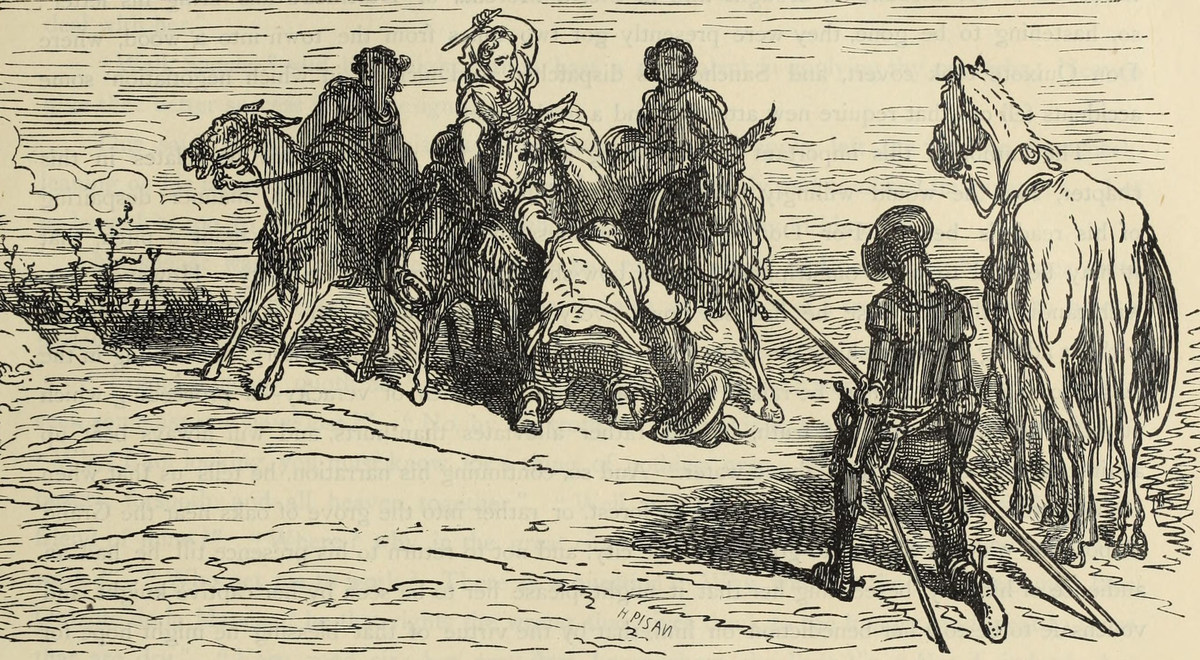
Sancho has told his master that a peasant girl on a donkey is Dulcinea, and he kneels in the road to address her in the language of romance. She answers in the language of the village. Few passages put the two registers so close together, and the girl's reply is full of rural forms that were already comic in 1615.
The passage, exactly as Cervantes wrote it
Miguel de Cervantes, Part Two, Chapter 10. Unadapted.
Apártense nora en tal del camino, y déjenmos pasar, que vamos de priesa. A lo que respondió Sancho: — ¡Oh princesa y señora universal del Toboso! ¿Cómo vuestro magnánimo corazón no se enternece viendo arrodillado ante vuestra sublimada presencia a la coluna y sustento de la andante caballería? Oyendo lo cual, otra de las dos dijo: — Mas, ¡jo, que te estrego, burra de mi suegro! ¡Mirad con qué se vienen los señoritos ahora a hacer burla de las aldeanas, como si aquí no supiésemos echar pullas como ellos! Vayan su camino, e déjenmos hacer el nueso, y serles ha sano.
Get out of the road, curse you, and let us by, for we are in a hurry. To which Sancho replied: O princess and universal lady of El Toboso! How is it that your magnanimous heart is not softened to see, kneeling before your sublime presence, the pillar and prop of knight errantry? Hearing this, another of the two said: Whoa there, let me rub you down, my father in law's donkey! Look at the young gentlemen coming now to make fun of village girls, as if we did not know how to trade insults as well as they do! Go on your way and let us go on ours, and it will be the better for you.
The same thing in Spanish as it is written today
Read the two side by side. What has changed between them is the syllabus of this level.
Apártense del camino, maldita sea, y déjennos pasar, que tenemos prisa. A lo que respondió Sancho: ¡Oh princesa y señora universal del Toboso! ¿Cómo no se enternece vuestro magnánimo corazón viendo arrodillado ante vuestra sublime presencia a la columna y el sostén de la caballería andante? Al oír esto, otra de las dos dijo: ¡So, que te cepillo, burra de mi suegro! ¡Mirad con qué vienen ahora los señoritos a burlarse de las aldeanas, como si aquí no supiéramos lanzar pullas como ellos! Sigan su camino, déjennos seguir el nuestro, y les irá mejor.
What changed, form by form
| In the text | Today | Why it matters |
|---|---|---|
| nora en tal | maldita sea | A softened curse, from en hora mala with the bad word swapped out. |
| déjenmos | déjennos | A rural form of déjennos, with the n turned into m. |
| de priesa | de prisa | The older vowel. Priesa is everywhere in the book. |
| sublimada | sublime | A learned participle where the plain adjective would do. Sancho is reaching. |
| coluna | columna | The consonant group simplified, as people pronounced it. |
| ¡jo! | ¡so! | The word to stop a donkey. She is talking to her mount, not to Sancho. |
| que te estrego | que te cepillo | Estregar, to rub down an animal. A calming phrase for the beast. |
| echar pullas | lanzar pullas | Pullas are jibes. The word is alive, and so is the habit. |
| e déjenmos | y déjennos | E for y, the old conjunction, kept in village speech. |
| el nueso | el nuestro | A rural form of nuestro. In literature it still marks a speaker as a peasant. |
| serles ha sano | les irá mejor | The future split in two, infinitive plus ha, with the pronoun in between. The origin of the Spanish future, fossilised in the countryside. |
The syntax
Sancho's sentence is a rhetorical question with the object moved to the very end, viendo arrodillado ante vuestra sublimada presencia a la coluna, so the grand title arrives last, as it does in the books. The girl's reply is made of commands and exclamations with no subordination at all, and the most interesting form comes last: serles ha sano, a future tense still in pieces, infinitive plus pronoun plus ha. That is how the Spanish future was formed in the first place, and here a farm girl uses it as a threat.
What a Spanish reader hears
The scene is Sancho's revenge. Don Quixote sent him to find Dulcinea's palace, which does not exist, so Sancho picks the first peasant girl who comes along and swears she is the princess, knowing that his master will blame enchanters for whatever he sees. Then Sancho himself performs the courtly speech, and does it well. So for once the roles are reversed: the squire speaks the language of chivalry, and the lady answers like Sancho. Don Quixote concludes that Dulcinea has been enchanted into a peasant, and that idea drives the whole of the second part.
Where the course prepares you for this
- Lo bueno, lo peor, lo queLesson 62Three peasant girls on the road