Level B2 · Chapter 90
The End of the Story
The whole novel on one page, from the village in La Mancha to the pen hanging on a wire. And with it the course closes.
What you will learn
- Tell a long story from end to end, with its tenses and connectors, without losing the thread.
- Spot the B2 points at a glance inside a running text.
- Know what I can already do in Spanish and what is left to do without this course.
Before you read
This last text has no new grammar in it. Everything it uses you have already met, and it is written to prove that to you. Read it once straight through, without stopping, and then go back and see how much of it you could have written yourself. That gap, whatever size it turns out to be, is the honest measure of where you are.The story in easy Spanish
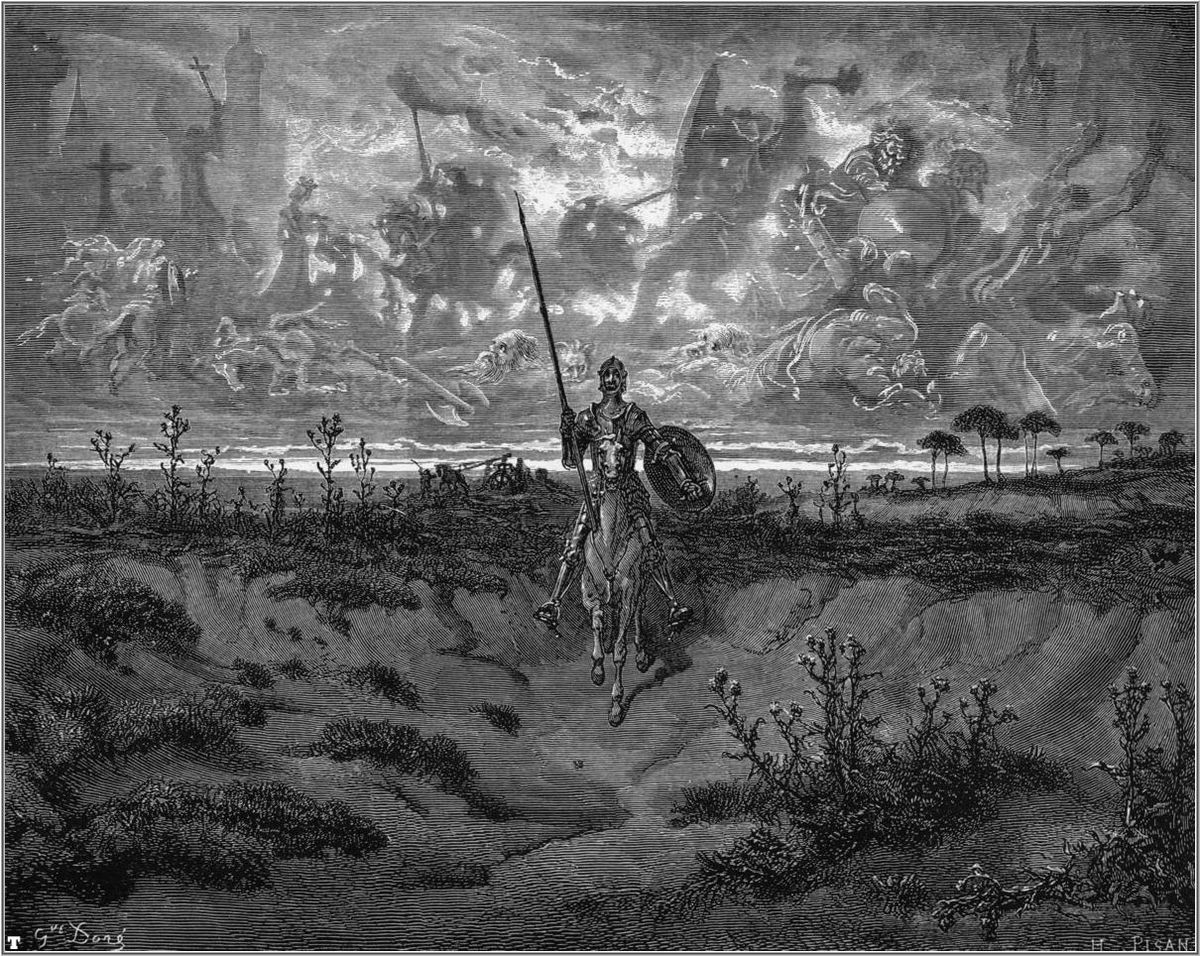
Todo empezó en un lugar de la Mancha cuyo nombre el autor no quiso recordar.
It all began in a village of La Mancha whose name the author chose not to recall.
Vivía allí un hidalgo de unos cincuenta años, flaco, madrugador y aficionado a la caza.
There lived a gentleman of about fifty, thin, an early riser and fond of hunting.
Tenía una casa, una sobrina, un ama, un mozo de campo y unos pocos libros.
He had a house, a niece, a housekeeper, a farm lad and a few books.
De tanto leerlos y de dormir tan poco, acabó por secársele el cerebro.
From reading them so much and sleeping so little, his brain ended up drying out.
Se armó con las armas oxidadas que habían sido de sus bisabuelos.
He armed himself with the rusty armour that had belonged to his great-grandparents.
Puso nombre a su caballo, se puso otro a sí mismo y eligió dama en un pueblo vecino.
He named his horse, gave himself another name and chose a lady in a neighbouring village.
Salió al campo antes de amanecer, a deshacer agravios y a enderezar entuertos.
He rode out into the fields before dawn, to right wrongs and set crooked things straight.
Confundió ventas con castillos y molinos de viento con gigantes de brazos larguísimos.
He took inns for castles and windmills for giants with enormously long arms.
Confundió rebaños con ejércitos y una bacía de barbero con el yelmo de Mambrino.
He took flocks for armies and a barber’s basin for the helmet of Mambrino.
En la segunda salida se llevó consigo a un labrador de su pueblo, Sancho Panza.
On his second sally he took with him a farmhand from his village, Sancho Panza.
Le prometió una ínsula, y Sancho lo siguió por eso y también por curiosidad.
He promised him an island, and Sancho followed him for that and out of curiosity too.
Desde entonces la novela son dos hombres hablando por los caminos de Castilla.
From then on the novel is two men talking along the roads of Castile.
Uno de ellos ve lo que ha leído y el otro ve lo que tiene delante.
One of them sees what he has read and the other sees what is in front of him.
Ninguno de los dos convence del todo al otro en mil páginas de conversación.
Neither of them ever quite convinces the other in a thousand pages of talk.
Entre una venta y la siguiente cabía media España de aquel siglo.
Between one inn and the next there was room for half the Spain of that century.
Cabían cabreros, galeotes, curas, barberos, moriscos, duques, bandoleros y una imprenta.
There was room for goatherds, galley slaves, priests, barbers, Moriscos, dukes, bandits and a printing house.
Y cabía además un truco que no había hecho nadie antes que Cervantes.
And there was room for a trick that nobody had pulled before Cervantes.
En la segunda parte, los que se cruzan con don Quijote han leído ya la primera.
In the second part, the people who meet Don Quixote have already read the first.
Saben quién es antes de verlo y le preparan las aventuras de antemano.
They know who he is before they see him and prepare his adventures in advance.
Los duques lo hospedaron para reírse de él y le montaron un teatro entero.
The duke and duchess took him in to laugh at him and staged a whole theatre for him.
Hubo un caballo de madera que volaba, una dueña con barbas y una ínsula de mentira.
There was a flying wooden horse, a bearded duenna and a make-believe island.
Pero la burla se les torció, porque el gobernador falso gobernó bien.
But the joke went wrong on them, because the make-believe governor governed well.
Juzgó con tino, no robó nada y se marchó de allí por su propio pie.
He judged shrewdly, stole nothing and walked away on his own two feet.
Dijo al irse que él no había nacido para gobernar, sino para arar y comer.
He said as he left that he had not been born to govern but to plough and to eat.
Al final, en la playa de Barcelona, un vecino suyo disfrazado lo derribó.
In the end, on the beach at Barcelona, a disguised neighbour knocked him down.
Le hizo prometer que volvería a casa y no tomaría las armas en un año.
He made him promise to go home and not take up arms for a year.
En el suelo y sin poder levantarse, podía salvarse mintiendo, y no mintió.
Flat on the sand and unable to rise, he could have saved himself with a lie, and did not.
Sostuvo que Dulcinea era la más hermosa y pidió la muerte antes que la palabra.
He maintained that Dulcinea was the most beautiful and asked for death rather than his word.
Volvió a su pueblo despacio, por el mismo camino por donde había salido.
He went back to his village slowly, by the same road he had left by.
Quiso hacerse pastor, se le echó encima una fiebre y recobró el juicio.
He tried to turn shepherd, a fever came down on him and he recovered his reason.
Renegó de los libros que lo habían enloquecido y volvió a llamarse Alonso Quijano.
He renounced the books that had driven him mad and was called Alonso Quijano again.
Hizo testamento delante de un escribano y murió en su cama, cuerdo y sosegado.
He made his will before a notary and died in his bed, sane and at peace.
Sancho, que había empezado creyendo en la ínsula por interés, lloró más que nadie.
Sancho, who had started out believing in the island out of self-interest, wept more than anyone.
Fue el único que en el último momento le pidió que siguiera loco un poco más.
He was the only one who at the last moment begged him to go on being mad a while longer.
Cervantes cerró el libro colgando su propia pluma de un alambre.
Cervantes closed the book by hanging his own pen on a wire.
Le mandó quedarse allí y no dejar que nadie moviera a su caballero de la sepultura.
He told it to stay there and let nobody move his knight from the grave.
Lo escribió para que ningún otro autor volviera a robarle el personaje.
He wrote it so that no other author would ever steal the character from him again.
Cuatrocientos años después, la pluma sigue colgada del mismo alambre.
Four hundred years later, the pen is still hanging on the same wire.
Y el hidalgo sigue saliendo al campo cada vez que alguien abre el libro.
And the gentleman still rides out into the fields every time somebody opens the book.
Basta con empezar por el capítulo primero, que es donde empezaste tú hace noventa lecciones.
You need only start at chapter one, which is where you started ninety lessons ago.
Vocabulary
The beginning
- el hidalgo
- the gentleman
- madrugador
- an early riser
- oxidado
- rusty
- secarse el cerebro
- for the brain to dry up
- deshacer agravios
- to right wrongs
- enderezar entuertos
- to set crooked things straight
- la bacía
- the barber’s basin
- el yelmo
- the helmet
The Spain of the road
- el galeote
- the galley slave
- el cabrero
- the goatherd
- la dueña
- the older lady companion
- torcerse una burla
- for a joke to go wrong
- juzgar con tino
- to judge shrewdly
- arar
- to plough
- por su propio pie
- on his own two feet
- de antemano
- in advance
The end
- renegar de
- to renounce
- recobrar el juicio
- to recover your reason
- sosegado
- at peace
- la sepultura
- the grave
- el alambre
- the wire
- la pluma
- the pen
- sostener
- to maintain, to stand by
- antes que
- rather than
The whole of B2, and the whole course behind it
Podía salvarse mintiendo, y no mintió.
Lo escribió para que nadie le robara el personaje.
La burla se les torció, porque el gobernador gobernó bien.
This is the last lesson, so there is no new rule. What follows is the map of the B2 block, with a line from this text for each point, and then a shorter map of the four blocks behind it.
1. The subjunctive, now in its harder homes
| trigger | from this text |
|---|---|
| purpose, para que | Lo escribió para que nadie le robara el personaje. |
| an order reported in the past | Le pidió que siguiera loco un poco más. |
| de ahí que | Nadie lo creía, de ahí que nadie lo ayudara. |
| a condition contrary to fact | Si lo hubiera visto, no lo habría dicho. |
| que with nothing in front | Que en paz descanse. |
The B1 subjunctive was about wanting, doubting and feeling. The B2 subjunctive is about purpose, about things that did not happen, and about sentences with the main verb removed. That is the whole difference between the two blocks in one line.
2. Time, from four angles at once
| form | example | job |
|---|---|---|
| imperfecto | Vivía allí un hidalgo… | the standing scenery |
| indefinido | …que un día salió al campo. | the events in a line |
| pluscuamperfecto | Las armas habían sido de sus bisabuelos. | earlier than all of it |
| condicional | Prometió que volvería a casa. | the future seen from the past |
| condicional compuesto | Habría dado un reino si pudiera. | the future that never came |
3. The small machinery that makes it sound Spanish
| device | example | what it buys you |
|---|---|---|
| accidental se | Se le secó el cerebro. | nobody is to blame |
| cuyo | un lugar cuyo nombre no quiso recordar | one clause instead of two |
| suffixes | brazos larguísimos, leóncitos | size and attitude inside the word |
| connectors | como, así que, de ahí que | a paragraph instead of a list |
| register | agradecería que against oye, pásame | sounding right in the room you are in |
4. Where you came from
The same event, told the way each block of this course would have told it.
| block | the windmill |
|---|---|
| A1 | Don Quijote es un hidalgo. Hay molinos en el campo. Él cree que son gigantes. |
| A2 | Vio unos molinos y creyó que eran gigantes, y atacó al primero. |
| B1 | Aunque Sancho le dijo que eran molinos, no quiso creerlo y arremetió. |
| B2 | Arremetió sin escuchar a nadie, de ahí que acabara en el suelo con la lanza rota. |
Nothing in the fourth row is more correct than the first. It is denser, and density is what the four blocks were building. A1 gave you the pieces, A2 put them in the past, B1 added the mood, and B2 stopped you needing three sentences where a Spaniard uses one.
5. What is left, honestly
Three things, and none of them is grammar. The first is vocabulary, which from here on comes only from reading and has no shortcuts. The second is speed, which comes from listening to Spanish spoken at the speed Spaniards actually use, not the speed courses use. The third is the part this course could not give you, which is other people. The next step is not another lesson. It is a real book, a real conversation, and being wrong in front of somebody who will not correct you kindly.
If you want the book to be this one, use a modern edition with notes and read the second part first if the first proves hard, since it is easier. Nobody reads the Quixote in the order it was written, and almost nobody finishes it the first time. That is not a failure. It was not written to be finished in a hurry.
The pen on a wire
Most readers remember the death as the ending. It is not. After Alonso Quijano dies there are three more paragraphs, and they are the strangest thing in the book. The narrator hands the page to Cide Hamete Benengeli, the Arab historian Cervantes invented to be the supposed author of the whole story, and Cide Hamete does not address the reader. He addresses his own pen. He hangs it on a wire, tells it to stay there for long ages, and warns off any presumptuous historian who might take it down.
The threat is aimed at one man. Avellaneda had published a false second part in 1614 and had promised a third, in which Don Quixote would ride to Castilla la Vieja. The last page of the real novel makes that impossible: the hero is dead, the death is notarised, and the pen is on the wall. It is a copyright notice with no law behind it, and it worked, which is not something you can say about most copyright notices.
And then the line that everybody quotes, and the last line of this course. Para mí sola nació don Quijote, y yo para él. Cervantes was sixty-eight, poor, and had been writing for forty years without much reward. He published this in 1615, wrote one more book, and died in April 1616. He is claiming, at the end of a working life largely spent failing, that he and the character he invented were made for each other and for nobody else. Four hundred years of readers, including you, have proved him right and wrong at the same time, which he would probably have enjoyed.
Cervantes in the original · «Para mí sola nació don Quijote…»
Para mí sola nació don Quijote, y yo para él: él supo obrar y yo escribir, solos los dos somos para en uno
For me alone was Don Quixote born, and I for him: he knew how to act and I to write, we two alone are made for each other
These are the last lines of the novel, from II, 74, and they are the last lines of this course, which is why they were chosen. Read who is speaking. Not Cervantes. The pen, addressed by Cide Hamete Benengeli, the Arab historian Cervantes invented to be the supposed author of a book he had in fact written himself. The most personal sentence in the whole work is therefore spoken by a fictional pen belonging to a fictional author, which is exactly as complicated as it sounds and entirely deliberate. The phrase to keep is the last one. Ser para en uno was a set formula of the marriage service, said of two people who are made for each other, and Cervantes uses it about a writer and an invented man. Notice also the division of labour, él supo obrar y yo escribir, he knew how to act and I to write, which quietly gives the character the harder half. The man who wrote this had been a soldier, lost the use of a hand at Lepanto, spent five years as a slave in Algiers, failed as a tax collector, went to prison twice and published his first novel at thirty-eight to no particular acclaim. He finished this book at sixty-eight and died six months later. If you have read this far, ninety lessons from a village in La Mancha whose name nobody wanted to remember, you now have enough Spanish to go and read him without us. That was the point of all of it.