Level B2 · Chapter 87
Defeat on the Beach
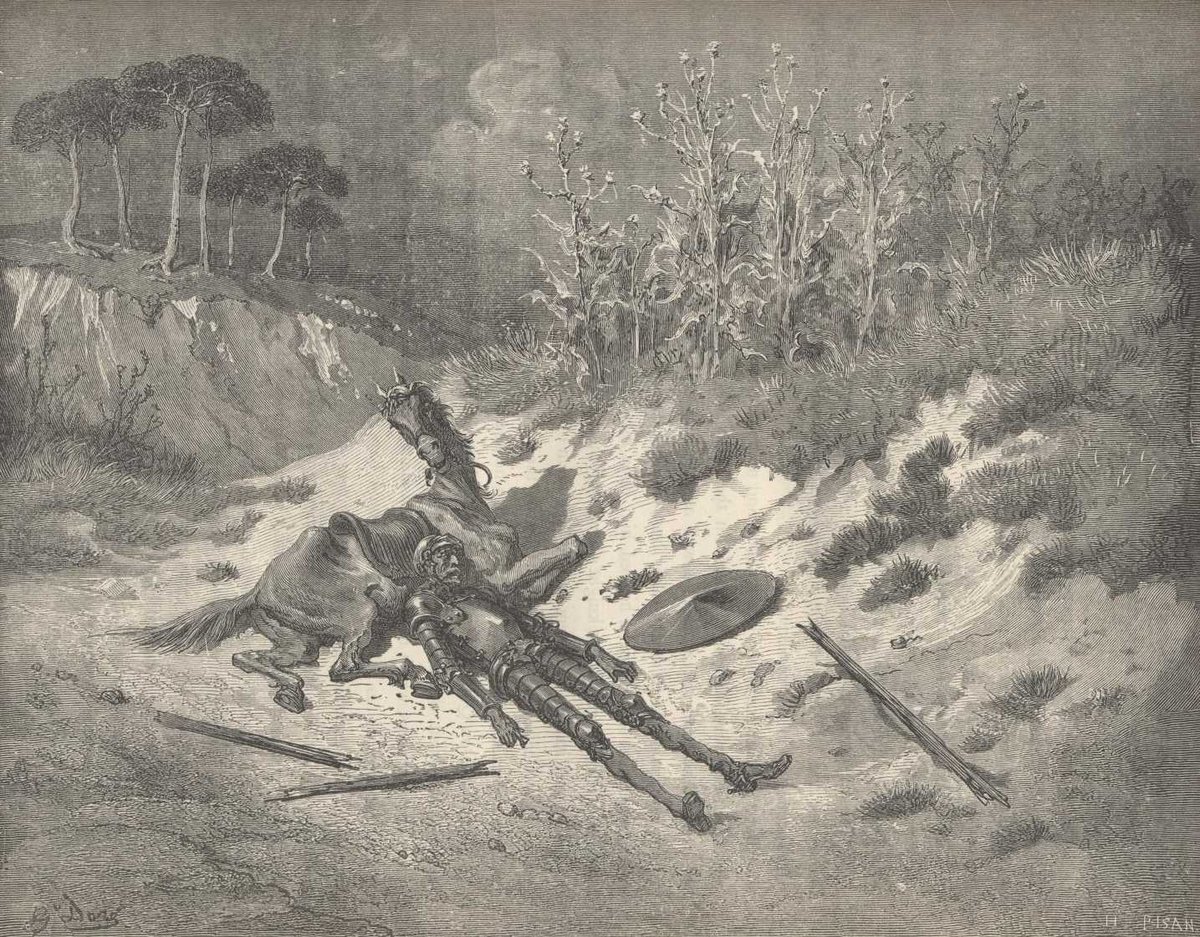
An unknown knight brings Don Quixote down on the beach at Barcelona and makes him promise to go home. Flat on the sand he could save himself with a lie, and does not.
What you will learn
- Accept out loud something that can no longer be helped, with the phrases actually used.
- Tell resignation from obligation, which look alike and are not the same.
- Maintain what you believe after losing everything for believing it.
Before you read
This is the chapter where the novel stops being funny. Read it once for the story, then read it again looking only at how people accept things. Spanish has a large set of fixed phrases for admitting that something cannot be helped, and half of them appear here in one form or another.The story in easy Spanish
Una mañana temprano don Quijote estaba armado en la playa de Barcelona.
Early one morning Don Quixote was standing armed on the beach at Barcelona.
Apareció frente a él un caballero con las armas llenas de lunas resplandecientes.
A knight appeared before him with armour covered in shining moons.
Dijo llamarse el Caballero de la Blanca Luna y habló muy alto para que todos lo oyeran.
He said he was called the Knight of the White Moon and spoke very loudly so that everyone could hear.
Venía a hacerle confesar que su dama, fuera quien fuera, era más hermosa que Dulcinea.
He had come to make him confess that his own lady, whoever she was, was more beautiful than Dulcinea.
Puso después las condiciones del desafío, delante del virrey y de mucha gente.
He then set out the terms of the challenge, in front of the viceroy and a great many people.
Si vencía él, don Quijote dejaría las armas y no saldría de su pueblo en un año.
If he won, Don Quixote would lay down his arms and not leave his village for a year.
Si vencía don Quijote, quedarían suyos el caballo, las armas y la vida del retador.
If Don Quixote won, the challenger’s horse, arms and life would be his.
Don Quijote aceptó sin discutir nada, salvo un punto pequeño.
Don Quixote accepted without arguing over anything, except one small point.
Aquel caballero no podía haber visto nunca a Dulcinea, porque si la hubiera visto callaría.
That knight could never have seen Dulcinea, because if he had, he would have kept quiet.
Don Antonio Moreno, que estaba delante, fue nombrado juez del campo.
Don Antonio Moreno, who was present, was named judge of the field.
Les señaló el sitio y les repartió el sol, y no hubo trompetas ni ceremonia.
He marked out the ground and shared out the sun between them, and there were no trumpets and no ceremony.
Tomaron campo y arremetieron el uno contra el otro sin esperar más.
They took their distance and charged at each other without waiting.
El caballo del de la Blanca Luna era más veloz y llegó bastante antes.
The White Moon’s horse was faster and arrived a good deal sooner.
Sin tocarlo siquiera con la lanza, que levantó a propósito, lo derribó de puro encuentro.
Without even touching him with the lance, which he raised on purpose, he brought him down by sheer collision.
Rocinante y su amo cayeron juntos, y don Quijote se quedó en la arena sin poder moverse.
Rocinante and his master fell together, and Don Quixote lay in the sand unable to move.
El vencedor le puso la lanza sobre la visera y le mandó confesar lo pactado.
The victor set his lance on his visor and ordered him to confess what had been agreed.
Don Quijote, molido y aturdido, contestó sin alzar la visera y con voz enferma.
Don Quixote, battered and dazed, answered without raising his visor, in a sick voice.
Hablaba como quien habla desde dentro de una sepultura, y apenas se le oía.
He spoke like a man speaking from inside a tomb, and could barely be heard.
Dijo que Dulcinea del Toboso era la mujer más hermosa del mundo.
He said that Dulcinea del Toboso was the most beautiful woman in the world.
Y que él era el caballero más desdichado de la tierra, que es cosa distinta.
And that he was the unluckiest knight on earth, which is a different matter.
No era justo, añadió, que su flaqueza quitara verdad a aquello.
It was not right, he added, that his own weakness should make that any less true.
Le pidió luego que apretara la lanza y le quitara la vida, ya que le quitaba la honra.
He then asked him to press the lance home and take his life, since he was taking his honour.
El de la Blanca Luna dijo que no, que viviera con su fama entera.
The Knight of the White Moon said no, that he should live with his fame intact.
Le bastaba con que cumpliera lo pactado y no tocara las armas en un año.
It was enough for him that the terms be kept and that he touch no weapon for a year.
Debajo de aquellas armas estaba el bachiller Sansón Carrasco, vecino suyo.
Beneath that armour was Sansón Carrasco, the graduate from his own village.
Ya lo había intentado meses antes con otro disfraz y había acabado él en el suelo.
He had tried it months earlier in another disguise and had ended up on the ground himself.
Esta vez le salió bien, y se lo confesó en secreto a don Antonio aquella tarde.
This time it worked, and he admitted it privately to Don Antonio that afternoon.
No lo hacía por burla, dijo, sino por devolver a un hombre honrado a su casa.
He was not doing it for a joke, he said, but to get an honourable man home.
Don Antonio le contestó que Dios le perdonara el agravio hecho a todo el mundo.
Don Antonio answered that God might forgive him the wrong he had done the whole world.
Volver cuerdo al loco más gracioso que había en él no era ningún favor.
Making the funniest madman in it sane again was no kindness at all.
Mientras tanto levantaron a don Quijote y le descubrieron el rostro.
Meanwhile they lifted Don Quixote up and uncovered his face.
Estaba pálido y sudado, y Rocinante, de puro malparado, no se podía mover.
He was pale and drenched in sweat, and Rocinante, too badly knocked about, could not move.
Lo llevaron a la ciudad en una silla de manos que mandó traer el virrey.
They carried him into the city in a sedan chair that the viceroy sent for.
Sancho iba detrás sin saber qué decir ni qué hacer, como si soñara.
Sancho walked behind not knowing what to say or do, as though he were dreaming.
Veía deshecho todo lo prometido, como se deshace el humo con el viento.
He saw everything he had been promised undone, the way smoke is undone by wind.
Seis días estuvo su amo en la cama, triste, callado y sin quejarse de nada.
For six days his master lay in bed, sad, silent, and complaining of nothing.
Al séptimo mandó ensillar y tomó despacio el camino de su pueblo.
On the seventh he ordered the horses saddled and took the road home, slowly.
Vocabulary
The challenge
- el retador
- the challenger
- el desafío
- the challenge
- tomar campo
- to take up position
- arremeter
- to charge
- derribar
- to knock down
- la visera
- the visor
- el juez del campo
- the judge of the field
- lo pactado
- what was agreed
After the fall
- molido
- battered
- aturdido
- dazed
- malparado
- in a bad way
- la sepultura
- the tomb
- la flaqueza
- weakness
- la honra
- honour, good name
- desdichado
- unlucky, wretched
- la silla de manos
- the sedan chair
Accepting what cannot be fixed
- resignarse
- to resign yourself
- conformarse con
- to make do with
- no hay más remedio
- there is nothing else for it
- no queda otra
- there is no other option
- aguantarse
- to put up with it
- qué le vamos a hacer
- what can you do
- tocarle a uno
- to fall to somebody’s lot
- cumplir la palabra
- to keep your word
Resignation: what you say when nothing can be done
No hay más remedio que volver al pueblo.
Le tocó perder, y se aguantó.
Por más que quisiera, no podía levantarse.
Don Quixote loses everything in three minutes on a beach and does not complain once. The Spanish for that attitude is a closed set of phrases every speaker owns, and a learner who knows only tener que cannot produce any of it.
1. Nothing else for it
| Spanish | English | register |
|---|---|---|
| No hay más remedio que volver. | There is nothing for it but to go back. | neutral, always safe |
| No queda otra que volver. | There is no other option but to go back. | spoken, blunt |
| Habrá que volver. | We will have to go back. | impersonal, nobody blamed |
| Es lo que hay. | That is how it is. | very spoken, very modern |
| Qué le vamos a hacer. | What can you do. | a shrug, no question mark needed |
All of these take an infinitive, not a subjunctive, which makes them easy. Habrá que is the one to steal first: it is hay que in the future and it lets you announce an unpleasant necessity without saying whose fault it is.
2. The three verbs of acceptance
| verb | what it really says | example |
|---|---|---|
| resignarse a | accept something bad, for good | Se resignó a no salir de casa en un año. |
| conformarse con | settle for less than you wanted | Se conformó con volver vivo. |
| aguantarse | put up with it and shut up | Perdió la apuesta y se aguantó. |
Watch the prepositions, because they are not guessable: resignarse a, conformarse con. And note tocarle a uno, which works like gustar and means that fate dealt you this: me tocó a mí, it fell to me, a cada uno le toca lo suyo.
3. However much you want it
This is the one with the subjunctive, and it is the most useful pattern here.
| Spanish | English |
|---|---|
| Por más que quisiera, no podía moverse. | However much he wanted to, he could not move. |
| Por mucho que insistas, no iré. | However much you insist, I will not go. |
| Por muy fuerte que sea, perderá. | However strong he may be, he will lose. |
| Diga lo que diga, no cambia nada. | Whatever he says, it changes nothing. |
The last pattern, the verb repeated in the subjunctive twice, is worth memorising whole: pase lo que pase, sea como sea, cueste lo que cueste, digan lo que digan. It is everywhere in spoken Spanish and there is nothing to work out, only four or five blocks to own.
4. Resignation is not obligation
Tengo que volver says there is a duty. No hay más remedio que volver says there is no door. The first accepts a rule, the second accepts a fact, and Spanish keeps them apart even though English uses have to for both. Don Quixote uses the second kind. He has been beaten, and he goes home because a promise given in front of witnesses is the last piece of the world he still controls.
The moment he stops being funny
Up to here the book has been a machine for making its hero look ridiculous, and the reader has been allowed to laugh at every fall. This fall is different, and Cervantes builds the difference out of one sentence. Asked to deny that Dulcinea is the most beautiful woman in the world, with a lance point on his visor, he separates two things that a lesser writer would have run together. His own defeat he grants at once: he is the unluckiest knight on earth, and there is no argument. The other claim he will not touch, and the reason he gives is that his personal weakness has no authority over a truth. A man on his back in the sand, beaten, publicly humiliated, distinguishing between what he has lost and what he never owned.
The cruelty of the scene is in who is inside the armour. Not an enemy, not a rival, but a neighbour with a university degree who has spent three months planning this for the patient’s own good. Sansón is right, in the narrow sense. Don Quixote is a sick man of nearly sixty riding around in armour, and the cure is to get him home. Don Antonio’s answer is the one the reader wants to make and cannot quite justify: God forgive you for the wrong you have done the world by curing the funniest madman in it.
What follows is six days in bed and a slow road home, and the novel never gets its energy back, because it is not supposed to. Everything after this beach is aftermath. Cervantes could have let him win one last time. He does not, and the refusal is why the book survived the century it was written in.
Cervantes in the original · «Dulcinea del Toboso es la más hermosa mujer del…»
Dulcinea del Toboso es la más hermosa mujer del mundo, y yo el más desdichado caballero de la tierra, y no es bien que mi flaqueza defraude esta verdad. Aprieta, caballero, la lanza, y quítame la vida, pues me has quitado la honra.
Dulcinea del Toboso is the most beautiful woman in the world, and I the unluckiest knight on earth, and it is not right that my weakness should defraud this truth. Press home your lance, sir knight, and take my life, since you have taken my honour.
From II, 64, spoken flat on the sand with a lance point resting on his visor, by a man who could end the whole thing by saying yes. Read the sentence slowly, because it is built with great care. He concedes everything that is his: he is the unluckiest knight on earth, and that is a fact about him. He concedes nothing about her, and the reason he gives is a piece of logic rather than of loyalty. A truth does not stop being true because the man defending it has been knocked off a horse. Defraudar here does not mean to cheat somebody, it means to rob a thing of its value, and it is used in that older sense. The word to notice is flaqueza, from flaco, thin. It means weakness of body and weakness of character at once, and he is using it about both. Then, having refused to lie, he asks to be killed, and the request is not theatre. He has just been told he must go home and stop, and he understands exactly what that means. Everything the character has been since chapter one is being taken away from him on a public beach in front of a viceroy, and he answers in one sentence and then falls silent.