Level B1 · Chapter 53
Basin or Helmet
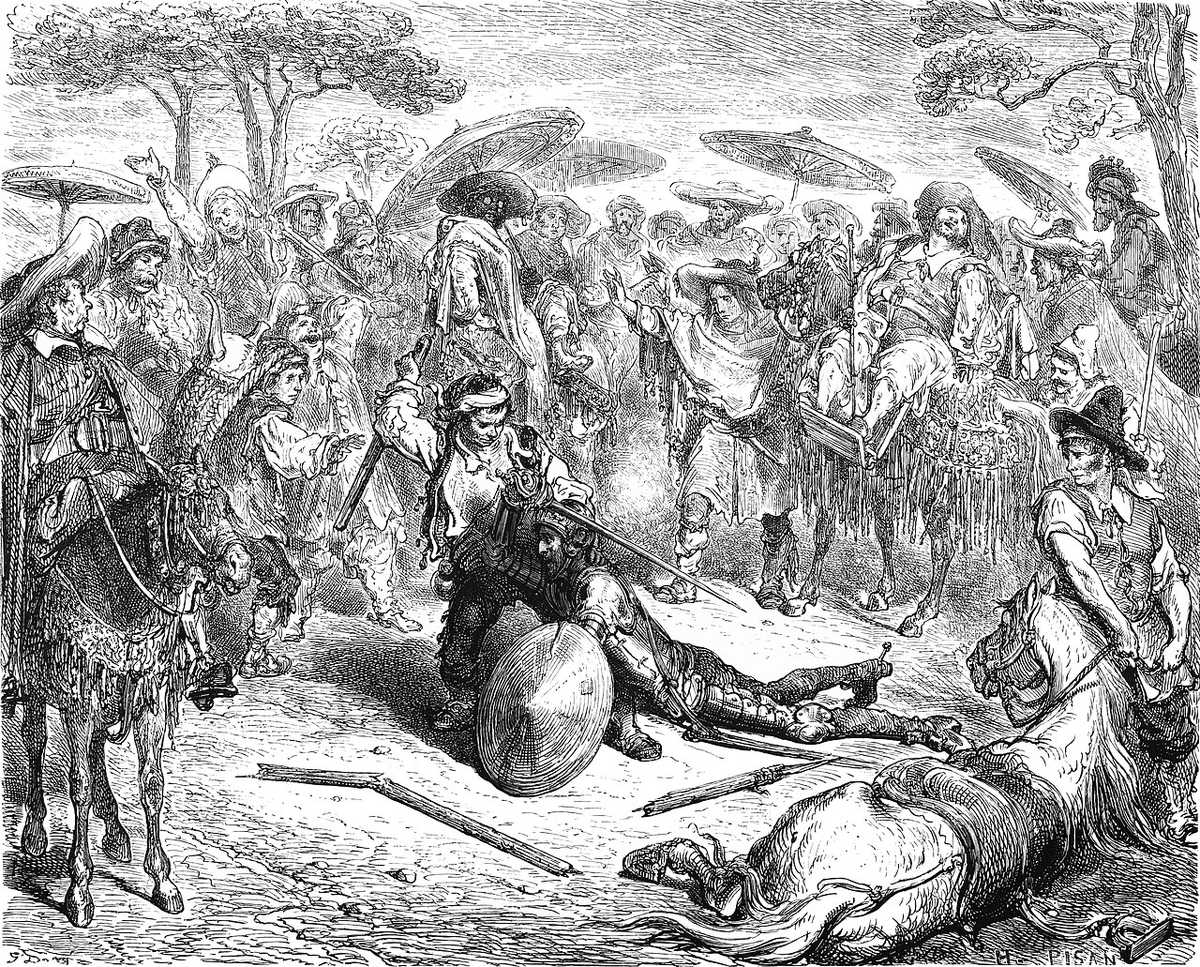
A barber claims back his basin and his packsaddle. Don Fernando and his friends decide to agree with Don Quixote, and Sancho invents a word so that everybody wins.
What you will learn
- Say you agree using more than three different formulas.
- Contradict somebody without sounding rude.
- Give an opinion and ask for somebody else’s in an argument.
Before you read
This lesson is one long argument, and almost every line in it is somebody agreeing or refusing to agree. Spanish has a fixed set of phrases for that, and they are graded: some are polite, some are flat, and one or two are almost an insult. Collect them as you read and notice who uses which, because the joke of the scene depends entirely on the fact that everybody is being extremely courteous.The story in easy Spanish
A la venta llegó un barbero que venía de camino, cansado y con prisa.
A barber arrived at the inn, travelling through, tired and in a hurry.
En cuanto vio a Sancho, lo señaló con el dedo y empezó a gritar.
As soon as he saw Sancho, he pointed at him and began to shout.
«¡Esa bacía es mía, y esa albarda también!», dijo delante de todos.
"That basin is mine, and that packsaddle too!" he said in front of everyone.
«Me las quitaron en el camino hace semanas, y aquí están las 2».
"They were taken from me on the road weeks ago, and here they both are."
En la sala estaban también el cautivo, Zoraida y los hombres del viaje.
In the room there were also the captive, Zoraida and the men from the voyage.
Ninguno de ellos dijo una palabra, porque venían de cosas peores.
Not one of them said a word, because they had come from worse things.
«No estoy de acuerdo», contestó don Quijote sin levantarse de la silla.
"I disagree," answered Don Quixote without getting up from his chair.
«Eso no es una bacía, sino el yelmo de Mambrino, que gané en buena batalla».
"That is not a basin but the helmet of Mambrino, which I won in fair battle."
«Perdone usted, pero se equivoca», contestó el barbero muy serio.
"Forgive me, but you are mistaken," the barber answered very seriously.
«Es de latón, vale 8 reales y sirve para afeitar a cualquiera».
"It is brass, it is worth eight reales, and it will shave anybody."
«Que lo diga aquí quien quiera, porque la prueba está a la vista».
"Let anyone here say so, because the proof is there for all to see."
Don Fernando y sus amigos vieron la ocasión y decidieron seguirle la broma.
Don Fernando and his friends saw their chance and decided to play along.
Uno tras otro fueron dando su opinión con mucha seriedad, sin reírse.
One after another they gave their opinion with great seriousness, without laughing.
«Yo opino que es un yelmo», dijo uno de ellos.
"I hold that it is a helmet," said one of them.
«Desde luego que sí», dijo otro, y le puso una mano en el hombro.
"Certainly it is," said another, putting a hand on his shoulder.
«Tienes toda la razón», añadió un tercero, mirando al barbero con lástima.
"You are absolutely right," a third added, looking at the barber with pity.
El pobre hombre miraba a unos y a otros y no entendía nada.
The poor man looked from one to another and understood nothing.
«Pues yo no lo veo así en absoluto», dijo, ya con la voz rota.
"Well, I do not see it that way at all," he said, his voice breaking.
«¿De verdad están todos ustedes de acuerdo en una cosa tan clara?».
"Do you really all agree about something so obvious?"
El cura quiso advertirle en voz baja que no discutiera más.
The priest tried to warn him quietly not to argue any more.
Sancho, que se había quedado pensando, encontró por fin la solución.
Sancho, who had been thinking it over, finally found the solution.
Dijo que aquello no era un yelmo ni una bacía, sino un baciyelmo.
He said that the thing was neither a helmet nor a basin, but a basin-helmet.
Y añadió que de ese modo todos tenían razón y nadie perdía nada.
And he added that in that way everyone was right and nobody lost anything.
Hubo risas, y hasta el barbero tuvo que bajar la cabeza y callarse.
There was laughter, and even the barber had to lower his head and go quiet.
Con la albarda, en cambio, no hubo manera de ponerse de acuerdo.
Over the packsaddle, however, there was no way of reaching agreement.
Cada uno lamentaba una cosa distinta y la discusión empezó a subir de tono.
Each of them was complaining about something different, and the argument began to grow heated.
Allí ya no había justicia posible, porque nadie quería la misma verdad.
By then no justice was possible there, because nobody wanted the same truth.
Vocabulary
Agreeing
- estar de acuerdo
- to agree
- tener razón
- to be right
- desde luego
- certainly
- por supuesto
- of course
- yo también lo veo así
- I see it that way too
- opinar lo mismo
- to be of the same opinion
- sin duda
- without a doubt
- ponerse de acuerdo
- to reach an agreement
Disagreeing
- no estoy de acuerdo
- I do not agree
- se equivoca
- you are mistaken
- en absoluto
- not at all
- yo no lo veo así
- I do not see it that way
- perdone, pero
- forgive me, but
- ni hablar
- no way
- depende
- it depends
- hasta cierto punto
- up to a point
From the sea to the inn
- el cautivo
- the captive
- la barca
- the small boat
- el remero
- the oarsman
- navegar
- to sail
- el puerto
- the harbour
- la costa
- the coast
- la orilla
- the shore
- el cabo
- the headland
- el jardín
- the garden
- las joyas
- the jewels
- la fuga
- the escape
Agreeing and disagreeing
No estoy de acuerdo. Eso no es una bacía.
Perdone usted, pero se equivoca.
Pues yo no lo veo así en absoluto.
An argument is a set of moves, and Spanish has a fixed phrase for each move. Learn them as blocks. Nobody assembles these from grammar rules, not even native speakers.
1. Saying yes
| Spanish | English | how strong |
|---|---|---|
| estoy de acuerdo | I agree | neutral, works everywhere |
| yo también lo veo así | I see it that way too | neutral, warmer |
| tienes toda la razón | you are absolutely right | strong |
| desde luego | certainly | strong |
| por supuesto | of course | strong |
| sin duda | without a doubt | strong, slightly formal |
2. Saying no
Here the grading matters much more, because the wrong choice makes you sound aggressive in a language that is careful about this.
| Spanish | English | how strong |
|---|---|---|
| perdone, pero… | forgive me, but… | the polite opening, always safe |
| no estoy de acuerdo | I do not agree | neutral and direct |
| yo no lo veo así | I do not see it that way | neutral, softer than the last |
| se equivoca | you are mistaken | blunt, but usted keeps it civil |
| en absoluto | not at all | flat refusal |
| ni hablar | no way | very blunt, friends only |
Watch what the barber does. He opens with perdone usted and only then says se equivoca. That is the standard Spanish move: soften first, contradict second. Dropping the softener is what makes a foreigner sound rude when every individual word was polite.
3. Half agreeing
The most useful zone, and the one learners never reach.
| Spanish | what it does |
|---|---|
| hasta cierto punto | yes, but not all the way |
| depende | refuses the question as put |
| en parte sí, pero… | concedes, then turns |
| sí, aunque… | the same, more formal |
4. Tener razón, and the trap in it
Being right in Spanish is something you have, not something you are.
| ✗ wrong | ✓ right |
|---|---|
| soy razón, estoy razón | tengo razón |
| estoy correcto | tengo razón |
| soy de acuerdo | estoy de acuerdo |
And note the pair that goes with it: estar de acuerdo is the state of agreeing, while ponerse de acuerdo is the act of reaching an agreement. The last sentence of this story needs the second one: over the packsaddle they never manage to ponerse de acuerdo.
Baciyelmo, the word Sancho invented
Baciyelmo did not exist in Spanish before this chapter. Sancho welds bacía and yelmo together, offers the result to the room, and the argument stops. Cervantes uses the word exactly once in the whole novel and never explains it, which is how you can tell he knew what he had done.
What makes it more than a pun is the move it performs. Everybody else in the room is trying to establish which of two men sees reality correctly, and there is no way to settle that, because the barber is right about the metal and Don Quixote is right about what the object has become. Sancho refuses the question. He does not say that one of them is deluded. He says the thing is both, and gives it a name, and the moment it has a name the fight is over. Philosophers have been quoting this scene for two hundred years, and they are not being whimsical when they do.
Now look at what happens immediately afterwards, because Cervantes is not a sentimentalist. The packsaddle comes up. Nobody invents a word for it. Within a page the officers of the Holy Brotherhood are involved, somebody is pulling Sancho’s beard, and the whole inn is fighting. The joke about the basin works because a group of people decided together to let it work, and that decision is fragile. The next lesson is what happens when it is not made.
One footnote for readers who like the machinery. The basin has been with us since lesson 29, when Don Quixote took it from a barber riding through the rain with it on his head. It has taken sixteen lessons for its owner to catch up with it, and when he does, he loses.
Cervantes in the original · «si no fuera por este baciyelmo…»
si no fuera por este baciyelmo, no lo pasara entonces muy bien, porque hubo asaz de pedradas en aquel trance
if it were not for this basin-helmet, I would not have come off well that time, because there was a fair quantity of stone-throwing in that scrape.
This is the only appearance of baciyelmo in the entire novel, and the surprise is who says it: not Sancho, who coined it, but Don Quixote, several chapters later, using it as though it had always been a normal Spanish word. That is the real end of the argument. A knight who has spent the book insisting that the object is the helmet of Mambrino picks up his squire’s joke word and keeps it. He has accepted, without saying so, that the thing is both. Grammatically the sentence is running ahead of you: si no fuera por with no lo pasara is an unreal conditional, the type that talks about what did not happen, and that is lesson 74. For now just notice the shape and that the si half is nowhere near a present tense, which tells you at a glance that this is not the type you learned last lesson. And keep asaz de pedradas, a fair quantity of thrown stones, which is Don Quixote being drily funny about the worst beating of his life.