Level B1 · Chapter 49
Arms and Letters
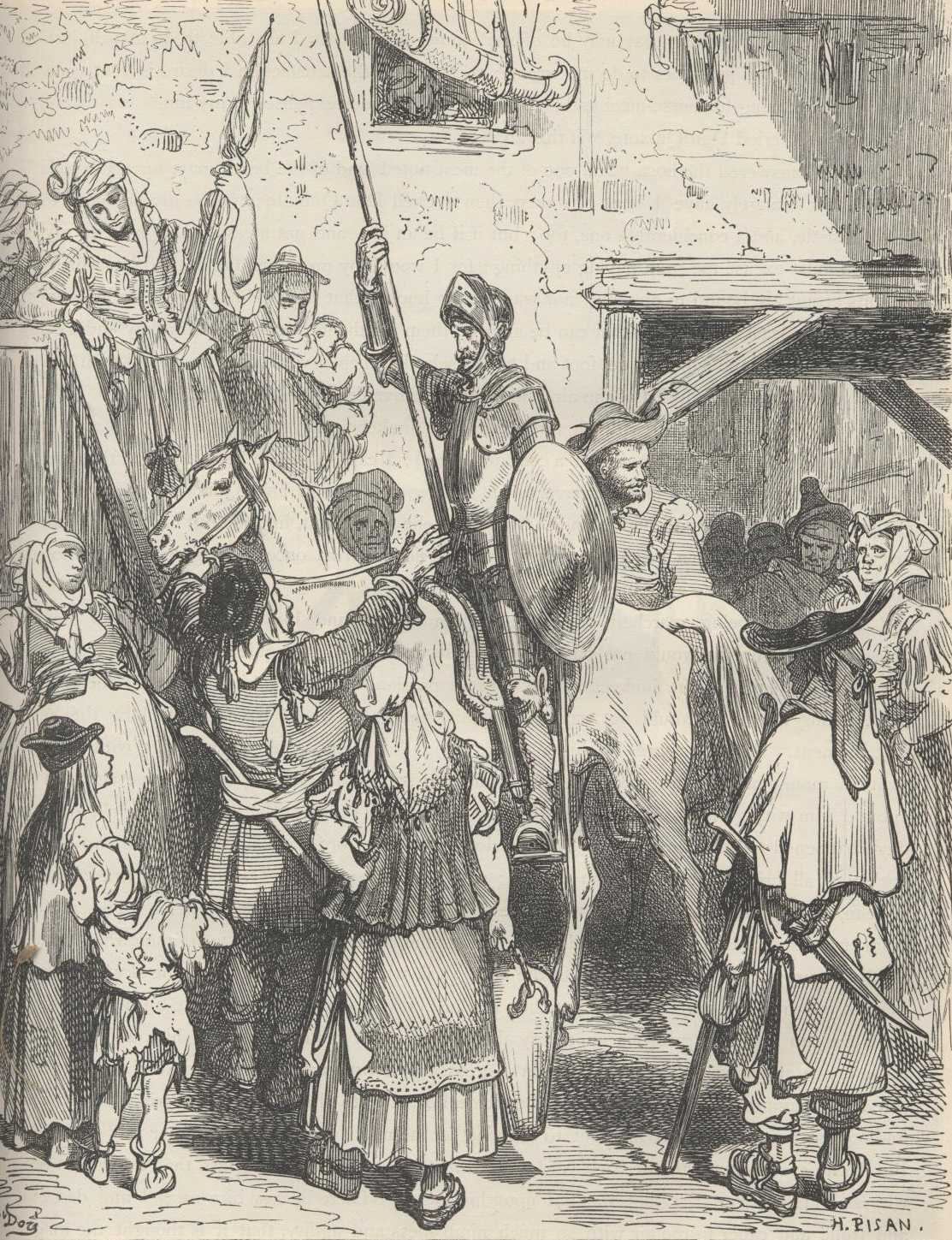
After supper Don Quixote stands up and delivers a serious speech about which is worth more, the life of the soldier or that of the scholar. He speaks so well that nobody laughs.
What you will learn
- Organise an argument with en primer lugar, por otra parte and en resumen.
- Tell formal Spanish apart from everyday Spanish.
- Defend an opinion point by point, without saying además every time.
Before you read
Don Quixote speaks here the way a book speaks, not the way people speak in the street. Almost every one of his sentences opens with a signpost: en primer lugar, por otra parte, en cambio, por último, en resumen. Those signposts are the grammar point. Watch where they sit and what each of them promises the listener.The story in easy Spanish
Aquella noche hubo cena para todos, porque el ventero quería olvidar el desastre del vino.
That night there was supper for everyone, because the innkeeper wanted to forget the disaster of the wine.
Cuando terminaron de comer, don Quijote pidió silencio y se puso en pie muy despacio.
When they had finished eating, Don Quixote called for silence and got slowly to his feet.
Empezó a hablar como quien ha preparado el discurso durante años y espera su momento.
He began to speak like a man who has prepared his speech for years and is waiting for his moment.
El tema era antiguo y serio, y en aquella época se discutía en todas las universidades.
The subject was old and serious, and in that age it was argued over in every university.
¿Qué vale más, la vida del soldado o la vida del estudiante?
Which is worth more, the life of the soldier or the life of the scholar?
Es decir, ¿qué vale más, las armas o las letras?
That is to say, which is worth more, arms or letters?
Nadie en la sala esperaba una respuesta ordenada.
Nobody in the room was expecting an orderly answer.
«En primer lugar», dijo, «hay que mirar el fin que persigue cada una de las dos».
"In the first place," he said, "one must look at the end that each of the two pursues."
«El fin de las letras es la justicia, que es un fin altísimo y muy difícil».
"The end of letters is justice, which is a very high end and a very hard one."
«Pero el fin de las armas es la paz, y no hay bien mayor que ese en la tierra».
"But the end of arms is peace, and there is no greater good than that on earth."
«Por otra parte», continuó, «se dice que el estudiante pasa hambre y frío».
"On the other hand," he went on, "it is said that the scholar suffers hunger and cold."
«Es verdad, aunque el soldado pasa lo mismo y además pasa miedo todas las noches».
"That is true, although the soldier suffers the same and is frightened besides, every night."
«El estudiante, en efecto, termina sus años de estudio y consigue un puesto tranquilo».
"The scholar, indeed, finishes his years of study and obtains a quiet post."
«En cambio, el soldado termina cojo, o manco, o sencillamente no termina».
"The soldier, by contrast, ends up lame, or one-handed, or simply does not end up at all."
«Por último», dijo, y aquí se le puso la voz más grave, «quiero hablar de la artillería».
"Finally," he said, and here his voice grew graver, "I want to speak of artillery."
«Una bala disparada desde lejos por una mano cobarde mata al hombre más valiente del mundo».
"A ball fired from far off by a coward’s hand kills the bravest man in the world."
«Por eso lamento haber nacido en una edad que ya no premia el valor de nadie».
"That is why I regret having been born in an age that no longer rewards anyone’s courage."
«En resumen, quien inventó la pólvora no ayudó a la valentía, sino que la castigó».
"In short, whoever invented gunpowder did not help courage, but punished it."
El discurso duró casi media hora y no le tembló la voz.
The speech lasted almost half an hour and his voice never shook.
Cuando se sentó, nadie se rió, y en la sala se hizo un silencio largo.
When he sat down, nobody laughed, and a long silence fell in the room.
Los que lo escuchaban se miraron entre ellos con lástima y no supieron qué decir.
Those who had listened looked at one another with pity and did not know what to say.
Hablaba tan bien de todo lo demás y tan mal de sí mismo.
He spoke so well about everything else and so badly about himself.
Sancho, que no había entendido ni la mitad, aplaudió con las dos manos.
Sancho, who had not understood even half of it, applauded with both hands.
Su amo le dio las gracias con una inclinación de cabeza.
His master thanked him with a small bow of the head.
Vocabulary
Opening, continuing and closing a speech
- en primer lugar
- in the first place
- por otra parte
- on the other hand
- en cambio
- by contrast
- en efecto
- indeed
- es decir
- that is to say
- por último
- finally
- en resumen
- in short
- sin embargo
- however
Arms
- el soldado
- the soldier
- la bala
- the cannonball
- la pólvora
- gunpowder
- la valentía
- courage
- cobarde
- cowardly
- cojo
- lame
- manco
- one-handed
- la paz
- peace
Letters
- el estudiante
- the student
- el estudio
- the study
- la universidad
- the university
- la justicia
- justice
- el puesto
- the post
- el discurso
- the speech
- el fin
- the purpose
- la lástima
- pity
Discourse markers and the formal register
En primer lugar, hay que mirar el fin de cada cosa.
Por otra parte, se dice que el estudiante pasa hambre.
En resumen, quien inventó la pólvora castigó la valentía.
You can already narrate and you can already join events in time. What you cannot do yet is argue, and arguing in Spanish is not the same job as telling a story. A story is held together by when things happened. An argument is held together by what each sentence is doing to the sentence before it, and Spanish says that out loud, at the front, before the comma.
1. The nine you need
| marker | English | what it promises the listener |
|---|---|---|
| en primer lugar | in the first place | a numbered list of reasons is starting |
| por otra parte | on the other hand | another reason, different but not opposite |
| en efecto | indeed | yes, that is true, and here is the proof |
| en cambio | by contrast | the opposite case, side by side |
| sin embargo | however | an objection to what was just said |
| es decir | that is to say | the same idea again, more clearly |
| por eso | that is why | the consequence of everything above |
| por último | finally | the last reason, so pay attention |
| en resumen | in short | the whole argument in one sentence |
Three of these are worth separating carefully, because English speakers reach for the wrong one. Por otra parte adds a different consideration and does not contradict anything. En cambio puts two cases next to each other so the difference shows: the scholar gets a post, en cambio the soldier gets a wooden leg. Sin embargo genuinely pushes back, and it is the strongest of the three. Using sin embargo where you only meant por otra parte makes you sound like you are contradicting a person who agreed with you.
2. Where they go
The default position is the front of the sentence, with a comma after. That is what Don Quixote does five times in this lesson, and it is what written Spanish does constantly.
| position | example |
|---|---|
| front, with comma | En resumen, la pólvora castigó la valentía. |
| after the subject, between commas | La pólvora, en efecto, castigó la valentía. |
| front of a quoted clause | Dijo que, por último, quería hablar de artillería. |
The middle position is more formal still, and slightly literary. It works because the marker interrupts the sentence and forces a pause, which is exactly the effect a careful speaker wants.
3. The register itself
Markers are only half of what makes this speech sound the way it does. The other half is register, and register in Spanish is mostly a matter of three choices.
| everyday | formal |
|---|---|
| bueno, pues, o sea | en primer lugar, es decir |
| pero | sin embargo, no obstante |
| hay que mirar una cosa | hay que mirar el fin que persigue cada cosa |
Notice the third row. Formal Spanish is not merely politer vocabulary: the sentences are longer, and they are longer because they carry a relative clause with que inside them. El fin de las letras es la justicia, que es un fin altísimo could have been two sentences. Making it one is the register.
The impersonal se belongs here too. Se dice que el estudiante pasa hambre says it is said without saying by whom, and formal Spanish loves it, because it lets you introduce an objection that you are about to knock down without attributing it to anybody in the room.
A maimed man’s speech about maimed men
Cervantes was a soldier before he was a writer. In 1571 he fought at Lepanto, the great sea battle against the Ottoman fleet, and he fought it with a fever, having refused to stay below decks. He took three gunshot wounds that day, two in the chest and one in the left hand, and the hand never worked again. Spain called him el manco de Lepanto, the one-handed man of Lepanto, and he wore the name with open pride: he wrote later that the wound was beautiful to him because he had received it in the greatest occasion the centuries had seen.
So when Don Quixote says that the scholar finishes his studies and gets a post, while the soldier finishes lame, or one-handed, or does not finish at all, the sentence is not a rhetorical flourish. It is a man holding up his own hand. Cervantes came home from the war, was captured by pirates on the way, spent five years enslaved in Algiers, was ransomed at the last possible moment, and then spent the rest of his life short of money, working as a tax collector and going to prison over accounts that would not balance. The end of arms, in his case, was not peace. It was paperwork.
The debate itself was a fixed exercise of the period, argued in universities and printed in dozens of books, and every educated listener at that table would have recognised it instantly. That is part of the joke and part of the sadness. Don Quixote is not raving here. His reasoning is orderly, his markers are in place, and his conclusion about gunpowder, that a distant coward can now kill the bravest man alive, was the anxiety of the entire sixteenth century. He is talking perfect sense, in perfect register, and everyone in the room already knows he thinks a bucket of wine is a giant.
Cervantes gives you no signal about how to take it. He simply reports that nobody laughed and that the listeners looked at each other with pity. It is the first time in the book that the joke does not land, and the reader is left holding it.
Cervantes in the original · «Así que, aunque es mayor el trabajo del soldado…»
Así que, aunque es mayor el trabajo del soldado, es mucho menor el premio
And so, although the soldier’s labour is greater, the reward is far smaller.
Thirteen words, and the entire lesson is inside them. Start at the front: así que announces a conclusion, which means everything before it in the speech was preparation and the listener now knows to pay attention. Then aunque, a concession. Cervantes has Don Quixote grant the other side its best point, that the soldier’s work really is harder, before turning it into evidence for his own case. Granting a point in order to win with it is the most formal move in argument, and Spanish builds it with aunque plus the indicative when the concession is a fact. Then the two comparatives, mayor and menor, set head to head with a comma between them and no verb repeated. The sentence is balanced like a scale, which is what the whole debate is about. Notice finally what is not here: no y, no pero, nothing conversational. Every joint in the sentence is a formal one, and that is why a Spanish reader hears a man giving a speech rather than a man talking.