Level A2 · Chapter 23
The speech on the Golden Age
Some poor goatherds invite Don Quixote to supper, and he pays them with a speech about a world that no longer exists. The whole speech runs in the imperfect.
What you will learn
- Describe what a place, a person or a whole age was like in the past.
- Say what people used to do, without saying when it started or ended.
- Use era, había, iba and veía without slipping.
Before you read
Almost every verb in this lesson ends in -aba or -ía. As you read, notice that not one of them reports an event with a beginning and an end. They paint a world instead of moving a plot. That is the whole job of the tense you are about to meet.The story in easy Spanish
Una tarde, don Quijote y Sancho llegaron a unas cabañas de cabreros en el monte.
One afternoon, Don Quixote and Sancho reached some goatherds’ huts up in the hills.
Los cabreros eran pobres, pero invitaron a los dos viajeros a cenar con ellos.
The goatherds were poor, but they invited the two travellers to have supper with them.
Había carne de cabra, queso duro y bellotas. Todos comían sentados en el suelo.
There was goat meat, hard cheese and acorns. Everyone ate sitting on the ground.
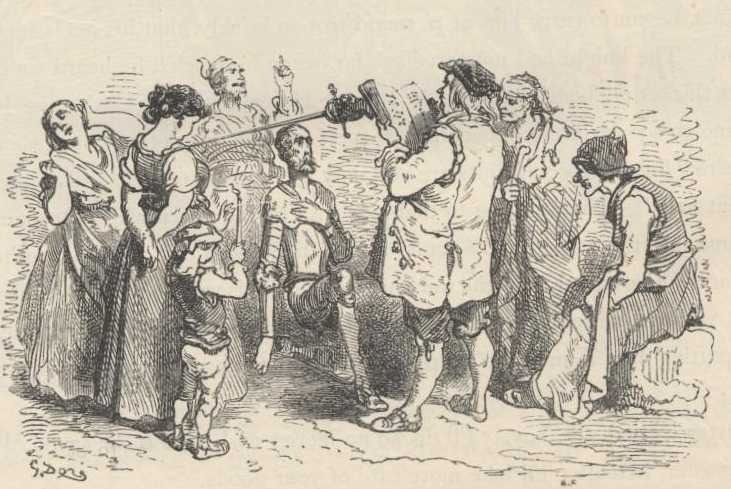
Don Quijote cogió un puñado de bellotas. Las miró un rato largo y empezó a hablar.
Don Quixote picked up a handful of acorns. He looked at them for a long while and began to speak.
«En la Edad de Oro los hombres no conocían dos palabras: tuyo y mío», dijo.
"In the Golden Age men did not know two words: yours and mine," he said.
Entonces todo era de todos. Nadie trabajaba para comer.
Back then everything belonged to everyone. Nobody worked in order to eat.
Las encinas daban fruta dulce y las fuentes daban agua fría.
The holm oaks gave sweet fruit and the springs gave cold water.
No existían las leyes, porque nadie hacía daño a nadie.
There were no laws, because nobody did any harm to anybody.
Las muchachas andaban solas por el campo y nadie las molestaba.
Young women walked alone through the countryside and nobody bothered them.
Los cabreros escuchaban en silencio, con la boca abierta.
The goatherds listened in silence, open-mouthed.
No entendían casi nada, pero les gustaba la música de aquellas palabras.
They understood almost none of it, but they liked the music of those words.
Sancho bebía vino y miraba el fuego. La noche era larga y tranquila.
Sancho drank wine and watched the fire. The night was long and quiet.
Vocabulary
The hills and the goatherds
- el cabrero
- the goatherd
- la cabaña
- the hut
- la cabra
- the goat
- el monte
- the hills, the scrubland
- el fuego
- the fire
The supper
- la bellota
- the acorn
- el queso
- the cheese
- la carne
- the meat
- el vino
- the wine
- el puñado
- the handful
The ancient world
- la Edad de Oro
- the Golden Age
- la encina
- the holm oak
- la fuente
- the spring
- la ley
- the law
- molestar
- to bother
The imperfect: the world as it used to be
Los cabreros eran pobres.
Todos comían sentados en el suelo.
Las fuentes daban agua fría.
You cannot, and that is exactly the point. The imperfect never tells you where the edges of an event are. It describes, it repeats and it paints the background.
The endings are the tidiest in the language. Two sets, and no exceptions at all:
| -ar (andar, to walk) | -er / -ir (comer, vivir) | |
|---|---|---|
| yo | andaba | comía / vivía |
| tú | andabas | comías |
| él / ella / usted | andaba | comía |
| nosotros | andábamos | comíamos |
| vosotros | andabais | comíais |
| ellos / ellas | andaban | comían |
Two things worth noticing. The yo form and the él form are identical, so the subject pronoun often comes back to keep them apart. And every single -er and -ir form carries a written accent on the í, which is not decoration: it is what stops comía from being read as comia.
The only three irregular verbs
| ser | ir | ver |
|---|---|---|
| era | iba | veía |
| eras | ibas | veías |
| era | iba | veía |
| éramos | íbamos | veíamos |
| erais | ibais | veíais |
| eran | iban | veían |
Three verbs, and you have the whole tense. Compare that with the preterite of lessons 21 and 22, which is a museum of exceptions.
What the tense is for
| job | from the story | English |
|---|---|---|
| describing | Los cabreros eran pobres. | The goatherds were poor. |
| habit | Todos comían sentados en el suelo. | They all used to eat sitting on the ground. |
| background | Sancho bebía vino y miraba el fuego. | Sancho was drinking wine and watching the fire. |
| age, time, weather | La noche era larga. | The night was long. |
Look at the speech again with this in hand. No conocían, todo era, nadie trabajaba, las encinas daban, no existían, nadie molestaba. Six verbs, one tense, and a whole lost world. Don Quixote is not telling the goatherds what happened. He is telling them what things were like, for ever, until they stopped being like that.
One special form deserves its own line. Hay becomes había in the past, and había never changes for plural: había un cabrero and había veinte cabreros.
The Golden Age and the acorns
The Golden Age was not Don Quixote’s invention, and Cervantes’ readers knew it. The myth comes from Hesiod and from Ovid: a first age of the world with no property, no laws and no work, when the earth fed everyone by itself. Every educated reader in 1605 recognised the speech within a line or two, the way a modern reader recognises the opening of a fairy tale.
The joke is the audience. This set piece of Renaissance rhetoric, built for a palace or a printed page, is being delivered to men who cannot read, by firelight, in payment for a supper of goat meat. And the acorns in his hand are not a symbol to them. Acorns were real food in Castile in a bad year, the thing you ate when the wheat failed, and these men had eaten them for that reason.
So the scene works in two directions at once, which is what Cervantes does best. The speech is genuinely beautiful. It is also completely useless to the people listening to it. They understand almost nothing, and they let him finish anyway, because he is a guest and because the sound is pleasant. That courtesy from very poor men is the quietest thing in the chapter, and the most Spanish.
Cervantes in the original · «Dichosa edad y siglos dichosos aquellos a quien los…»
Dichosa edad y siglos dichosos aquellos a quien los antiguos pusieron nombre de dorados
Happy age and happy centuries, those to which the ancients gave the name of golden
This is the first line of the speech. After it, the whole thing runs in the imperfect, exactly the tense of this lesson. Two examples from the original: ignoraban estas dos palabras de tuyo y mío, and todo era paz entonces, todo amistad, todo concordia. Note a quien where modern Spanish would write a los que, and dorados rather than de oro.