C2 · Part Two, Chapter 54
¡Guelte! ¡Guelte! Pilgrims, gestures and Ricote
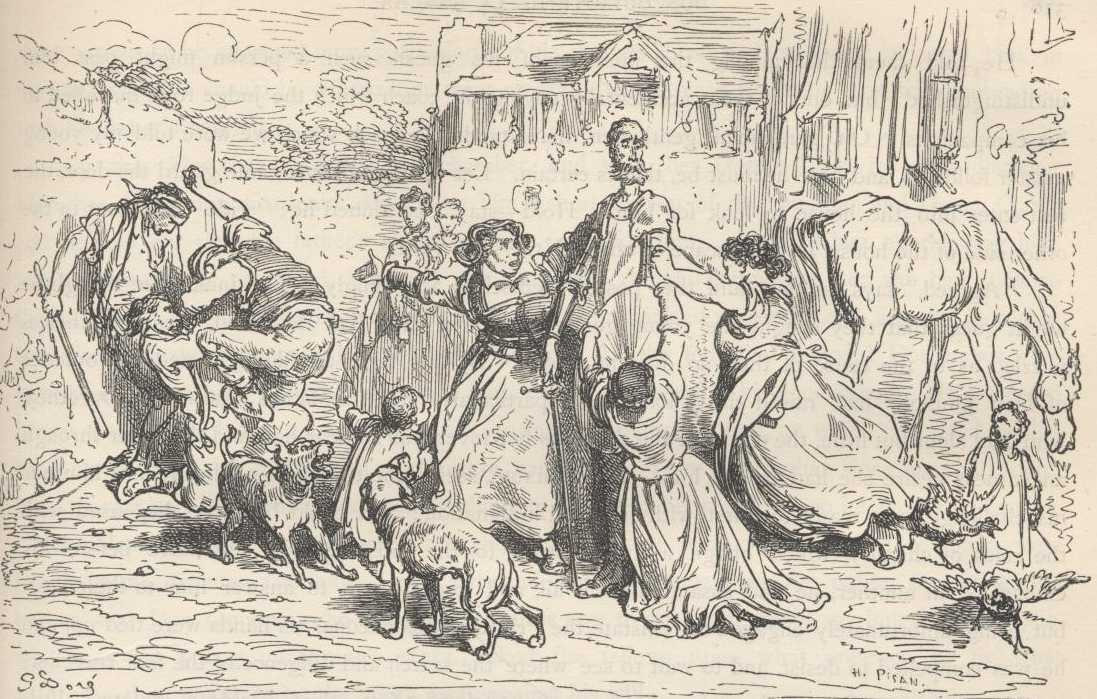
On his way home from the governorship, Sancho meets a band of foreign pilgrims begging in a language he does not know. They communicate with one German word and a set of gestures, until one of them throws his arms round Sancho in perfect Castilian. This unit is about language without grammar, and about a disguise that is also an exile.
The passage, exactly as Cervantes wrote it
Miguel de Cervantes, Part Two, Chapter 54. Unadapted.
comenzaron a cantar en su lengua lo que Sancho no pudo entender, si no fue una palabra que claramente pronunciaba limosna, por donde entendió que era limosna la que en su canto pedían; y como él, según dice Cide Hamete, era caritativo además, sacó de sus alforjas medio pan y medio queso, de que venía proveído, y dióselo, diciéndoles por señas que no tenía otra cosa que darles. Ellos lo recibieron de muy buena gana, y dijeron: — ¡Guelte! ¡Guelte! — No entiendo —respondió Sancho— qué es lo que me pedís, buena gente. Entonces uno de ellos sacó una bolsa del seno y mostrósela a Sancho, por donde entendió que le pedían dineros; y él, poniéndose el dedo pulgar en la garganta y estendiendo la mano arriba, les dio a entender que no tenía ostugo de moneda, y, picando al rucio, rompió por ellos; y, al pasar, habiéndole estado mirando uno dellos con mucha atención, arremetió a él, echándole los brazos por la cintura; en voz alta y muy castellana, dijo: — ¡Válame Dios! ¿Qué es lo que veo? ¿Es posible que tengo en mis brazos al mi caro amigo, al mi buen vecino Sancho Panza? Sí tengo, sin duda, porque yo ni duermo, ni estoy ahora borracho.
began to sing in their own language what Sancho could not understand, except for one word that they pronounced clearly, alms, from which he understood that it was alms they were begging for in their song. And since he, as Cide Hamete says, was charitable in the extreme, he took out of his saddlebags half a loaf and half a cheese that he had brought with him, and gave them to them, telling them by signs that he had nothing else to give. They received it very gladly and said: Geld! Geld! I do not understand, answered Sancho, what it is you are asking me for, good people. Then one of them took a purse out of his shirt and showed it to Sancho, from which he understood that they were asking for money. And he, putting his thumb to his throat and stretching his hand upwards, gave them to understand that he had not a scrap of coin, and, spurring on his donkey, pushed through them. And as he passed, one of them, who had been looking at him very closely, rushed at him, throwing his arms round his waist, and said in a loud voice and very Castilian: God help me! What is this I see? Is it possible that I have in my arms my dear friend, my good neighbour Sancho Panza? Yes I have, no doubt of it, because I am neither asleep nor drunk just now.
The same thing in Spanish as it is written today
Read the two side by side. What has changed between them is the syllabus of this level.
empezaron a cantar en su lengua algo que Sancho no pudo entender, salvo una palabra que pronunciaban con claridad, limosna, por la que entendió que lo que pedían en su canto era limosna. Y como él, según dice Cide Hamete, era caritativo en extremo, sacó de sus alforjas medio pan y medio queso que llevaba, y se lo dio, diciéndoles por señas que no tenía otra cosa que darles. Ellos lo recibieron con mucho gusto y dijeron: ¡Guelte! ¡Guelte! No entiendo, respondió Sancho, qué es lo que me pedís, buena gente. Entonces uno de ellos sacó una bolsa del pecho y se la enseñó a Sancho, por donde entendió que le pedían dinero. Y él, poniéndose el pulgar en la garganta y extendiendo la mano hacia arriba, les dio a entender que no tenía ni una moneda, y, arreando al burro, se abrió paso entre ellos. Y al pasar, uno de ellos, que lo había estado mirando con mucha atención, se lanzó hacia él, le echó los brazos a la cintura y dijo en voz alta y en muy buen castellano: ¡Válgame Dios! ¿Qué es lo que veo? ¿Es posible que tenga en mis brazos a mi querido amigo, a mi buen vecino Sancho Panza? Sí que lo tengo, sin duda, porque ni estoy dormido ni estoy borracho.
What changed, form by form
| In the text | Today | Why it matters |
|---|---|---|
| si no fue una palabra | salvo una palabra | Si no fue, except, frozen in the preterite. |
| caritativo además | caritativo en extremo | Además in its old sense of exceedingly, not in addition. |
| Guelte | dinero | Geld, German for money, as a Spaniard heard it. |
| del seno | del pecho | Seno for the fold of the shirt over the chest, where purses were carried. |
| ostugo | pizca | A tiny bit. A rare word even in 1615. |
| rompió por ellos | se abrió paso entre ellos | Romper por, to push through. |
| echándole los brazos por la cintura | le echó los brazos a la cintura | A gerund carrying the action, where modern Spanish prefers a finite verb. |
| en voz alta y muy castellana | en voz alta y en muy buen castellano | Castellana as an adjective of voz. His voice is Castilian, and that is what gives him away. |
| al mi caro amigo | a mi querido amigo | Article and possessive together, al mi, an archaism of affection. |
| ¿Es posible que tengo | ¿es posible que tenga | The indicative after es posible que, as in the basin unit. Normal then. |
The syntax
Two systems of communication run side by side. The pilgrims have one word of Spanish, limosna, and one of German, guelte, and everything else is done with objects and gestures: a purse, a thumb on the throat, a hand held out. Cervantes narrates each gesture and its meaning with por donde entendió que, twice, as if he were translating. Then one pilgrim speaks, and his sentence is fluent, emotional and full of Castilian idiom, which is the revelation in itself.
What a Spanish reader hears
The pilgrim is Ricote, Sancho's neighbour, a morisco expelled from Spain by the decrees of 1609 to 1614, who has come back in disguise among German pilgrims to dig up the treasure he buried before he left. His Castilian is the one thing he cannot disguise. The comedy of the gestures turns in a single line into one of the most serious scenes in the book, and the reader is meant to feel the turn: the foreigner begging in German is a Spaniard who is no longer allowed to be one.
Where the course prepares you for this
- The subjunctive, all of it at onceLesson 82Ricote, the exiled neighbour