Level A2 · Chapter 35.5
Review 7: lessons 31 to 35
The vocabulary from lessons 31 to 35 that does not come back, the grammar of the block in one table, and two exercises.
What you will learn
- Check, word by word, how much of the vocabulary from lessons 31 to 35 you actually remember.
- Say what will happen and what would happen, with the future and the conditional.
- Join two clauses with que, donde and quien, and build adverbs in -mente.
The story in easy Spanish
En aquella venta se paga la cama, la cebada y el vino.
At that inn you pay for the bed, the barley and the wine.
El ventero quiso cobrar, pero don Quijote no pagaba nunca.
The innkeeper wanted to charge them, but Don Quixote never paid.
Unos hombres cogieron a Sancho y lo mantearon con una manta.
Some men grabbed Sancho and tossed him up and down in a blanket.
Salió volando, cayó molido y perdió las alforjas.
He flew up, came down aching all over and lost his saddlebags.
Bebió un trago de bálsamo y siguió el camino lentamente.
He drank a swig of balm and went on down the road slowly.
A lo lejos se veía una gran nube de polvo.
A great cloud of dust could be seen in the distance.
Don Quijote dijo que allí venían dos ejércitos con tambores.
Don Quixote said that two armies were coming there with drums.
Eran dos rebaños de ovejas que los pastores llevaban al mercado.
They were two flocks of sheep that the shepherds were driving to market.
Atacó a los carneros y un pastor le tiró una piedra con la honda.
He charged the rams and a shepherd slung a stone at him.
Perdió media oreja y muchos dientes, pero se levantó rápidamente.
He lost half an ear and a good many teeth, but he got up quickly.
Aquella noche vieron veinte encamisados con antorchas por el camino.
That night they saw twenty men in white shirts with torches on the road.
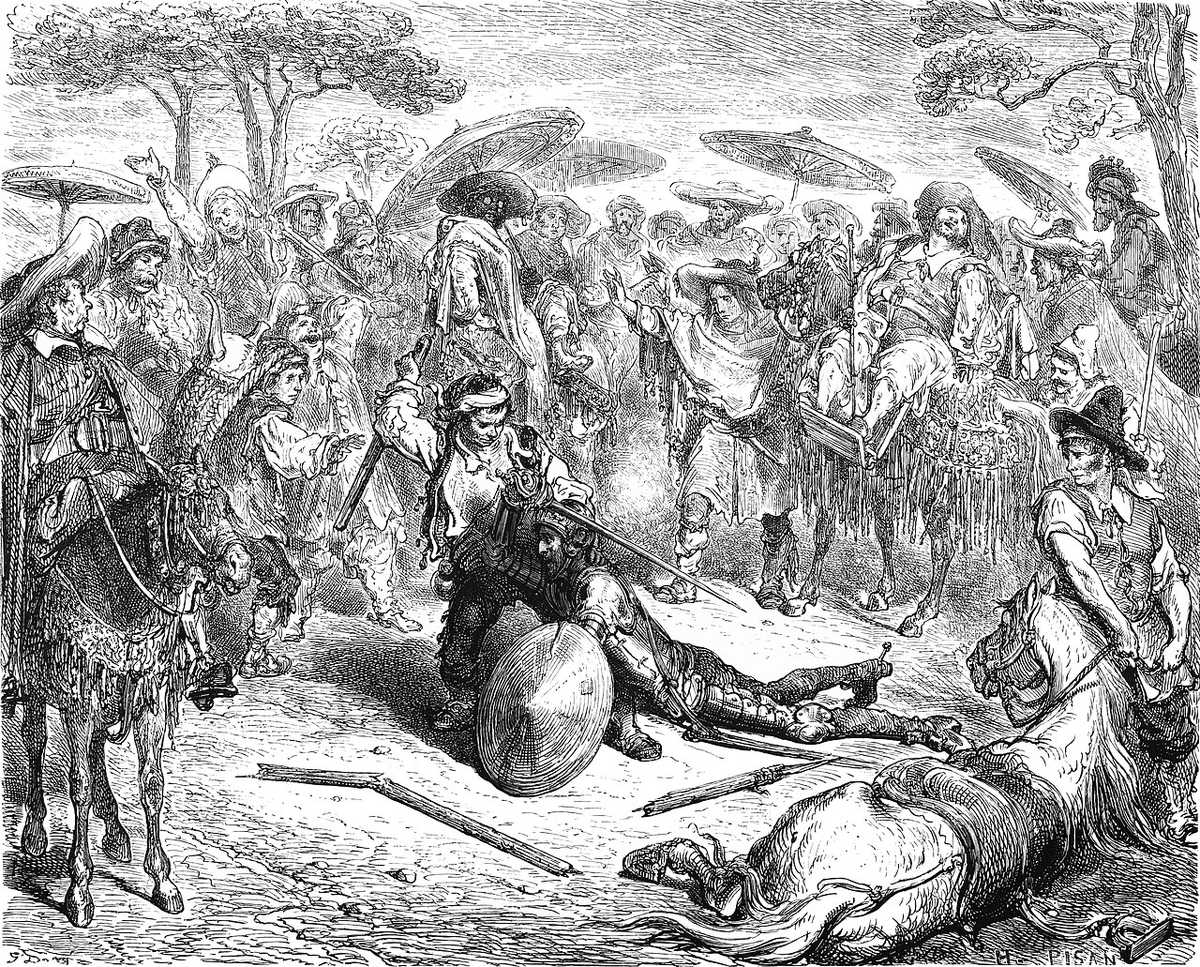
Detrás iba una litera donde llevaban un cuerpo muerto.
Behind them went a litter in which they were carrying a dead body.
El caballero creyó que eran fantasmas y pidió venganza.
The knight believed they were ghosts and demanded vengeance.
Un bachiller cayó de su mula y tuvo que rendirse.
A scholar fell off his mule and had to surrender.
Era un hombre tuerto que venía de Baeza con fiebres.
He was a one-eyed man who was coming from Baeza with a fever.
Acompañaba el cuerpo hasta su sepultura de Segovia.
He was accompanying the body to its grave in Segovia.
Después, en la oscuridad, se oyó un estruendo de mazos.
Afterwards, in the dark, a din of hammers was heard.
Sancho temblaba de espanto y no se apartaba de su amo.
Sancho was shaking with terror and would not move away from his master.
Por la mañana vieron seis batanes que sonaban tranquilamente.
In the morning they saw six fulling hammers thudding away quietly.
Sancho soltó una risa que le costó cara.
Sancho let out a laugh that cost him dear.
Vocabulary
The bill at the inn (lesson 31)
- el ventero
- the innkeeper
- cobrar
- to charge, to collect payment
- las alforjas
- the saddlebags
- la paja
- the straw
- la cebada
- the barley
- el bálsamo
- the balm
- el trago
- the swig, the gulp
- molido / molida
- aching all over
The armies of sheep (lesson 32)
- el rebaño
- the flock
- la oveja
- the sheep
- el pastor
- the shepherd
- el balido
- the bleating
- la nube de polvo
- the cloud of dust
- el ejército
- the army
- el tambor
- the drum
- la honda
- the sling
- apartarse
- to move away, to stand aside
The dead body (lesson 33)
- el encamisado
- the man in a white shirt
- la litera
- the litter
- la antorcha
- the torch
- la venganza
- the vengeance
- el fantasma
- the ghost
- rendirse
- to surrender
The scholar from Baeza (lesson 34)
- el bachiller
- the scholar, the graduate
- la sepultura
- the grave
- las fiebres
- the fever
- el recado
- the errand, the message
- enderezar
- to set straight, to right
- tuerto / tuerta
- one-eyed
- acompañar
- to go with, to accompany
- poner peor cara
- to pull a worse face
The night of the fulling hammers (lesson 35)
- el batán
- the fulling mill
- el mazo
- the mallet, the hammer
- el estruendo
- the din, the crash
- la oscuridad
- the darkness
- el espanto
- the terror
- temblar
- to shake, to tremble
- la risa
- the laugh, the laughter
- el paño
- the cloth
Lessons 31 to 35 in one table
The vocabulary list above comes first, with the English column covered. Then read the table, which is an index of the block and not a lesson to study again.
| point | rule | from the summary above |
|---|---|---|
| impersonal se | se plus a singular verb, and nobody is named | En aquella venta se paga la cama. |
| passive se | the verb agrees with the thing, not with the hidden doer | Aquí se venden ovejas. |
| simple future | the whole infinitive plus é, ás, á, emos, éis, án | Mañana atacará al rebaño. |
| irregular future | tendré, saldré, haré, diré, podré, vendré, querré, and the endings never change | Saldremos de la venta sin pagar. |
| conditional | the same stem plus ía, for what would happen if | Yo no me acercaría a los batanes. |
| relatives | que for anything, donde for a place, quien for a person after a preposition | una litera donde llevaban un cuerpo |
| adverbs in -mente | built on the feminine adjective, and any accent on it stays put | lentamente, rápidamente |
The full conjugations of the future and the conditional are in the verb tables at the back of the book. Notice there that the two share one stem, so learning the seven irregular futures buys you the seven irregular conditionals free.