Level A2 · Chapter 25.5
Review 5: lessons 21 to 25
The vocabulary from lessons 21 to 25 that does not come back, the grammar of the block in one table, and two exercises.
What you will learn
- Check, word by word, how much of the vocabulary from lessons 21 to 25 you actually remember.
- Choose between the preterite and the imperfect inside one single sentence.
- Read the summary of the whole block without looking at the translation.
The story in easy Spanish
Aquella mañana don Quijote y Sancho salieron a la llanura de Montiel.
That morning Don Quixote and Sancho rode out onto the plain of Montiel.
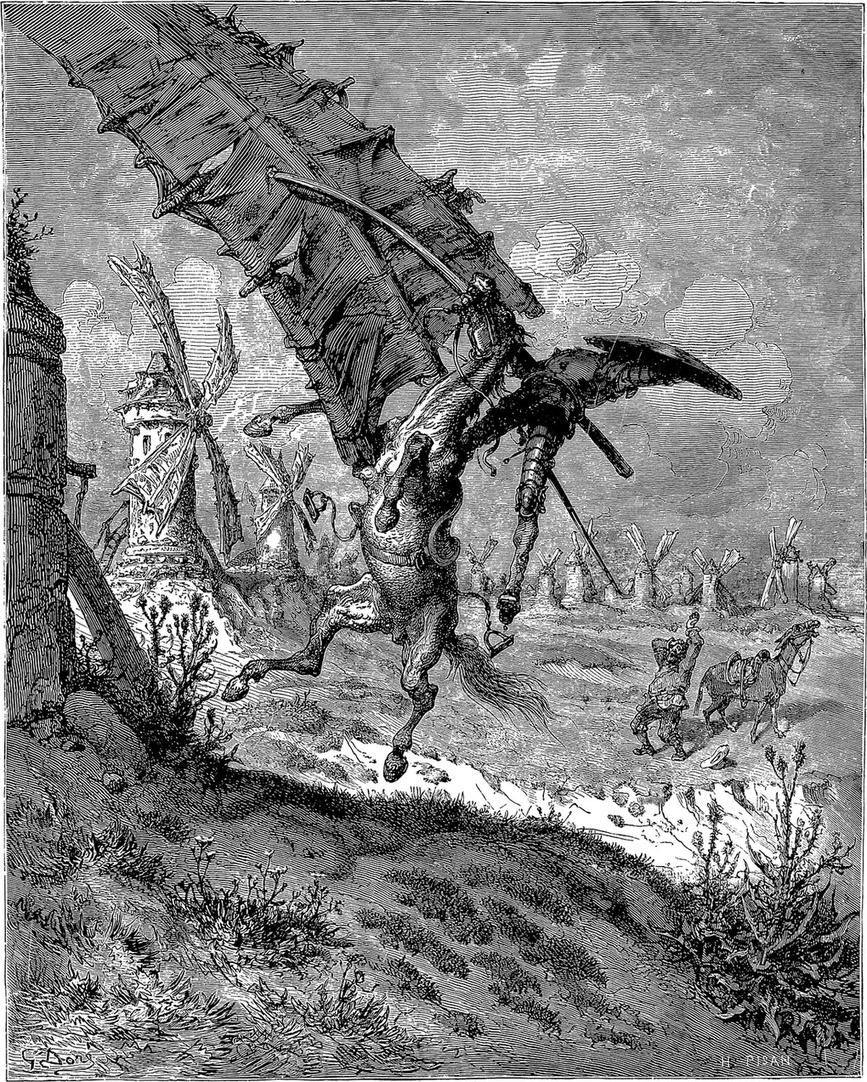
El caballero descubrió treinta molinos de viento con sus aspas enormes.
The knight made out thirty windmills with their enormous sails.
Creyó que eran gigantes y atacó con toda su fuerza.
He believed they were giants and charged with all his strength.
El viento movió un aspa y el caballo rodó por el campo.
The wind swung one sail round and the horse rolled across the field.
Sancho corrió a ayudar a su amo, que estaba muy pálido.
Sancho ran to help his master, who was very pale.
Después vieron un coche con dos frailes montados en sus mulas.
Afterwards they saw a coach with two friars riding their mules.
Detrás venía un escudero vizcaíno de muy mal genio.
Behind it came a Basque squire with a very bad temper.
Los dos pelearon y el vizcaíno se defendió con una almohada del coche.
The two of them fought and the Basque defended himself with a cushion from the coach.
El historiador árabe cortó la pelea en aquel cuaderno viejo.
The Arab historian cut the fight short in that old notebook.
Otro día llegaron a la cabaña de unos cabreros.
Another day they reached the hut of some goatherds.
Cenaron queso y bellotas debajo de una encina.
They had cheese and acorns for supper under a holm oak.
Don Quijote tomó un puñado de bellotas y habló de la edad de oro.
Don Quixote took a handful of acorns and spoke about the Golden Age.
Entonces nadie molestaba a nadie y la tierra daba comida a todos.
Back then nobody troubled anybody and the earth gave food to everyone.
Sancho se quejaba en voz baja, porque tenía una herida en la oreja.
Sancho was complaining under his breath, because he had a wound on his ear.
Le pusieron romero y sal, y la oreja dejó de arder.
They put rosemary and salt on it, and the ear stopped burning.
Antonio, el sobrino del viejo, cantó una canción y todos aplaudieron.
Antonio, the old man’s nephew, sang a song and everyone clapped.
Mientras, un estudiante rico moría de amor por la pastora Marcela.
Meanwhile, a rich student was dying of love for the shepherdess Marcela.
Era huérfano, tenía dinero y quería casarse con ella.
He was an orphan, he had money and he wanted to marry her.
Marcela nunca lo quiso, y aquella tristeza acabó en una tumba.
Marcela never loved him, and that sadness ended in a grave.
Vocabulary
The windmills (lesson 21)
- la llanura
- the plain
- el aspa
- the sail of a windmill
- la fuerza
- the strength, the force
- descubrir
- to make out, to discover
- rodar
- to roll
- ayudar
- to help
The Basque squire (lesson 22)
- el coche
- the coach, the carriage
- el fraile
- the friar
- la mula
- the mule
- el vizcaíno
- the Basque
- la almohada
- the pillow, the cushion
- el cuaderno
- the notebook
- el historiador
- the historian
- pálido / pálida
- pale
The Golden Age (lesson 23)
- la bellota
- the acorn
- la encina
- the holm oak
- el queso
- the cheese
- el puñado
- the handful
- molestar
- to trouble, to bother
- la edad de oro
- the Golden Age
Antonio’s song (lesson 24)
- la herida
- the wound
- la oreja
- the ear
- el romero
- the rosemary
- quejarse
- to complain
- arder
- to burn, to sting
- aplaudir
- to clap
- el sobrino
- the nephew
- mientras
- while, meanwhile
The dead student (lesson 25)
- el estudiante
- the student
- huérfano / huérfana
- orphan
- casarse con
- to marry someone
- la tristeza
- the sadness
Lessons 21 to 25 in one table
Start with the vocabulary list above, not with the table. Cover the English column with your hand, read the Spanish aloud, and mark every word you cannot turn into English in about three seconds. Those marked words, and only those, are your homework for this block.
| point | rule | from the summary above |
|---|---|---|
| regular preterite | hablé, hablaste, habló, and the accent is what tells hablo from habló | habló de la edad de oro |
| irregular preterite | fue, fui, estuvo, tuvo, hizo, quiso, puso, vio, and none of them takes an accent | Marcela nunca lo quiso. |
| imperfect | -aba and -ía, for background, habit and description | Entonces nadie molestaba a nadie. |
| the two together | the imperfect paints the room, the preterite is what happens in it | Sancho se quejaba porque tenía una herida. |
| telling a story | aquella mañana, después, otro día, entonces, and the tense changes with them | Otro día llegaron a la cabaña. |
The full conjugations are in the verb tables at the back of the book. This unit is not the place to learn them again, it is the place to find out whether you can use them without looking.