Level B2 · Chapter 85
The Visit to the Printing House
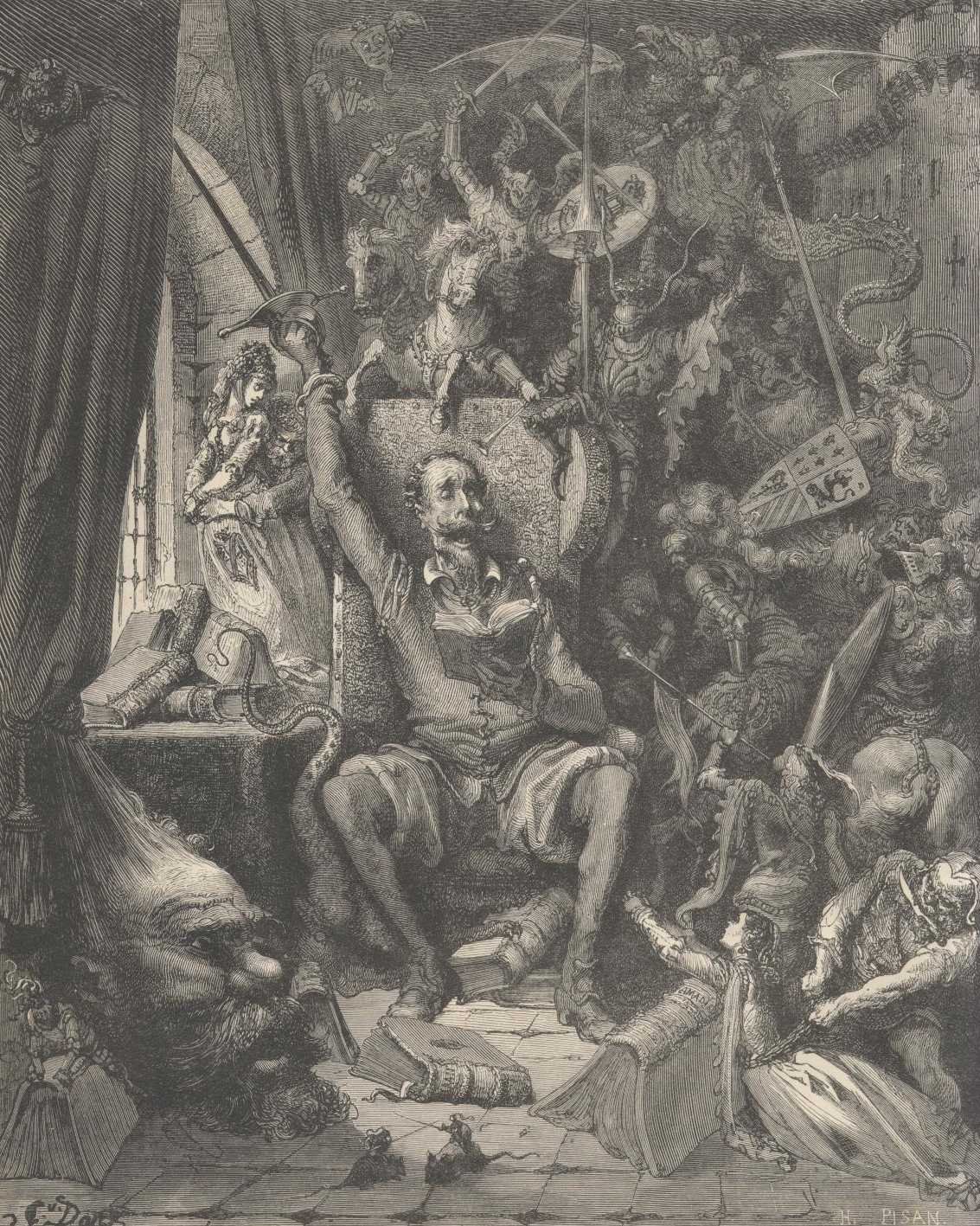
Don Quixote walks into a printing house in Barcelona and argues about translation with a man who is translating a book. At the next table a book about him is being printed.
What you will learn
- Ask and say what a word means, in five different ways.
- Say what a book is called and what it is about without always using the same formula.
- Talk about a translation, saying what it gains and what it loses.
Before you read
This chapter is a conversation about words, so it is full of the machinery Spanish uses to talk about words. Count the different ways the text says what something means or what something is called. There are at least four, they are not interchangeable, and the grammar section takes them apart afterwards.The story in easy Spanish
Aquella mañana don Quijote salió a pasear por Barcelona sin armas y a pie.
That morning Don Quixote went out to walk through Barcelona unarmed and on foot.
Iba en traje de camino, con Sancho y con dos criados que le prestó don Antonio.
He was in travelling clothes, with Sancho and two servants lent to him by Don Antonio.
Prefería andar así, porque a caballo lo seguían los muchachos por todas las calles.
He preferred to go about like that, because on horseback the boys followed him down every street.
En una calle cualquiera alzó los ojos y vio un letrero puesto sobre una puerta.
In some ordinary street he raised his eyes and saw a sign set above a doorway.
Decía en letras muy grandes que allí se imprimían libros, y aquello lo alegró mucho.
It said in very large letters that books were printed there, and that delighted him.
Nunca había visto una imprenta por dentro y quiso saber cómo era aquello.
He had never seen the inside of a printing house and he wanted to know what it was like.
Entró con toda su comitiva y se quedó parado en medio del taller, mirando.
He went in with his whole party and stopped in the middle of the workshop, looking.
En una parte tiraban de la prensa y en otra corregían pliegos que ya estaban secos.
In one place they were hauling at the press and in another they were correcting sheets that were already dry.
Unos componían con las letras sueltas en la mano y otros enmendaban lo ya compuesto.
Some were setting type with the loose letters in their hands and others were amending what had been set.
En un rincón estaban las hojas puestas a secar, colgadas como ropa lavada.
In one corner the sheets were laid out to dry, hung up like washing.
Don Quijote se acercó a cada cajón y fue preguntando qué hacía cada hombre.
Don Quixote went up to each type case and asked what each man was doing.
Los oficiales le daban cuenta con paciencia, y él se admiraba y pasaba adelante.
The workmen explained it to him patiently, and he marvelled and moved on.
En una de las mesas encontró a un hombre de buen talle que traducía un libro.
At one of the tables he found a well set up man who was translating a book.
Le preguntó el título, y el traductor contestó que en toscano se llamaba Le bagatele.
He asked him the title, and the translator answered that in Tuscan it was called Le bagatele.
En castellano aquello venía a ser algo así como Los juguetes.
In Castilian that came out as something like The Trifles.
Era un libro humilde de nombre, dijo, pero con cosas buenas y sustanciales dentro.
It was a humble book by its name, he said, but with good and solid things inside it.
Don Quijote sabía algún tanto de italiano y quiso lucirlo con una prueba pequeña.
Don Quixote knew a certain amount of Italian and wanted to show it off with a small test.
Le preguntó cómo traducía piñata, y el otro contestó al momento que olla.
He asked him how he translated piñata, and the other man answered at once, olla.
Apostó entonces que traducía piache por place, più por más y giù por abajo.
He then wagered that he translated piache as place, più as más and giù as abajo.
El traductor dijo que sí, que ésas eran exactamente sus propias correspondencias.
The translator said yes, that those were exactly the words that answered to them.
Entonces don Quijote soltó la opinión que traía ya formada sobre aquel oficio.
Then Don Quixote delivered the opinion of the trade that he already had ready.
Traducir de una lengua fácil a otra fácil no prueba ingenio ninguno ni estilo.
Translating from one easy language into another proves no wit at all and no style.
Lo comparó con copiar un papel de otro papel, que tampoco prueba nada.
He compared it to copying one sheet of paper from another, which proves nothing either.
Y le puso encima la comparación que él tenía guardada para estos casos.
And on top of that he gave him the comparison he kept in reserve for such occasions.
Traducir de una lengua a otra era como mirar los tapices flamencos por el revés.
Translating from one language into another was like looking at Flemish tapestries from the back.
Las figuras se ven, pero salen llenas de hilos que las oscurecen y las estropean.
The figures can be seen, but they come out full of threads that blur them and spoil them.
No se ven con la lisura ni con el color que tienen por el derecho.
They are not seen with the smoothness or the colour they have on the right side.
Con todo, no despreció al hombre, y le dijo que había traductores excelentes.
For all that, he did not look down on the man, and told him there were excellent translators.
Le preguntó luego si imprimía por su cuenta o si había vendido el privilegio.
He then asked him whether he was printing at his own expense or had sold the rights.
Por su cuenta, contestó, y esperaba ganar mil ducados con dos mil ejemplares.
At his own expense, he answered, and he hoped to make a thousand ducats on two thousand copies.
Don Quijote le dijo que echaba mal las cuentas y que no conocía a los impresores.
Don Quixote told him his sums were wrong and that he did not know printers.
El otro respondió que no imprimía por fama, que fama ya tenía, sino por provecho.
The other man replied that he was not printing for fame, which he already had, but for profit.
En el cajón siguiente estaban corrigiendo un libro de devoción llamado Luz del alma.
At the next case they were correcting a devotional book called Light of the Soul.
Don Quijote dijo que ésos eran precisamente los libros que se debían imprimir.
Don Quixote said that those were precisely the books that ought to be printed.
En el de más allá corregían la segunda parte de un hidalgo de la Mancha.
At the one beyond that they were correcting the second part of a gentleman of La Mancha.
La había escrito, según decían allí, un tal vecino de Tordesillas.
It had been written, they said there, by a certain fellow from Tordesillas.
Don Quijote dijo que ya tenía noticia de aquel libro y que lo creía quemado.
Don Quixote said he had already heard of that book and believed it burned.
Y salió de la imprenta con muestras de despecho, sin volver la cabeza.
And he walked out of the printing house showing his annoyance, without turning his head.
Nunca se le ocurrió preguntar por el otro libro, el verdadero, el que iba ganando.
It never occurred to him to ask about the other book, the true one, the one that was winning.
Aquella misma mañana, en aquel mismo taller, podían estar componiendo su historia.
That very morning, in that very workshop, they might have been setting his own story in type.
Vocabulary
The printing workshop
- la imprenta
- the printing house
- la prensa
- the press
- el pliego
- the printed sheet
- el cajón
- the type case
- componer
- to set type
- enmendar
- to correct, to amend
- el oficial
- the journeyman
- el letrero
- the sign
The book as a business
- el ejemplar
- the copy
- el privilegio
- the printing rights
- el librero
- the bookseller
- la impresión
- the print run
- imprimir por su cuenta
- to print at one’s own expense
- el provecho
- the profit, the gain
- echar las cuentas
- to do the sums
- el título
- the title
Saying what something means
- venir a ser
- to come out as
- querer decir
- to mean
- la correspondencia
- the equivalent word
- el tapiz
- the tapestry
- el revés
- the wrong side
- el derecho
- the right side
- la lisura
- smoothness
- el despecho
- annoyance
Saying what a word means and what a book is called
El libro, en toscano, se llama Le bagatele.
Le bagatele viene a ser en castellano Los juguetes.
Piñata se traduce por olla.
This chapter is two men arguing about words, so the Spanish in it is the Spanish you need whenever you talk about language itself. That is a bigger part of a learner’s day than of anyone else’s: you spend hours asking what things mean, and there are six formulas for it that native speakers keep strictly apart.
1. What it is called
| Spanish | English | used for |
|---|---|---|
| El libro se llama Le bagatele. | The book is called Le bagatele. | anything at all |
| La obra se titula Luz del alma. | The work is entitled Light of the Soul. | books, films, songs only |
| Se conoce como el Caballero de los Leones. | He is known as the Knight of the Lions. | a name people use, not the official one |
Note the se. English says the book is called with a passive. Spanish uses the reflexive verb llamarse, and ✗ el libro es llamado is not Spanish outside a legal document.
2. What it means
| Spanish | English | register |
|---|---|---|
| ¿Qué quiere decir bagatela? | What does bagatela mean? | spoken, the everyday one |
| Bagatela significa cosa de poco valor. | Bagatela means a thing of little value. | written, dictionary |
| Bagatela viene a ser un juguete. | Bagatela amounts to a toy. | approximate, on purpose |
| Bagatela equivale a trifle. | Bagatela is the equivalent of trifle. | technical, comparing two systems |
Two of these are worth learning as a pair. Querer decir is what you say out loud, and it also works with a person as its subject: ¿qué quieres decir con eso?, what do you mean by that. Significar almost never takes a person: ✗ ¿qué significas? is not a question anybody asks. So the rule is simple. Words significan. People quieren decir.
Venir a ser is the one worth stealing. It marks the translation as loose and saves you from claiming more than you can: sobremesa viene a ser the time you stay at the table after eating. Every learner needs that hedge daily and most never find it.
3. How you translate it
| Spanish | trap |
|---|---|
| traducir del italiano al español | de and a, never en |
| traducir piñata por olla | por for the word chosen |
| ¿Cómo se dice table en español? | the question you will ask most |
| En español no hay palabra para eso. | the honest answer, often |
4. Talking about the book itself
Tratar de, which you met at B1, says what a book is about: trata de un hidalgo que enloquece. Beside it put tratarse de, impersonal and with no subject: se trata de una traducción del toscano, it is a matter of a translation from Tuscan. The two are one letter apart and do different jobs, and mixing them is the commonest mistake in this whole area.
The book being printed behind him
In 1614, while Cervantes was writing the second part of his own novel, somebody else published one. It came out under the name Alonso Fernández de Avellaneda, which nobody has ever identified, it was printed in Tarragona, and its prologue insulted Cervantes for being old, poor and one-handed. Cervantes was sixty-seven and had about two years left. What he did with the insult is the most interesting thing in this chapter.
He did not answer it in a preface. He put it inside the story. From that point on, the false book exists in the world Don Quixote walks through: characters mention it, one of them swears he met the other Don Quixote, and here the hero stands in a Barcelona workshop watching the proofs of the counterfeit go past on a table. The revenge is structural rather than personal. The real Don Quixote gets to see the fake one being made, disapprove of it and walk out.
And then comes the detail that lifts the scene. He never asks about his own book. He knows it exists, he discussed it at length twenty chapters earlier, and here, standing in a printing house, it does not cross his mind to ask whether they are printing the true history of his deeds. A press was a loud, crowded, half-industrial place in 1615, and Cervantes had watched his own sheets come off one. He put his character in the room where his character was being manufactured, and let him miss it.
Cervantes in the original · «me parece que el traducir de una lengua en otra…»
me parece que el traducir de una lengua en otra, como no sea de las reinas de las lenguas, griega y latina, es como quien mira los tapices flamencos por el revés, que, aunque se veen las figuras, son llenas de hilos que las escurecen, y no se veen con la lisura y tez de la haz
it seems to me that translating from one language into another, unless it is from the queens of languages, Greek and Latin, is like someone looking at Flemish tapestries from the back, for although the figures can be seen, they are full of threads that darken them, and they are not seen with the smoothness and surface of the right side
From II, 62, and it is the most quoted thing ever said in Spanish about translation. Three details are worth having. First the spelling: veen is the old form of ven, escurecen of oscurecen, and la haz is the face or right side of a cloth, the opposite of el revés. Second the exemption. Don Quixote lets Greek and Latin off, which was the standard view of his century and is the part everybody forgets when they quote him. Third, and this is the reason the line is not simply an insult to translators, the man who wrote it spent his working life inside translation and knew the trade from the floor. Cervantes praises two named translators by name three lines later. And the novel containing this speech presents itself as a translation, made in Toledo by an anonymous Morisco, of an Arabic manuscript by Cide Hamete Benengeli. So the sharpest attack on translation in Spanish literature appears inside a book that claims to be one, spoken by a character who is at that moment standing in the printing house where his own translated history could be coming off the press. Cervantes is not saying translation is worthless. He is saying you are reading the back of the tapestry right now and had better remember it.