Level B2 · Chapter 79
The Judgements of Sancho
Three lawsuits in one morning, and a judge who cannot read settles all three by watching what people do with their hands.
What you will learn
- Chain reasons together to reach a conclusion.
- Say why you decided something, not only what you decided.
- Use the connectors that hold a Spanish argument together.
Before you read
Watch the little words that tie one reason to the next: porque, puesto que, de modo que, por tanto, en cambio. Sancho never announces a verdict on its own. He always shows the step that got him there, and those steps are what this lesson is about.The story in easy Spanish
Los duques, para reírse de él, le habían dado a Sancho el gobierno de la ínsula Barataria.
The duke and duchess, to amuse themselves at his expense, had given Sancho the government of Barataria.
Apenas tomó posesión, lo llevaron a la sala de audiencias y lo sentaron en una silla alta.
He had barely taken office when they led him to the courtroom and sat him on a high chair.
Le dijeron que allí se gobernaba, que oyera los pleitos y que sentenciara.
They told him that this was where governing happened, that he was to hear the cases and pass sentence.
El primer pleito fue el de un sastre y un labrador que discutían por un paño.
The first case was between a tailor and a farmer arguing over a piece of cloth.
El labrador había ido subiendo el número de caperuzas y el sastre había cosido cinco diminutas.
The farmer had kept raising the number of caps and the tailor had sewn five tiny ones.
Sancho lo pensó despacio y sentenció que el sastre perdiera el trabajo y el labrador el paño.
Sancho thought it over slowly and ruled that the tailor should lose his labour and the farmer his cloth.
Las caperuzas se llevarían a los presos, puesto que ninguno de los dos las merecía.
The caps would go to the prisoners, since neither of the two deserved them.
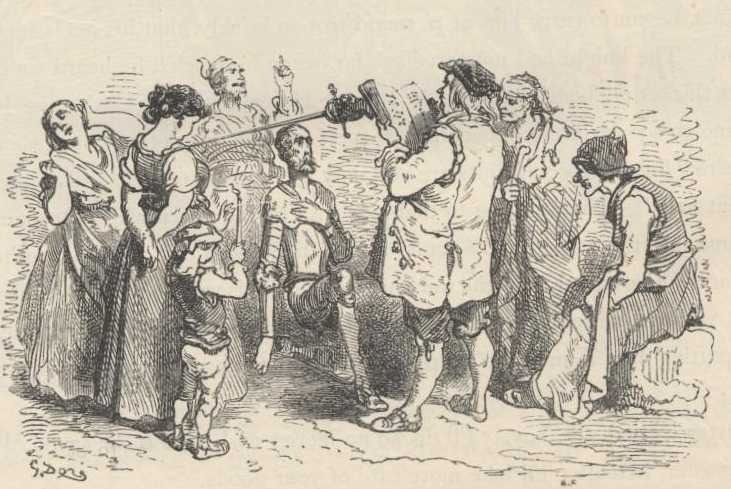
Vinieron después dos viejos, y uno de ellos traía un báculo grueso en la mano.
Next came two old men, and one of them carried a thick staff in his hand.
El que no llevaba báculo reclamaba diez escudos de oro que había prestado hacía tiempo.
The one without a staff was claiming ten gold escudos he had lent some while before.
Dijo que se los había pedido muchas veces y que el otro se los negaba.
He said he had asked for them many times and that the other man denied the whole thing.
Añadió que no tenía testigos, y que se conformaba con que el deudor jurase.
He added that he had no witnesses, and that he would be satisfied if the debtor swore an oath.
El viejo del báculo aceptó, y antes de jurar le dio el báculo al otro para tener las manos libres.
The old man with the staff agreed, and before swearing he handed it to the other so as to have his hands free.
Puso la mano sobre la vara del gobernador y juró que se los había devuelto en mano.
He laid his hand on the governor’s rod and swore that he had given them back in person.
Acabado el juramento, tomó otra vez su báculo y se fue de la sala con la cabeza baja.
The oath finished, he took his staff back and left the room with his head down.
El acreedor dijo entonces que su vecino era hombre de bien y que ya no le pediría nada.
The creditor then said that his neighbour was an honest man and that he would ask him for nothing more.
A Sancho, en cambio, le quedó dando vueltas aquel cambio de mano.
Sancho, however, could not stop turning that passing of the staff over in his mind.
Mandó llamar al viejo, le pidió el báculo y se lo entregó al acreedor delante de todos.
He sent for the old man, asked him for the staff and handed it to the creditor in front of everyone.
Dijo que con aquello quedaba pagado, y mandó abrir la caña por el medio.
He said that with that the debt was settled, and ordered the cane to be split open.
Dentro estaban los diez escudos, y los circunstantes quedaron admirados.
Inside were the ten escudos, and the bystanders were astonished.
Le preguntaron cómo lo había sabido, y él explicó su razonamiento paso a paso.
They asked him how he had known, and he explained his reasoning step by step.
El hombre había jurado que le había dado el dinero en mano, y aquello era verdad.
The man had sworn that he had given him the money in his hand, and that was true.
Como se lo había dado dentro del palo, el juramento era verdad en la letra y mentira en todo lo demás.
Since he had given it inside the stick, the oath was true to the letter and false in everything else.
El tercer caso fue el más delicado de los tres.
The third case was the most delicate of the three.
Una mujer entró arrastrando a un ganadero rico y gritando que la había forzado en el campo.
A woman came in dragging a rich herdsman and shouting that he had forced her in the field.
Él lo negaba y decía que le había pagado lo suyo y que ella no quedó contenta.
He denied it and said he had paid her what was due and that she was not satisfied.
Sancho le preguntó si llevaba dinero encima, y el hombre sacó una bolsa de cuero.
Sancho asked him whether he had money on him, and the man produced a leather purse.
Mandó que se la entregase allí mismo, y a ella, que saliera de la sala con ella.
He ordered him to hand it over there and then, and ordered her to leave the room with it.
La mujer se fue dando las gracias y sujetando la bolsa con las dos manos.
The woman went out thanking him and holding the purse with both hands.
Apenas salió, Sancho mandó al ganadero que fuera tras ella y se la quitara.
The moment she was gone, Sancho told the herdsman to go after her and take it back.
Volvieron los dos forcejeando, y ella no soltaba la bolsa por nada del mundo.
The two of them came back grappling, and she would not let go of the purse for anything.
Sancho le hizo dar la bolsa, se la devolvió al ganadero y le habló a ella muy despacio.
Sancho made her hand it over, gave it back to the herdsman and spoke to her very slowly.
Le dijo que si hubiera defendido su cuerpo con la mitad de aquel ánimo, no se lo habrían quitado.
He told her that if she had defended her body with half that spirit, it would not have been taken from her.
Los criados del duque, que estaban allí para reírse, se quedaron callados.
The duke’s servants, who were there to laugh, fell silent.
Habían venido a ver a un labrador hacer el ridículo y estaban viendo juzgar con tino.
They had come to watch a farmhand make a fool of himself and were watching sound judgement instead.
El que escribía cada palabra suya no acababa de decidir si era tonto o discreto.
The man writing down his every word could not make up his mind whether he was a fool or a wise man.
Vocabulary
The courtroom
- la sala de audiencias
- the courtroom
- sentenciar
- to pass sentence
- la vara
- the rod of office
- el circunstante
- the bystander
- el testigo
- the witness
- jurar en falso
- to swear falsely
- el tino
- good judgement
- hacer el ridículo
- to make a fool of oneself
Lent money
- el deudor
- the debtor
- el acreedor
- the creditor
- reclamar
- to claim
- devolver
- to give back
- el báculo
- the walking staff
- quedar pagado
- to be settled
- en la letra
- to the letter
- dar vueltas a algo
- to turn something over in one’s mind
The case of the purse
- el ganadero
- the herdsman
- forcejear
- to grapple
- soltar
- to let go of
- sujetar
- to hold tight
- el ánimo
- the nerve, the spirit
- admirado
- astonished
- delicado
- delicate, awkward
- negar
- to deny
Chaining reasons together
Le dio el báculo antes de jurar, de modo que dentro estaba el dinero.
Puesto que ninguno de los dos las merece, las caperuzas van a los presos.
Defendió la bolsa con mucho ánimo. Por tanto, pudo defenderse a sí misma.
An argument in Spanish is built from four kinds of joint, and choosing the wrong one is the commonest way a learner’s reasoning stops making sense.
Reason first, or conclusion first
| connector | what follows it | example |
|---|---|---|
| porque | the reason, and it cannot start the sentence | Lo dejo pasar porque las razones están iguales. |
| puesto que, ya que, como | the reason, and these can start the sentence | Como las razones están iguales, lo dejo pasar. |
| por tanto, por consiguiente | the conclusion, formal | Juró en falso. Por tanto, devuelva el dinero. |
| así que, de modo que, o sea que | the conclusion, spoken | Le dio el palo, así que el dinero iba dentro. |
| luego | the conclusion, in strict logic | Miente, luego debe el dinero. |
Luego is worth a second look. In ordinary Spanish it means later, but between two clauses of an argument it means therefore, exactly as in pienso, luego existo. Context tells you which, and the comma helps.
Turning against your own reason
| connector | use |
|---|---|
| en cambio | contrasts two people or two cases |
| sin embargo, no obstante | admits the reason and rejects the conclusion |
| ahora bien | opens a serious objection, very common in speech |
| aunque | indicative for a known fact, subjunctive for a supposition |
That last row matters and it is easy to miss. Aunque juró means he did swear and I know it. Aunque jure means even if he should swear, which nobody has done yet.
Two closing formulas from this chapter
A juicio de buen varón means judged by plain common sense rather than by the letter of the law, and it is still used. Y no haya más is how Sancho ends a ruling, and it is the plainest possible case closed.
The wise judge who cannot read
None of these three cases is original. The staff with the coins inside travels through medieval collections of judge stories and turns up in the Talmud, in Arabic anthologies and in Spanish exempla, always attributed to a famous wise judge. Cervantes keeps the plots and changes the judge. Instead of Solomon he gives you a farmhand who has just asked to have it minuted that he cannot sign his name, and the same rulings come out.
The third case does not read the same way now, and it should not. Sancho tests a rape accusation by staging a robbery and measuring how hard the woman fights, then concludes from her grip on a purse that she cannot have been forced. That is not evidence and the reasoning is bad, whatever the seventeenth century thought of it. It is worth reading the scene knowing that the man writing it also wrote Marcela, who in the first part faces down a crowd of men and tells them her beauty does not oblige her to love anyone. Cervantes gives his characters better arguments than his age had, and sometimes worse ones, and this is one of the worse.
The line that closes the episode is the one to keep. The chronicler taking down Sancho’s every word cannot decide whether to file him as a fool or as a wise man. Nobody in the book ever settles it, and neither does Cervantes.
Cervantes in the original · «los circunstantes quedaron admirados de nuevo de…»
los circunstantes quedaron admirados de nuevo de los juicios y sentencias de su nuevo gobernador
the bystanders were astonished once again at the judgements and rulings of their new governor
Cervantes uses this sentence to close the third case, and the two words that carry it are de nuevo. It has happened before, twice, in the same morning. The room came in expecting a clown and keeps having to revise its opinion. Admirado is a false friend worth fixing in place here: in this Spanish it means astonished, struck, taken aback, not full of admiration, and the modern verb admirar has drifted towards the English sense while the participle in fixed phrases like quedar admirado has kept the old one. Note also circunstantes, literally those standing around, which is still the exact word for the people present at an event and is worth knowing because it appears in every account of a trial in this period.