Level B2 · Chapter 72
Paying for the Broken Puppets
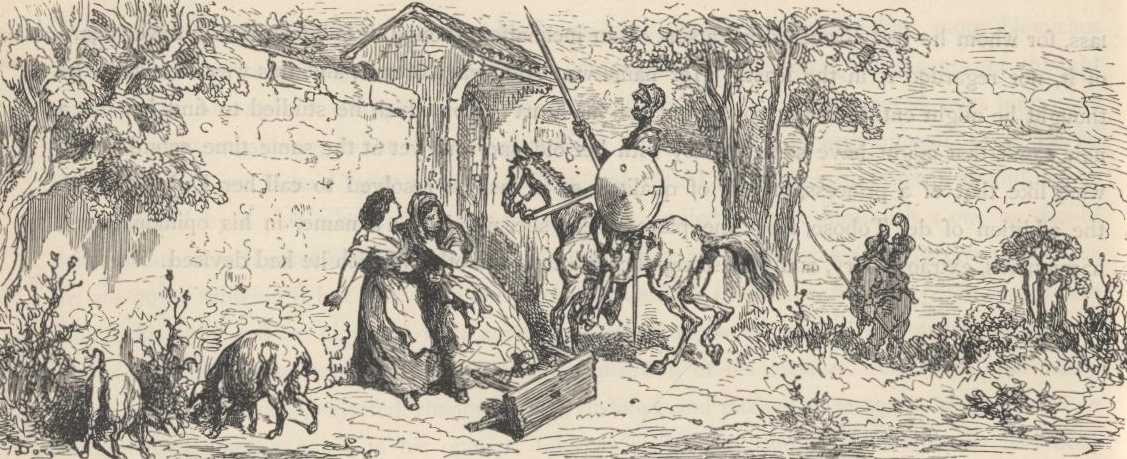
Don Quixote charges into the puppet theatre with his sword to save two wooden figures. Afterwards he pays for the damage piece by piece, with haggling.
What you will learn
- Understand set phrases that do not mean what their words say.
- Exaggerate in Spanish using the formulas the language keeps for it.
- Recognise the register of the inn, which is ordinary street Spanish.
Before you read
This text is built out of set phrases. Blood goes up to a head, heels get trodden on, bread is taken out of a mouth, and something is done in the time it takes to say two creeds. None of them mean what the individual words mean, and you cannot work any of them out by translating. Read the story once for the plot and mark every phrase that looks odd literally. There are about a dozen.The story in easy Spanish
El muchacho dijo que los moros iban ya pisando los talones a los dos fugitivos.
The boy said that the Moors were already treading on the two fugitives’ heels.
Al oírlo, a don Quijote se le subió la sangre a la cabeza de golpe.
On hearing it, the blood rushed to Don Quixote’s head all at once.
Sacó la espada, dio un salto y se plantó delante del retablo de un brinco.
He drew his sword, leapt up and planted himself in front of the theatre in one bound.
Gritó que no consentiría semejante atropello mientras él viviese en este mundo y tuviese espada.
He shouted that he would not allow such an outrage while he lived in this world and had a sword.
Empezó a repartir cuchilladas a diestro y siniestro, sin mirar a quién ni pensarlo dos veces.
He began laying about him left and right, without looking at whom or thinking twice.
En dos credos dejó el retablo hecho una lástima, sin dejar figura entera.
In the time it takes to say two creeds he reduced the theatre to a sorry state, leaving no figure whole.
Descabezó moros, partió caballos por la mitad y tiró al suelo el castillo de Zaragoza.
He beheaded Moors, split horses down the middle and brought the castle of Saragossa to the floor.
Estuvo a punto de rebanarle una oreja a maese Pedro, que se agachó a tiempo.
He came within an inch of slicing off Master Pedro’s ear, who ducked in time.
El titiritero se echó al suelo entre los muñecos rotos y se puso a dar voces.
The puppeteer threw himself down among the broken figures and started shouting.
Gritaba que aquel hombre lo había arruinado y le había quitado el pan de la boca.
He was shouting that this man had ruined him and taken the bread out of his mouth.
Decía que ya podía irse a pedir limosna por los caminos de Aragón y de Castilla.
He said he might as well go and beg on the roads of Aragon and Castile.
El mono se había subido al tejado desde el primer espadazo y no bajaba.
The ape had climbed onto the roof at the very first sword stroke and would not come down.
Cuando se calmó todo, don Quijote explicó su versión con mucha tranquilidad y sin levantar la voz.
When things quietened down, Don Quixote explained his version very calmly and without raising his voice.
Dijo que los encantadores que lo persiguen le habían puesto delante una batalla verdadera.
He said that the enchanters who pursue him had set a real battle in front of him.
Dijo que él había acudido a socorrer a los perseguidos, como manda su oficio.
He said that he had come to the aid of the pursued, as his calling requires.
Pero añadió enseguida que pagaría todo lo roto, hasta el último muñeco de madera.
But he added at once that he would pay for everything broken, down to the last wooden figure.
Allí mismo se hizo la cuenta, figura por figura, sobre una mesa de la venta.
The reckoning was done there and then, figure by figure, on a table in the inn.
El ventero hizo de tasador y Sancho se puso al lado del titiritero a regatear.
The innkeeper acted as valuer and Sancho stood beside the puppeteer to haggle.
Maese Pedro pidió por el rey Marsilio, que estaba sin cabeza, cinco reales y cuartillo.
Master Pedro asked five reales and a quarter for King Marsilio, who had no head left.
Sancho le rebajó a cuatro, y así fueron bajando de figura en figura.
Sancho beat him down to four, and so they went on down, figure by figure.
Por el emperador Carlomagno, que estaba partido en dos, pidió otro tanto de dinero.
For the Emperor Charlemagne, who was split in two, he asked as much again.
Por Melisendra, que había perdido la nariz y un ojo, quiso cobrar el doble.
For Melisendra, who had lost her nose and one eye, he wanted to charge double.
Sancho dijo que la señora iba camino de Francia con su marido y a buen paso.
Sancho said the lady was on her way to France with her husband and going at a good pace.
Dijo que sería mejor buscarla en la frontera antes de cobrarla como muerta.
He said it would be better to look for her at the border before charging for her as a corpse.
Todos se rieron menos maese Pedro, que llevaba la cuenta apuntada en un papel.
Everyone laughed except Master Pedro, who was keeping the account written down on a paper.
La cuenta subió a cuarenta reales y tres cuartillos, sin contar todavía el mono.
The bill came to forty reales and three quarters, not yet counting the ape.
Don Quijote los pagó sin rechistar y sacó el dinero delante de todos.
Don Quixote paid it without a murmur and took the money out in front of everyone.
Añadió dos reales más por el trabajo de cazar al animal del tejado.
He added two reales more for the trouble of catching the animal off the roof.
Aquella noche cenaron todos juntos y en paz, como si allí no hubiera pasado nada.
That night they all had supper together in peace, as if nothing had happened there.
Al día siguiente, maese Pedro se marchó antes del amanecer con el retablo a cuestas.
The next day Master Pedro left before dawn with the theatre on his back.
Don Quijote quedó convencido de que todo había sido cosa de los encantadores de siempre.
Don Quixote remained convinced that the whole thing had been the work of the usual enchanters.
Sancho pensó que aquel hombre del parche verde le sonaba mucho de alguna parte.
Sancho thought that the man with the green patch looked very familiar from somewhere.
No supo de qué le sonaba, y prefirió no decirle nada a su amo.
He could not think from where, and preferred to say nothing to his master.
Vocabulary
Wrecking the theatre
- la cuchillada
- the sword slash
- descabezar
- to behead
- rebanar
- to slice off
- agacharse
- to duck
- el muñeco
- the figure, the doll
- el atropello
- the outrage
- socorrer
- to come to the aid of
- arruinar
- to ruin
Set phrases from the inn
- pisar los talones
- to be hot on somebody’s heels
- subírsele la sangre a la cabeza
- for the blood to rush to your head
- a diestro y siniestro
- left, right and centre
- en dos credos
- in no time at all
- hecho una lástima
- in a sorry state
- quitar el pan de la boca
- to take the bread out of somebody’s mouth
- sin rechistar
- without a murmur
- sonarle a alguien
- to ring a bell with somebody
The reckoning
- el tasador
- the valuer
- tasar
- to value
- regatear
- to haggle
- rebajar
- to knock the price down
- el cuartillo
- the quarter real
- cobrar
- to charge for
- a cuestas
- on your back
- el tejado
- the roof
Set phrases and ways of exaggerating
A don Quijote se le subió la sangre a la cabeza.
En dos credos dejó el retablo hecho una lástima.
Aquel hombre le había quitado el pan de la boca.
An idiom is a single item of vocabulary that happens to be several words long. You cannot take it apart, you cannot swap a word for a synonym, and you cannot translate it. Pisar los talones is to be hot on somebody’s heels, but ✗ pisar los pies is nothing at all.
1. The dozen in this text
| Spanish | English | literally |
|---|---|---|
| pisar los talones | be hot on the heels of | tread on the heels |
| subírsele la sangre a la cabeza | see red | the blood goes up to the head |
| a diestro y siniestro | left, right and centre | to right and left |
| en dos credos | in no time | in two creeds |
| hecho una lástima | in a sorry state | made a pity |
| quitar el pan de la boca | take the food off the table | take the bread out of the mouth |
| estar a punto de | be about to | be at the point of |
| sin rechistar | without a murmur | without a squeak |
| sonarle a alguien | ring a bell | sound to somebody |
| a cuestas | on your back | on the slopes |
2. How Spanish exaggerates
Three devices, all in this chapter. Absurd measurement: en dos credos, de tres leguas a la redonda, a cien leguas. The unit is real and the quantity is not. The suffix -ísimo: rapidísimo, muchísimo, malísimo, which is stronger than muy and much more common in speech than English extremely. The prefix re- and its bigger brothers: rebueno, requetebueno, informal and affectionate.
3. Register
Everything on this page is spoken Spanish. It belongs in an inn, in a market and in conversation, and it would look wrong in a formal letter. Two lessons from now you will read a duke and a duchess talking, and not one of these phrases will appear. That contrast is deliberate, and it is a large part of what Cervantes is doing.
The joke is not the wreckage, it is the invoice
The sword fight lasts two minutes and Cervantes gives it half a paragraph. The valuation lasts far longer and he writes it out in full, item by item, with the prices, the haggling and the small change. That inversion is the whole joke. Anybody can wreck a puppet theatre. What is funny is a headless King Marsilio being priced at five reales and a quarter, Sancho beating it down to four, and an emperor of the West going for the same money as a horse.
There is a serious idea inside the farce, and it is the idea the second part of the novel keeps returning to. Fiction has a price. Don Quixote broke the story and now he pays for it in coin, in front of witnesses, with a valuer appointed. It is the same move as the notarised statement after the lions: the deed becomes paperwork. Cervantes is the first novelist to keep charging his hero for the damage.
And the man collecting the money is Ginés de Pasamonte, who owes Don Quixote his freedom and who stole Sancho’s donkey. He walks off before dawn with forty-two reales and the theatre on his back. Nobody ever tells Don Quixote who he was. Sancho half recognises him and says nothing, which is the most human thing in the chapter, and the debt from the first part is never settled.
Cervantes in the original · «que es de la hermosa Melisendra, quiero…»
que es de la hermosa Melisendra, quiero, y me pongo en lo justo, dos reales y doce maravedís
for the one that is of the fair Melisendra I want, and I am asking no more than is fair, two reales and twelve maravedis
Master Pedro says this in II, 26 while pricing the wreckage, and the sentence is a small machine for producing laughter. It runs three registers through one clause. It opens in the language of chivalric romance, la hermosa Melisendra, the fair Melisendra, exactly as the ballads call her. It closes in small change: two reales and twelve maravedis, a maravedi being a coin so minor that thirty-four of them made a real. And wedged between the two is me pongo en lo justo, the standard formula of a Spanish market haggle, meaning I am asking no more than is fair, which is what every trader says immediately before being beaten down. Melisendra is a princess in a ballad, a wooden doll with her nose knocked off, and a line item on an invoice, all inside fifteen words. The idiom is worth keeping. Spaniards still say it, and it still means the same thing.