Level B1 · Chapter 57
Their Story Is in Print
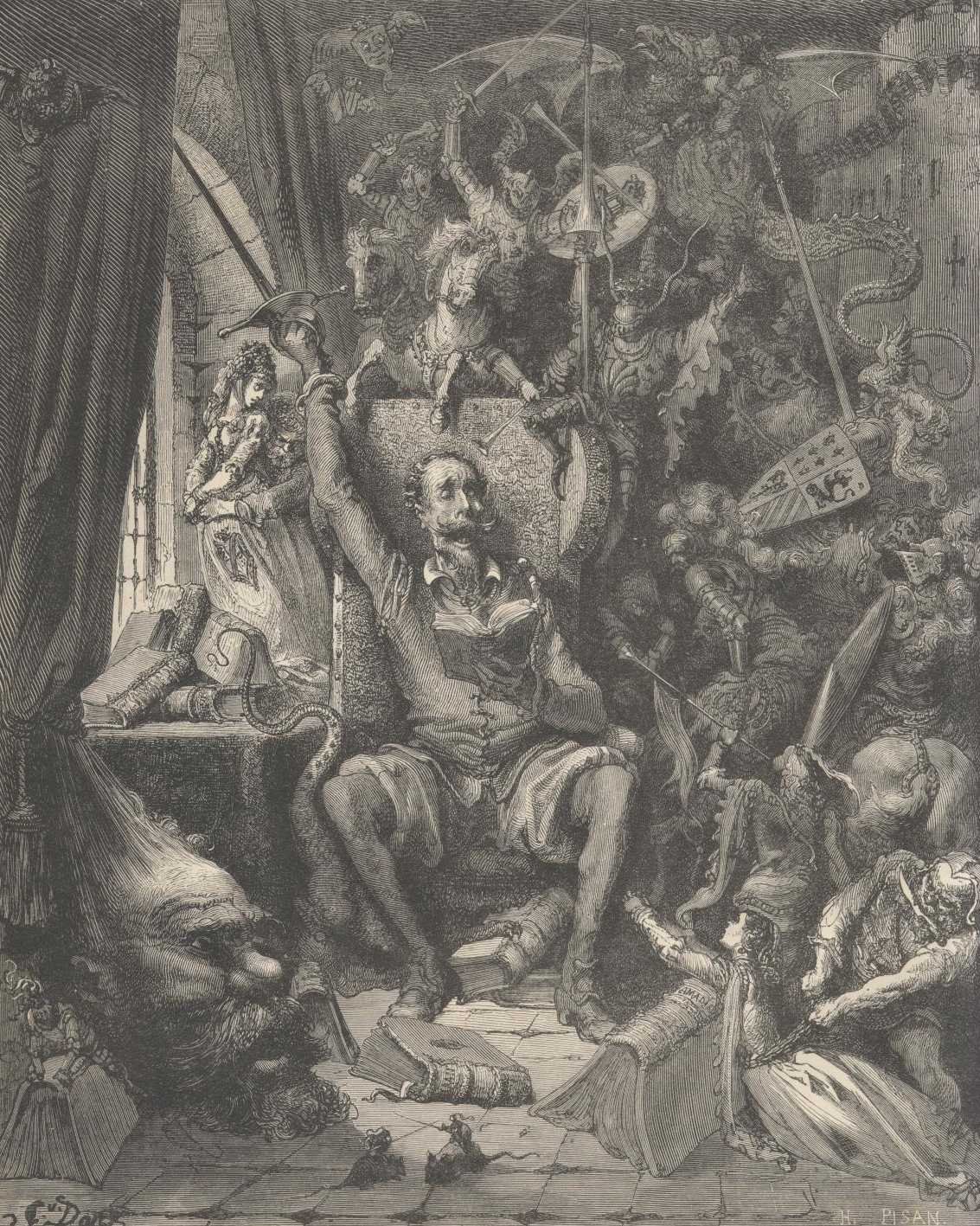
A student arrives from Salamanca with strange news: Don Quixote’s story is a book, on sale in the cities. Sancho appears in it by name.
What you will learn
- Talk about a book: what it is about, who wrote it, who reads it.
- Say that something is published, translated or sold out.
- Report what is said about a work without naming who says it.
Before you read
The whole lesson is about a book, and Spanish has a small set of fixed ways of talking about one: what it is about, who wrote it, whether it has been translated, how many copies have been printed. Several of them use the impersonal se you already know, because in publishing nobody says who printed the copies. Collect the phrases as you go, and note especially the ones that use estar plus a participle.The story in easy Spanish
Un día llegó a la aldea Sansón Carrasco, un estudiante joven de Salamanca.
One day Sansón Carrasco arrived in the village, a young student from Salamanca.
Acababa de terminar sus estudios y traía una noticia verdaderamente extraordinaria.
He had just finished his studies and was bringing genuinely extraordinary news.
La historia de don Quijote estaba impresa y se vendía en las ciudades.
Don Quixote’s story was in print and was on sale in the cities.
Existía un libro de verdad, con su título, sus capítulos y su autor.
There was a real book, with its title, its chapters and its author.
«Se han publicado ya 12.000 ejemplares», dijo el bachiller muy contento.
"Twelve thousand copies have already been printed," said the graduate, delighted.
«Y la obra se ha traducido a otras lenguas fuera de España».
"And the work has been translated into other languages outside Spain."
«Los niños lo hojean, los jóvenes lo leen y los viejos lo celebran».
"Children leaf through it, young people read it and old people praise it."
Don Quijote escuchaba muy serio, con las manos quietas sobre la mesa.
Don Quixote listened very solemnly, his hands still on the table.
Preguntó quién era el autor y si contaba bien las batallas.
He asked who the author was and whether he told the battles properly.
Sobre todo quiso saber si el libro le hacía justicia como caballero.
Above all he wanted to know whether the book did him justice as a knight.
Sansón le explicó que el autor era un moro llamado Cide Hamete Benengeli.
Sansón explained that the author was a Moor called Cide Hamete Benengeli.
Añadió que la obra había sido escrita en árabe y traducida después al castellano.
He added that the work had been written in Arabic and later translated into Spanish.
A don Quijote no le gustó que su historia viniera de una lengua enemiga.
Don Quixote did not like his story coming from an enemy language.
Sancho, en cambio, estaba encantado desde la primera palabra.
Sancho, by contrast, was delighted from the first word.
Salía en el libro con su nombre, con su burro y con sus refranes.
He appeared in the book by name, with his donkey and his proverbs.
Quiso saber enseguida si el capítulo de la manta estaba dentro del libro.
He wanted to know at once whether the blanket chapter was in the book.
«Está dentro», respondió Sansón, y no pudo evitar una sonrisa pequeña.
"It is," Sansón answered, and could not help a small smile.
Añadió que hay lectores que se ríen de esa escena y otros que no.
He added that some readers laugh at that scene and others do not.
Algunos preferirían no haberla leído nunca, porque les parece cruel.
Some would rather never have read it, because they find it cruel.
Sancho dijo que él tampoco la había disfrutado, aunque en el libro quedaba bien.
Sancho said he had not enjoyed it either, though it came out well in the book.
El bachiller les advirtió de que un libro impreso ya no es de nadie.
The graduate warned them that a printed book no longer belongs to anybody.
Desde ese momento, amo y escudero supieron una cosa rarísima y nueva.
From that moment on, master and squire knew something very strange and new.
Cualquiera que se cruzara con ellos podía haber leído ya sus aventuras.
Anyone they met might already have read their adventures.
Podía saber sus nombres, sus caídas y hasta lo que habían cenado.
They might know their names, their falls, and even what they had had for supper.
Don Quijote se quedó callado un rato largo y luego pidió el libro.
Don Quixote stayed quiet for a long while and then asked for the book.
Aquella noche volvió a hablar de salir al camino por tercera vez.
That night he talked again about taking to the road a third time.
Vocabulary
The book itself
- la obra
- the work
- el título
- the title
- el capítulo
- the chapter
- la página
- the page
- el ejemplar
- the copy
- la edición
- the edition
- impreso
- in print
- agotado
- sold out
The people of a book
- el autor
- the author
- el lector
- the reader
- el traductor
- the translator
- el bachiller
- the graduate
- el personaje
- the character
- el narrador
- the narrator
- el impresor
- the printer
- el público
- the public
What is done with a book
- publicar
- to publish
- traducir
- to translate
- hojear
- to leaf through
- leer
- to read
- tratar de
- to be about
- celebrar
- to praise
- salir en
- to appear in
- contar
- to tell
Talking about books and what gets published
La historia de don Quijote estaba impresa.
Se han publicado ya 12.000 ejemplares.
La obra se ha traducido a otras lenguas.
This lesson is vocabulary with a grammar spine. The vocabulary is the furniture of a book, and the spine is that Spanish talks about publishing almost entirely without naming agents.
1. The impersonal se, in its natural habitat
You met the se passive last lesson as an alternative to ser plus a participle. Publishing is where it lives.
| Spanish | English | note |
|---|---|---|
| Se han publicado 12.000 ejemplares. | Twelve thousand copies have been printed. | the verb agrees with ejemplares |
| La obra se ha traducido a otras lenguas. | The work has been translated into other languages. | singular subject, singular verb |
| Se vende en las ciudades. | It is on sale in the cities. | the standard shop-window formula |
| Se dice que es la mejor novela. | It is said to be the best novel. | opinion with no owner |
Watch the agreement, because it is the one thing that goes wrong. The verb agrees with the thing, not with the invisible people: se ha publicado un libro but se han publicado doce mil ejemplares.
2. Estar plus participle: the result, not the act
| form | meaning |
|---|---|
| está impreso | it exists in print, right now |
| está traducido al inglés | an English version exists |
| está agotado | there are no copies left |
| está descatalogado | it is out of print |
Compare fue impreso en 1605, which is the event, with está impreso, which is the situation Sansón is reporting. That distinction between ser and estar with a participle is the same one you met last lesson, and here it does real work: Don Quixote does not care when the printing happened. He cares that the book exists.
3. What a book is about
Three formulas, and they are not interchangeable.
| formula | subject | example |
|---|---|---|
| tratar de | the book itself | El libro trata de un hidalgo que enloquece. |
| tratarse de | no subject at all | Se trata de una novela muy larga. |
| ir de | the book, colloquially | El libro va de caballeros andantes. |
Tratarse de is the one to be careful with: it never takes a subject, so ✗ el libro se trata de un hidalgo is wrong, and it means something closer to it is a matter of.
4. Small words that trip people
| ✗ wrong | ✓ right |
|---|---|
| el autor por Cervantes | el autor de la obra, una obra de Cervantes |
| traducido en inglés | traducido al inglés |
| Sancho aparece dentro del libro | Sancho sale en el libro |
| leí sobre el libro | leí el libro |
That first row is worth a moment. English marks authorship with by, and Spanish marks it with de, the same preposition it uses for possession: una novela de Cervantes. There is no por anywhere near it unless you are building a full passive, escrita por Cervantes.
Characters who read their own book
Stop for a moment on what has just happened, because it is one of the genuinely new things in European literature. The characters of a novel have been told that they are the characters of a novel, that it has sold twelve thousand copies, and that people in other countries are reading it in translation. They then spend several chapters discussing the book: whether it is accurate, whether the author was fair to them, which episodes they wish had been left out. Sancho’s first question is whether the humiliating blanket-tossing scene made the cut, and he is told that it did.
The layering is dizzying and completely deliberate. Inside the fiction, the author is Cide Hamete Benengeli, a Moorish historian whom nobody has met, writing in Arabic. Cervantes has placed himself in the book not as its author but as a man who found the manuscript in a market in Toledo and paid a boy to translate it. So the book that Sansón Carrasco is holding is a Spanish translation of an Arabic history of two men who are standing in front of him, and one of those men objects that a Moor cannot be trusted to tell the truth about a Christian knight.
There was also a practical reason for all this, and it arrived while Cervantes was writing. In 1614 somebody publishing under the name Alonso Fernández de Avellaneda brought out an unauthorised second part of Don Quixote, complete with insults to Cervantes in the prologue. Cervantes was two thirds of the way through his own. He reacted by writing the fake book into his story: later on, his characters meet people who have read the false version, and Don Quixote changes his travel plans specifically to prove that the impostor’s account is wrong.
The warning Sansón gives here, that a printed book no longer belongs to anybody, was not a philosophical flourish in 1615. It was the news.
Cervantes in the original · «es tan clara, que no hay cosa que dificultar en…»
es tan clara, que no hay cosa que dificultar en ella: los niños la manosean, los mozos la leen, los hombres la entienden y los viejos la celebran
it is so plain that there is nothing in it to puzzle over: children thumb it, young men read it, grown men understand it and old men praise it.
The sentence is doing three jobs at once. On the surface it is a compliment about clarity, and it is built as a rising ladder of four ages and four verbs: children manosean, they paw and thumb it, a physical word with no reading in it at all. Then young men leen, they read. Then grown men entienden, they understand. And old men celebran, they praise. Each verb is one step further from the hands and closer to the mind, and the whole life of a reader is compressed into fourteen words. Underneath that, it is a sales report: Sansón is telling Don Quixote how well the book about Don Quixote is doing, which had never happened in a novel before. And underneath that again it is Cervantes talking about his own book, in his own book, in the mouth of a character he invented, with a straight face. The line has been quoted for four centuries as a description of what Don Quixote is, and it was written as a boast disguised as a character’s aside.