Adapted readers
Spanish adapted readers at A2
An adapted reader is a real story rewritten so that a learner can read it without stopping every line. At A2 that means short sentences, the present tense doing most of the work, and the difficult words explained where your eye already is. This page says what to look for in one, and then offers the one made here: the whole of Don Quixote, in Spanish you can actually read.
What to check before you buy one
Adapted readers are an old and crowded shelf, and most of the disappointment comes from the same four places.
- Is the stated level honest? The commonest complaint about graded readers is that they say A2 and read like B1. A book that starts below the level it claims gives you more than it promised, which is the only side nobody ever complains about.
- Where are the difficult words? At the foot of the page you are on, or at the back of the book? If you have to turn pages you lose the thread, and losing the thread is how a reader gets abandoned on page four.
- Is there a full translation facing the Spanish? If there is, you will read the English. It is not a moral failing, it is what eyes do.
- Is it a story or a course? Exercises, drills and comprehension tests belong in a course book. A reader is for reading.
The reader made here
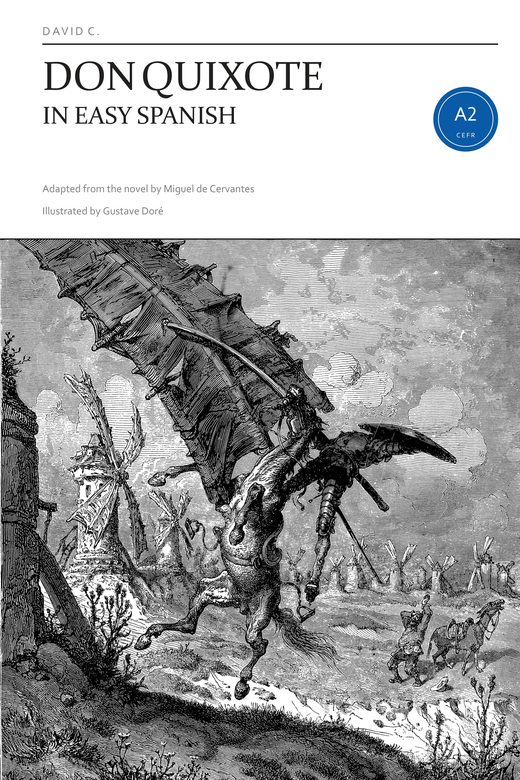
Don Quixote in Easy Spanish
The Complete Novel in 58 Short Episodes for Learners, A2 to B1, with English Word Notes on Every Page
Most learners give up on their first real Spanish novel somewhere on page four. This one is built so that does not happen. Cervantes' story is told in 58 short episodes, in graded Spanish that starts simple and grows with you.
How it works
- The early episodes are short and stay in the present tense.
- The Spanish gets longer and richer as the story goes on, a little at a time. By the last chapter you are reading paragraphs that would have stopped you on page one.
- At the foot of every page are the two to four words most likely to slow you down, with their English. No dictionary, and nothing to look up while you read.
- Every five episodes there is a break: the words from those episodes gathered together, and one sentence exactly as Cervantes wrote it in 1605, with its translation.
- An 831 word glossary at the end, in the same wording used on the page.
This is a novel, not a course
There are no exercises, no grammar drills and no vocabulary tests. Windmills, sheep mistaken for armies, a barber's basin worn as a golden helmet, an island to govern and a promise kept on a beach in Barcelona. You read it the way you read any other book, and the Spanish comes along for the ride.
Illustrated with 31 of the wood engravings Gustave Doré made for Don Quixote in 1863. The printed book is 100 pages, 6 by 9 inches, on cream paper.
Level: A2 to B1 on the Common European Framework. It starts below A2 on purpose. If you know the present tense and a few hundred words, you can start today, and an episode takes about five minutes.
Where to get it
If you read French rather than English, there is a separate edition with the word notes in French: Don Quichotte en espagnol facile, paperback on Amazon.fr. Same Spanish, only the notes change language.
Read the first chapter before you buy: sample PDF, the opening chapter exactly as it comes in the book.
Also in EPUB and PDF, 5.99 € on its own, or 11.99 € with Around the World in Eighty Days and The War of the Worlds. Bought and downloaded straight from this site.
How it differs from the course
The eight volumes listed on the books page are the course: ninety lessons with vocabulary, grammar and exercises, and the space to write the answers in. This is not one of them. It shares no page and no text with them: the story is rewritten shorter, the difficult episodes are made easier instead of being cut, and the whole novel is here, from the first windmill to the will of Alonso Quijano.
You can read it before the course, alongside it, or instead of it. If you would rather learn from lessons than from a story, the ninety of them are on this site, free, in order.